

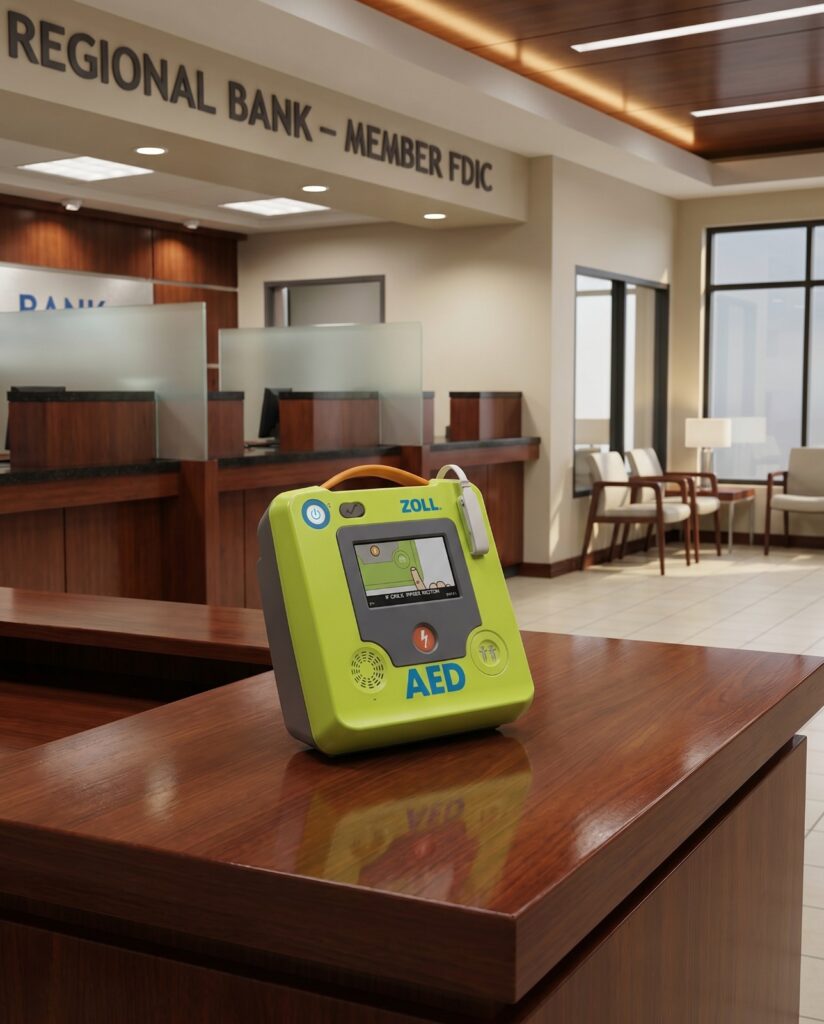
Sudden cardiac arrest can happen without warning. It does not wait for the “right” time, the right place, or the right people to be nearby. It can happen at work—during a meeting, on a warehouse floor, at a front desk, or in a gym—when a person collapses and normal breathing stops.
In that moment, your workplace doesn’t need a brochure. It needs a plan that works in minutes. The most effective workplaces treat emergency readiness as a system: trained responders, clear roles, visible equipment, and an AED that is truly ready when it is needed.
The case for workplace defibrillators isn’t theoretical. The American Heart Association reports that thousands of cardiac arrests occur in workplaces each year, and a surprising number of employees still don’t know where an AED is located. That gap—between having a device and being able to access it quickly—is where outcomes are won or lost. For employers, the question is no longer “Should we have an AED?” It’s “Are we rescue-ready if it happens here?”
The Quick Answer
A defibrillator in the workplace reduces the time to defibrillation during sudden cardiac arrest. It gives bystanders the ability to act before EMS arrives and improves the likelihood of survival when combined with high-quality CPR.
Just as importantly, a workplace AED program strengthens your overall safety culture. It creates a defined emergency response plan, clarifies roles, and brings confidence to a situation that would otherwise be chaotic. When the device is placed correctly, clearly marked, and maintained in ready status, it becomes a practical tool—not an object on a wall.
What An AED Does In A Workplace Emergency
An Automated External Defibrillator (AED) is built for real-world responders. It analyzes heart rhythm, provides voice prompts, and advises a shock only when appropriate. In plain terms, it helps a bystander take the correct steps quickly, even without medical training.
Because AEDs guide the user, they are well-suited to workplace environments where the first person on scene is usually a colleague or a member of the public. The unit doesn’t replace professional medical care. It bridges the time gap that often determines whether a person has a chance to survive.
Cardiac Arrest Vs Heart Attack
Many people use “heart attack” and “cardiac arrest” interchangeably, but they are not the same event. A heart attack is usually a circulatory issue where blood flow to the heart is blocked. Sudden cardiac arrest is an electrical malfunction where the heart stops pumping effectively.
AEDs are designed for sudden cardiac arrest. If a shock is needed, the AED will advise it. If a shock is not advised, the AED still supports the response by guiding CPR and next steps. That clarity matters because it reduces hesitation and helps responders act with confidence.
Why Minutes Matter
In cardiac arrest, time is everything. While EMS response time may be fast in some areas, workplace realities add layers of delay: access doors, elevators, large footprints, long corridors, multi-floor facilities, and remote areas.
This is why early CPR and AED use are so important. The American Heart Association emphasizes that immediate CPR and early defibrillation can significantly improve survival chances when cardiac arrest occurs. A workplace AED program exists to make that “early” response possible before paramedics reach the patient.
Why Workplaces Are High-Risk By Default
Workplaces concentrate people. They also involve physical exertion, stress, and—depending on the setting—heat exposure, machinery, electrical equipment, and long walking distances. Even in “low-risk” office environments, cardiac arrest can happen without a predictable trigger.
A workplace AED program isn’t about diagnosing risk in individuals. It’s about acknowledging that emergencies can happen anywhere people gather. The more people you have on-site, the more hours you operate, and the more public access you have, the more important it becomes to have a plan and the equipment to support it.
It’s Not Just Employees
Your duty of care doesn’t stop at payroll. Visitors, customers, vendors, contractors, and members of the public may spend time in your facility every day. If an emergency occurs, those individuals will rely on the readiness of your environment just as much as your employees do.
That’s why AEDs are common in offices, schools, gyms, community centers, and public-facing businesses. A well-run program supports everyone on-site and reinforces that safety is a core value, not a side project.
Workplace Conditions That Increase Risk
Certain environments naturally increase the likelihood of medical emergencies. Fitness centers involve intense exertion. Warehouses and manufacturing plants can involve heat, heavy lifting, and physical strain. Construction sites may be remote and time-sensitive, with long distances between responders and equipment.
Even when the environment is calm, the moment a cardiac arrest occurs, the workplace layout becomes the deciding factor. If the AED is hard to access, your program is weaker than it looks on paper.
The Business Case For AEDs
Decision-makers rarely approve AEDs because they are “nice to have.” They approve them because the cost of being unprepared is far higher than the cost of building readiness.
An AED program is one of the clearest examples of prevention meeting responsibility. It strengthens your safety posture, protects your team, and shows that leadership takes emergency readiness seriously.
Risk Reduction And Duty Of Care
AEDs support a faster, more effective response when a sudden medical emergency occurs. For many organizations, having an AED is part of a broader commitment to workplace health and safety, especially where the public is present or where response time may be delayed by building layout.
OSHA has long framed workplace readiness through expectations around medical services and first aid availability. While rules vary, the operational reality remains the same: employers are expected to plan for emergencies and provide appropriate response capability in the workplace.
Confidence And Culture
When an emergency happens, people either freeze or act. Programs that include AEDs, training, and clear roles reduce panic and increase action. Employees who know the AED exists, know where it is, and have practiced response steps are far more likely to respond effectively.
This is why AED programs are not just equipment decisions. They are training and culture decisions. A workplace that is prepared communicates stability and leadership—especially during high-stress incidents.
Program Value Beyond The Device
The device is one part of a complete program. The real purchase is reliability: proper placement, clear signage, a readiness schedule, and a defined plan that holds up under pressure. When you build those elements into your program, your AED becomes a dependable safety asset rather than a compliance checkbox.
Are AEDs Required In Workplaces?
It’s important to approach this question carefully because requirements depend on location and facility type. There isn’t a universal federal rule that mandates an AED for every workplace in every scenario.
However, OSHA provides guidance for responding to sudden cardiac arrest in workplace settings, and many organizations use this guidance to strengthen their emergency readiness planning. It also reinforces a broader expectation: emergency response should be practical, accessible, and fast—especially in environments where time to definitive care matters.
The practical takeaway is simple. Whether your workplace is explicitly required to have an AED or not, many organizations choose to deploy AEDs because they are one of the most effective tools for bridging the time gap between collapse and professional care.
What A “Rescue-Ready” Workplace AED Program Includes
The strongest AED programs follow a consistent structure. This keeps readiness from becoming “something we hope is fine” and turns it into “something we verify.”
A good program can be implemented in clear steps, and each step has a measurable outcome. Done correctly, it creates a repeatable system that stays ready year-round.
Step 1: Assess Risk And Response Time
Start by mapping where people gather and where an emergency is most likely to occur. Then do a walk test from those areas to the AED location. If someone can’t retrieve the device quickly and return without confusion, your placement needs improvement.
Consider shift coverage, after-hours access, and the difference between being “in the building” and being “reachable in time.” Response time planning is the foundation of a program that works in practice.
Step 2: Choose The Right AED For The Environment
Offices often prioritize simplicity, clear prompts, and low-maintenance design. Warehouses and industrial sites may need more rugged solutions and careful placement to avoid temperature and dust exposure. Public-facing environments may need cabinets that deter tampering while preserving immediate access.
Your goal is to choose an AED that your team can use confidently and maintain reliably. A great device that becomes difficult to service over time is not a great program choice.
Step 3: Place And Mount AEDs For Fast Access
AEDs should be mounted in visible, central areas. They should not be behind locked doors or placed in rooms that are inaccessible during parts of the day. The device must be easy to reach and easy to remove, even when someone is under stress.
Placement should also account for building complexity. Multi-floor sites, large campuses, and wide footprints often require more than one AED to support a fast response window.
Step 4: Add Signage And Wayfinding
An AED that no one can find is not truly available. Use signage above the cabinet, and add directional signs at hallway intersections, elevator lobbies, and stairwell exits as needed.
If visitors are common, entrance decals can also help. The goal is for someone unfamiliar with the facility to locate the AED quickly without asking for directions.
Step 5: Train For Real Response
AED training should be practical. It should reflect the actual workplace environment and the actual device people will use. Training becomes far more effective when roles are defined: who calls 911, who retrieves the AED, who performs CPR, and who meets responders at the entrance.
For many workplaces, training is also the moment where confidence is built. People leave not just with knowledge, but with the belief that they can act and help.
Step 6: Maintain “Ready Status”
Ready status is the heartbeat of the program. AEDs should show a ready indicator, and consumables like pads and batteries must remain within date. Visual checks should confirm no warning beeps, no visible damage, and no obstructions around the cabinet.
After any use, the AED must be reset properly. Pads should be replaced immediately, batteries should be checked, and the AED must be verified ready before it is considered back in service.
For ongoing readiness, structured service and tracking matter. If your program includes routine inspections, replacement planning, and documentation, readiness becomes stable rather than reactive.
Step 7: Document And Assign Ownership
Assign one program owner and a backup. Track locations, serial numbers, pad and battery dates, monthly checks, and post-use resets. Documentation isn’t paperwork for its own sake. It’s how you avoid missed expirations and ensure the program stays consistent during staff turnover.
In multi-site programs, centralized tracking is often the difference between “we think everything is fine” and “we know every unit is ready.”
Workplace Scenarios And Placement Examples
Different environments require slightly different approaches. The goal is always fast access, but the best placement and coverage strategy changes based on footprint and risk.
Offices And Corporate Campuses
In offices, AEDs are often best placed near reception, main corridors, cafeterias, and large meeting spaces. In multi-tenant buildings, coordinate with building management so the AED location is clear and accessible. If the building has multiple floors, consider whether one AED can realistically serve all floors in time.
For office-focused selection guidance, this related resource can help decision-makers align device choice with environment and program needs.
Warehouses And Manufacturing
Large footprints and noise increase the need for multiple AEDs and strong signage. Place AEDs near supervisor stations, break areas, high-traffic junctions, and areas with higher exertion. Temperature swings and dust exposure should be considered so consumables stay reliable.
Gyms, Fitness Centers, And Recreation Facilities
These environments are often high exertion and high public access. AEDs should be visible near check-in and training areas, and staff should be trained for fast response. Events and peak-hour crowds also make signage and visibility even more important.
Schools And Training Centers
Schools and campuses often require AED coverage across multiple buildings. High-occupancy areas like gyms, cafeterias, auditoriums, and main offices should be prioritized. Programs should also consider pediatric readiness when children are present and ensure signage is clear for visitors during games and events.
Construction And Remote Worksites
Remote worksites require careful planning because EMS may be farther away and access may be more difficult. AEDs should be placed where crews can reach them quickly, stored appropriately for the environment, and assigned to a responsible owner who performs regular checks.
Common Mistakes That Make AEDs Useless
Most AED failures in the real world are not device malfunctions. They are program breakdowns.
The first common mistake is placement. If the AED is hidden, restricted, or located where people won’t look, response time suffers. Another mistake is locking the cabinet, which creates access risk when keys or codes aren’t available. Expired pads and depleted batteries are silent failures that turn a ready device into a not-ready device without anyone noticing.
Training gaps matter as well. People hesitate when they don’t know what to do, where to go, or who is responsible. The strongest programs remove that hesitation with clear roles, routine practice, and confidence-building training.
How Life Support Systems Supports Workplace AED Programs
Life Support Systems helps organizations build workplace AED programs that are designed to perform in real conditions. We provide AED equipment, on-site service, inspections, readiness tracking, and training that matches the exact environment and device your team will use.
For many organizations, the goal is consistent readiness across multiple locations. Our approach supports this by building a program that keeps every unit visible, accessible, maintained, and verified in a ready status.
Clean Next Step
If you want to confirm your workplace is truly rescue-ready, request a workplace AED program review. Share your facility type, headcount, and location count, and our team can help you determine the right AED coverage, placement approach, training plan, and maintenance schedule.
FAQs
Are AEDs required in the workplace?
Requirements vary by state, industry, and facility type. Many workplaces deploy AEDs as a safety best practice because response time matters in sudden cardiac arrest.
What’s the difference between cardiac arrest and a heart attack?
A heart attack is usually a circulation issue. Sudden cardiac arrest is an electrical failure where the person collapses and needs CPR and often defibrillation.
How many AEDs does my workplace need?
It depends on building size, layout, and response time. Larger footprints and multi-floor facilities often require more than one AED to support quick access.
Where should an AED be placed in a workplace?
Place AEDs in central, visible, accessible locations such as lobbies, main corridors, cafeterias, gyms, and high-traffic zones. Avoid locked or hidden rooms.
Who is allowed to use an AED at work?
AEDs are designed for lay responders. The device provides prompts and advises a shock only when appropriate.
Do employees need training to use an AED?
Training is strongly recommended. CPR and AED training increases confidence and improves response speed during real emergencies.
What maintenance does a workplace AED program need?
Routine checks confirm ready status, pad and battery dates, and cabinet access. After any use, pads must be replaced and the AED must be verified ready again.
Should AEDs be locked to prevent theft?
Locked cabinets can delay access. Many programs use alarmed cabinets to deter tampering while preserving immediate access.
What should we do after an AED is used in an emergency?
Replace pads immediately, check battery status, verify the AED returns to ready status, and document the event so the unit is back in service quickly.
Last updated on 4 weeks ago
 Call Us
 Email Us