

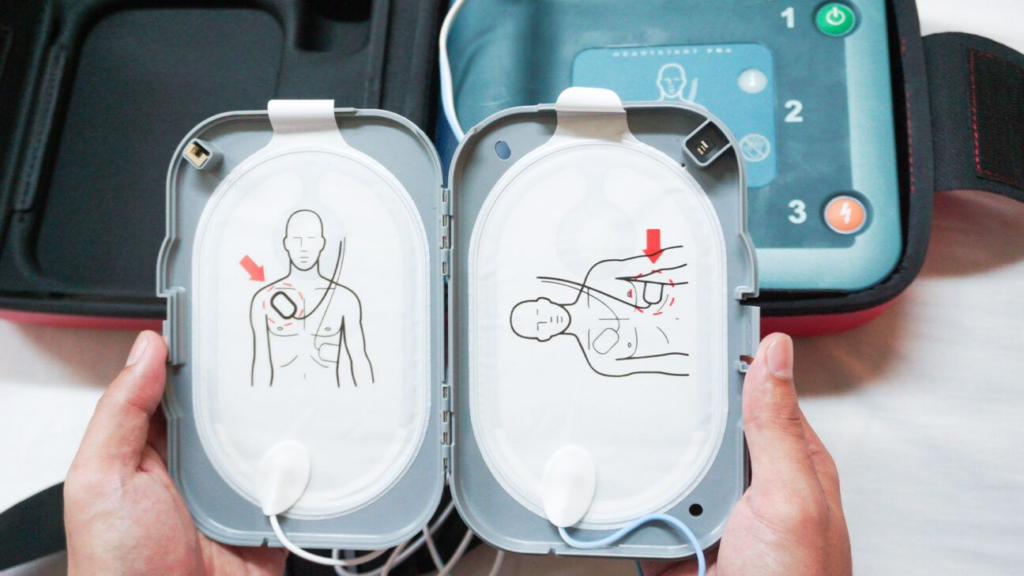
An AED on the wall is not the same thing as an AED program. The device is the visible part, but it’s the least likely point of failure. What fails is everything around it: the pads that expired six months ago, the battery nobody checked, the staff who’ve never touched the device, the missing inspection log that voids your Good Samaritan protections, or the single unit mounted in the lobby of a four-story building where it takes seven minutes to retrieve.
According to the American Heart Association, roughly 10,000 cardiac arrests happen in U.S. workplaces each year—and only about 50 percent of workers can even locate the AED in their building. When someone collapses, the gap between “we have a defibrillator somewhere” and “a trained person is applying pads within three minutes” is where outcomes are decided. Immediate CPR combined with AED use can double or triple survival rates. But those numbers only hold when the program behind the device is built to support fast, confident action.
This guide covers how to build a genuine on-site AED program—not just buy a device, but design the people, placement, maintenance, and training system that makes it work.
What an On-Site AED Program Actually Includes
An AED program is a coordinated system of equipment, people, policies, and procedures designed to respond to sudden cardiac arrest before EMS arrives. The AED Program Design Guidelines published by Readiness Systems (effective June 2025) define the framework that most industry professionals and compliance consultants use as a benchmark. OSHA’s guidance reinforces the same structure, recommending a written AED program that covers placement, maintenance, training, and medical oversight.
At a minimum, a functional on-site AED program includes the device itself (matched to your environment), a placement strategy based on response time—not convenience, a named program coordinator responsible for ongoing readiness, a documented inspection and maintenance routine, staff training with hands-on practice, a post-incident restocking and reporting process, and clearly defined AED program equipment requirements to ensure every component is accessible and ready when needed, along with compliance documentation that satisfies your state’s requirements.
Each of these components matters. Skip one, and the program has a gap that may not reveal itself until the worst possible moment.
Step 1: Assess Your Environment and Response Time
Before you choose a device or decide how many you need, start with your building. The goal isn’t to check a box—it’s to make sure a responder can get to an AED and back to the person in cardiac arrest within three to five minutes. That’s the window where defibrillation has the greatest impact on survival. The AHA, OSHA, and most state guidelines all reference this timeframe.
Walk your facility. Map the routes. Time them. Think about doors that require badge access, stairwells, elevators during peak hours, and remote areas like server rooms, warehouses, or loading docks. Think about what happens at 6:00 AM when the building is mostly empty versus 2:00 PM when it’s full.
For most multi-floor buildings, the math works out to at least one AED per floor. For large single-floor layouts—warehouses, open-plan offices, campus-style buildings—you may need multiple units to cover the distance. A five-year study of over 23,000 publicly installed AEDs found that access limitations (locked rooms, obstructed cabinets, devices in low-visibility locations) were a leading contributor to reduced usability. Placement isn’t a detail. It’s a design decision.
Step 2: Choose the Right Device for Your Setting
Once you understand your building and your people, you can match a device to the environment. The detailed model-by-model comparison is covered in our AED selection guide, but here are the factors that matter most for on-site office programs.
Ease of use is non-negotiable. The person who grabs the AED will almost certainly not be a medical professional. Every device on the market today provides voice prompts, but some go further with visual step-by-step displays, CPR training, or metronome-guided compression prompts. The 2025 AHA HeartSaver updates were specifically redesigned to reduce lay rescuer hesitation—choose a device that supports that same principle.
CPR feedback matters more than most buyers realize. Not every cardiac arrest involves a shockable rhythm. When it doesn’t, high-quality CPR is the primary intervention until EMS arrives. Devices like the ZOLL AED Plus provide real-time compression depth and rate feedback. The Stryker LIFEPAK CR2 can analyze the heart rhythm during compressions, reducing pauses. These features give untrained rescuers meaningful guidance during the most stressful minutes of their lives.
Factor in total cost of ownership, not just sticker price. AED pads last anywhere from two to five years, depending on the model. Batteries range from four to seven years. Over a ten-year ownership window, a device with a lower purchase price but two-year consumable cycles can cost significantly more in total than a pricier model with five-year consumables. Ask your provider to map out the full lifecycle cost before you commit.
Consider your workforce. Multilingual teams benefit from devices with bilingual voice prompts (the Stryker LIFEPAK CR2 and Cardiac Science Powerheart G5 both offer dual-language capability). Facilities with children need pediatric readiness—either pediatric pads, a pediatric key, or a built-in mode switch. Environments with dust, moisture, or temperature extremes need a higher IP (Ingress Protection) rating.
Step 3: Place the Device Where It Can Be Reached Fast
An AED should be mounted in a visible, unobstructed, high-traffic location at approximately four feet off the ground. Common placements include main hallways, reception areas, break rooms, near elevators, and adjacent to fitness or high-exertion areas. The AHA’s Implementation Guide and OSHA both emphasize accessibility and visibility as primary criteria.
Mark each location with universally recognized AED signage—the green heart-with-lightning-bolt symbol. Some states require specific signage by law. New York, for example, mandates signage at building entrances. Even where it’s not required, clear signage directly affects how fast someone can find and retrieve the device.
Don’t lock AEDs in offices, closets, or behind reception desks. Every second of search time during a cardiac arrest reduces the chance of survival. If theft is a concern, use an alarmed cabinet rather than a locked one—the alarm deters unauthorized removal without slowing emergency access.
Step 4: Assign a Program Coordinator
Every AED program needs a single person accountable for its readiness. This is the program coordinator—the person who owns the inspection schedule, tracks consumable expiration dates, coordinates training, manages post-incident restocking, and maintains compliance records.
Without a named coordinator, AED maintenance becomes “someone else’s job,” and things drift. Inspections get skipped. Expired pads sit in the cabinet for months. Training lapses. Compliance documentation doesn’t exist. This is exactly how the 15 percent of publicly installed AEDs found not ready during inspections got that way.
The coordinator doesn’t need to be a medical professional. They need to be organized, accountable, and supported with a clear checklist and a system for tracking dates. In larger organizations with multiple locations, the coordinator role may be shared across facilities—but every site needs someone who checks the device monthly and follows up when something isn’t right.
Step 5: Establish an Inspection and Maintenance Routine
The AHA recommends monthly visual inspections of every AED. Many states require documented inspections on a monthly or quarterly basis, and some (like California) mandate checks at least every 90 days.
A monthly inspection takes two to three minutes per device and should cover whether the readiness indicator shows green or “OK,” whether the pad expiration date is current (with at least 60–90 days of lead time before replacement is needed), whether the battery expiration date is current, whether the packaging is intact and undamaged, whether the cabinet is accessible, visible, and unobstructed, whether signage is in place, and whether the response kit (gloves, scissors, razor, barrier mask) is complete.
Document every inspection. A log—whether it’s a paper tag on the cabinet, a spreadsheet, or a program management platform—creates the compliance record that satisfies state requirements and supports your Good Samaritan protections. An undocumented program is functionally the same as no program when it comes to legal defensibility.
Beyond monthly checks, schedule proactive pad and battery replacement before expiration (not in response to device warnings), annual professional servicing to verify that the device meets manufacturer specifications, and firmware or software updates when available from the manufacturer. After any use—real emergency or drill—the device must be inspected and restocked immediately before returning to service.
Step 6: Train Your People
An AED is designed for use by anyone—no medical training required. But “designed for use” and “confident enough to act” are two different things. The AHA’s own research found that only about 41 percent of out-of-hospital cardiac arrest victims receive bystander CPR. The barrier isn’t equipment. It’s hesitation.
Training closes that gap. A well-run training program should include initial CPR/AED certification for designated responders (the AHA’s HeartSaver CPR AED course and the Red Cross’s First Aid/CPR/AED course both meet OSHA’s recommendation for hands-on skills evaluation), refresher training at least every two years (the AHA’s recommended interval, though OSHA encourages annual refreshers), awareness-level orientation for all employees so they know where AEDs are located and how to call for help, and scenario-based drills that simulate a real emergency response in your actual building.
Use AED training units with reusable practice pads for drills—not your live clinical device. If live pads are opened during a drill, they must be replaced immediately, and the AED must be restocked before it goes back into service.
One important detail: fully online CPR/AED courses typically do not meet OSHA’s workplace certification recommendations because they lack a hands-on skills component. If you’re training for workplace compliance, choose a blended or in-person course with a practical skills session.
Step 7: Build the Compliance Layer
AED compliance isn’t a single checkbox. It’s an ongoing set of requirements that varies by state and sometimes by county or city. At the federal level, OSHA does not mandate AEDs in most private workplaces but strongly recommends them and encourages a written AED program. The Cardiac Arrest Survival Act provides federal liability protection for acquirers and users of AEDs.
At the state level, requirements can include AED registration with local EMS, medical director oversight (a physician who reviews and signs off on the program), documented maintenance and inspection logs, staff training certifications, specific signage and placement standards, and post-use reporting.
Nearly every state provides Good Samaritan protections for AED use, but those protections are frequently conditioned on proper maintenance and compliance. An AED program that isn’t maintained—expired pads, no inspection records, untrained staff—may not qualify for the same legal protections as one that is. This is the single most underappreciated risk in workplace AED programs.
Your program coordinator should maintain a compliance file that includes a copy of your written AED program and emergency response plan, current pad and battery expiration dates for every device, signed and dated monthly inspection logs, training records and certification dates for all designated responders, medical director agreement (if required by your state), AED registration confirmation (if required), and records of any use events and post-incident restocking.
When To Partner With an AED Service Provider
Some organizations have the internal bandwidth to manage all of this in-house. Many don’t—and that’s where professional AED service providers add genuine value. A good provider doesn’t just sell you a device. They help you design the program around your building, maintain the equipment on a documented schedule, manage consumable replacement proactively, train your staff with hands-on courses, and keep your compliance documentation current.
Life Support Systems works with all major AED manufacturers and helps organizations across New England build and maintain on-site AED programs that are genuinely rescue-ready. From initial site assessment and device selection to pad and battery tracking, staff training, and compliance support, we treat readiness as the product—not just the hardware.
Contact us to build or review your on-site AED program →
Frequently Asked Questions
What is an on-site AED program?
An on-site AED program is a coordinated system that includes the device, a placement strategy, a maintenance routine, staff training, a designated program coordinator, and compliance documentation. The goal is to ensure the AED is genuinely ready for use—not just installed—when a cardiac arrest occurs.
How many AEDs does my office need?
There’s no formula based on headcount. The standard is placement density: every point in your facility should be reachable within a three-to-five-minute round trip to the nearest AED – ideally even shorter. For multi-floor buildings, that typically means at least one per floor. For large single-floor layouts, it may mean multiple units.
Does OSHA require workplaces to have AEDs?
OSHA does not mandate AEDs in most private-sector workplaces but strongly recommends them as part of a first-aid and emergency response plan. Many states have industry-specific or building-size-specific requirements. Check your state’s AED laws for applicable mandates.
How often should on-site AEDs be inspected?
The AHA recommends monthly visual inspections. Many states require documented monthly or quarterly checks. After any use—emergency or drill—the device must be inspected and restocked immediately.
Who should be the AED program coordinator?
Anyone who is organized and accountable. The coordinator doesn’t need medical training—they need a checklist, a calendar, and the authority to order replacement supplies and schedule training. In multi-site organizations, each location should have a designated person.
What training do employees need for an on-site AED program?
Designated responders should complete a hands-on CPR/AED certification course (AHA HeartSaver or Red Cross First Aid/CPR/AED) and refresh at least every two years. All other employees should receive awareness-level orientation on AED locations and how to activate the emergency response plan.
Can an AED service provider help with compliance?
Yes. Professional AED service providers manage inspections, consumable replacement, training scheduling, and compliance documentation—often more consistently than internal programs that depend on a single person remembering to check the cabinet every month.
Are there legal protections for organizations with AED programs?
The Cardiac Arrest Survival Act and nearly all state Good Samaritan laws provide liability protections for good-faith AED use. However, these protections are often conditioned on proper maintenance, documented inspections, and compliance with state requirements.
This article is for informational purposes and does not constitute legal, medical, or regulatory advice. AED requirements vary by state and locality. Content reflects current AHA2025 Guidelines, OSHA guidance, AED Program Design Guidelines (Readiness Systems, 2025), and FDA classification standards.
Last updated on 1 month ago
 Call Us
 Email Us