

Every 90 seconds, someone in the United States goes into sudden cardiac arrest. While many of these events happen at home, roughly 10,000 occur in workplace settings each year—and the office is one of the most common locations. When it happens, the math is unforgiving: for every minute without defibrillation, the chance of survival drops by 7to 10 percent. But when a bystander applies an AED within the first three to five minutes, survival rates can exceed 70 percent.
That gap—between a device on the wall and a life saved—is where the real decision lives. Choosing the right AED for your office isn’t about finding the “best” model in a vacuum. It’s about matching a device to your environment, your people, and the service infrastructure that keeps it ready for the day you actually need it.
Why the Device Is Only Half the Decision
Most AED buying guides focus almost entirely on features and price. Those matter, but they’re not the whole picture. A device that sits in a cabinet for three years without an inspection is not a safety tool—it’s a liability. Research shows that approximately 15 percent of publicly installed AEDs are not rescue-ready when inspected, with expired pads and batteries accounting for the majority of failures.
The organizations that get the best outcomes from their AED investment are the ones that treat the purchase as the starting point—not the finish line. That means pairing the device with a structured service program that covers inspections, consumable replacement, staff training, and compliance documentation. The AED you choose should fit naturally into that system.
What To Look For in an Office AED
Before comparing specific brands and models, it helps to understand which features actually matter in a typical office environment—and which ones are more relevant to industrial, outdoor, or clinical settings.
Ease of use for untrained responders. This is the single most important criterion for any office AED. The person who grabs the device during a cardiac arrest will almost certainly not be a medical professional. They’ll be a coworker, a receptionist, a facilities manager, or a visitor. The AED needs to guide them clearly with voice prompts and visual cues from the moment it powers on. The 2025 AHA HeartSaver updates were specifically redesigned to reduce hesitation in lay rescuers—and the AED should support that same goal.
CPR feedback capability. Not every cardiac arrest requires a shock. The AHA estimates that about half of cardiac arrest patients present with a non-shockable rhythm, which means high-quality CPR is the primary intervention until EMS arrives. AEDs with real-time CPR coaching—audio metronomes, compression depth feedback, or rate prompts—give untrained rescuers guidance that can meaningfully improve outcomes.
Self-testing and readiness indicators. Every modern AED performs some level of automatic self-testing. But the frequency and depth of those tests vary. Some devices run daily checks on the battery, pads, and internal circuitry. Others test weekly or monthly. A visible readiness indicator (green light, checkmark, or status screen) lets anyone confirm at a glance that the device is operational. One important caveat: self-tests check the electrical circuit, but they cannot assess whether the pad gel has dried out or the adhesive has weakened—which is why monthly visual inspections and date checks remain essential even when the indicator shows green.
Fully automatic vs. semi-automatic. A fully automatic AED analyzes the rhythm and delivers the shock on its own after a verbal countdown—no button press required. A semi-automatic AED advises a shock and then waits for the responder to press a flashing button. For most office environments, either type works well. Fully automatic models remove one decision point from a high-stress moment but can be slightly slower in delivering a shock than semi-automatic models. Semi-automatic models give the rescuer final control to confirm that nobody is touching the patient.
Consumable lifespan and total cost of ownership. The purchase price of an AED is a one-time cost. The ongoing cost is pads and batteries—and those replacement cycles vary significantly by model. Some pads last two years; others last five. Some batteries last four years; others last seven. Over a ten-year ownership window, a device with a lower sticker price but shorter consumable cycles can cost more in total. Factor this in.
Durability and environment rating. Most standard offices don’t need a ruggedized device. But if your AED will be near a loading dock, a fitness center, a pool, a kitchen, or an outdoor area, the IP (Ingress Protection) rating matters. A higher IP number means better protection against dust and water. Devices like the Philips HeartStart FRx (IP55) or the HeartSine samaritan PAD series (IP56) are built for tougher conditions.
Pediatric capability. If your workplace includes a childcare area, a school-age program, or regular visits from children, your AED needs pediatric readiness. Depending on the model, this might mean separate pediatric pads, a pediatric key, or a mode switch. The AHA supports AED use on children aged one and older, and having the right capability on hand avoids a dangerous gap.
Multilingual and accessibility features. In a diverse workplace, consider models with bilingual voice prompts or multilingual capability. Clear visual instructions also support hearing-impaired responders. The Stryker LIFEPAK CR2, for example, offers a dual-language option that switches between English and Spanish during a rescue.
Office AED Comparison: Six Models Side by Side
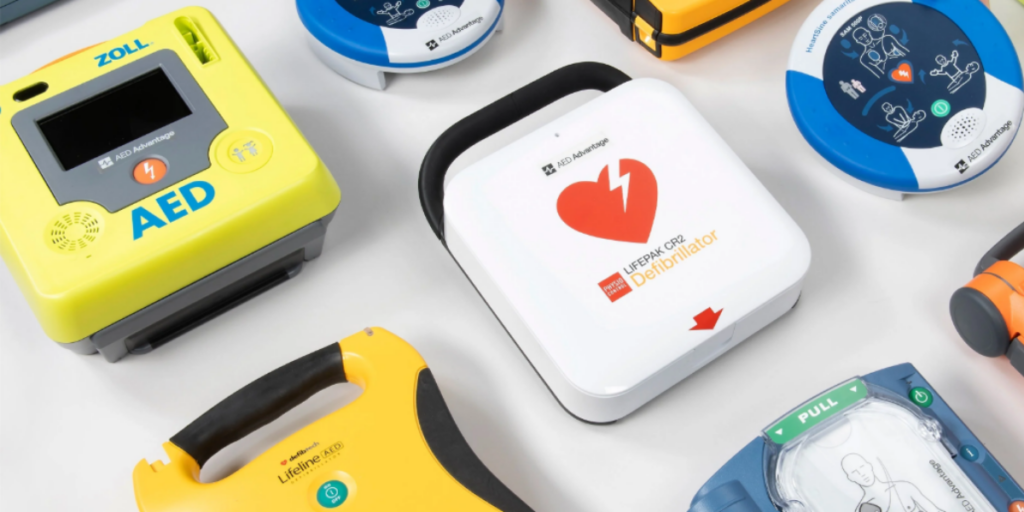
Every major AED brand builds reliable, FDA-cleared devices. The differences come down to feature emphasis, consumable lifespan, and total cost of ownership. This consolidated comparison covers the models most commonly deployed in office environments. Since Life Support Systems works with all manufacturers, the goal here isn’t to pick a winner—it’s to help you understand the tradeoffs so you can choose based on your own environment and priorities.
| Feature | ZOLL AED Plus | Philips HeartStart OnSite | Philips HeartStart FRx | Defibtech Lifeline | Cardiac Science Powerheart G5 | Stryker LIFEPAK CR2 |
| Type | Semi-auto | Semi-auto | Semi-auto | Semi-auto or Fully auto (by model) | Semi-auto or Fully auto | Semi-auto |
| CPR Feedback | Real-time depth + rate coaching | Audio coaching | Audio metronome | Audio prompts | RescueCoach audio coaching | CPR coaching + compression analysis during rhythm check |
| Pad Life | ~5 years | ~2 years | ~2 years | ~2 years | ~2 years | ~4 years |
| Battery Life | ~5 years | ~4 years | ~4 years | 4–7 years (model dependent) | ~4 years | ~4 years |
| IP Rating | IP55 | IP21 | IP55 | IP54 | IP55 | IP55 |
| Pediatric Option | Pediatric pads (sold separately) | Infant/child cartridge | Infant/child key (reusable) | Pediatric pads (sold separately) | Pediatric pads (sold separately) | Built-in pediatric mode |
| Bilingual | No (standard) | No (standard) | No (standard) | No (standard) | Dual-language support | Dual-language support (ClearVoice) |
| Self-Test Frequency | Daily, weekly, monthly | Daily, weekly, monthly | Daily, weekly, monthly | Daily + monthly | Daily, weekly, monthly | Daily |
| Warranty | 7 years | 8 years | 8 years | 8 years | 7 years | 8 years |
| Approx. Price Range | $1,695–$1,895 | ~$1,655 | ~$1,495 | $1,119–$1,695 (model dependent) | $1,500–$1,900 | ~$2,200 |
| Best Known For | Industry-leading CPR feedback and 5-year consumable cycle | Widest installed base; no prescription needed (OTC) | Rugged build; reusable pediatric key | Lowest entry cost; simple two-button interface | Dual-language support; automatic energy adjustment | Compression analysis during rhythm check; built-in pediatric mode |
Prices reflect approximate 2025–2026 street pricing for standard configurations and may vary. Always confirm current pricing with your provider.
A note on the table above: Every one of these devices is a proven, FDA-cleared AED that can save a life. The “right” choice depends on what matters most in your specific environment. An office with tight budgets and straightforward needs may find the Defibtech Lifeline ideal. A multilingual corporate campus may prioritize the LIFEPAK CR2 or Powerheart G5. A facility that values the lowest long-term consumable cost may lean toward the ZOLL AED Plus with its five-year pad and battery cycle. There’s no wrong answer among these models—only better and worse fits.
Choosing Based on Your Environment, Not Just Your Budget
Rather than ranking devices from “best” to “worst,” it’s more useful to think about which AED fits which scenario.
Standard corporate office with climate control and trained safety staff. Almost any device on this list works well. Prioritize CPR feedback and a solid service program over IP ratings or ruggedized features you don’t need.
Multi-floor building or campus with no dedicated safety team. Focus on ease of use (clear voice prompts, minimal steps) and strong self-test capability. Place enough units so that any location can be reached within a three-to-five-minute round trip—this often means at least one per floor.
Diverse workforce with multiple languages. Choose a model with built-in bilingual or multilingual prompts. The LIFEPAK CR2 and Powerheart G5 both offer dual-language capability without requiring any configuration change during a rescue.
Facility with children present (daycare, family visitors, youth programming). Make sure the AED has pediatric capability—either dedicated pediatric pads, a pediatric key, or a built-in mode. The Philips FRx’s reusable infant/child key is particularly cost-effective since it doesn’t expire like separate pediatric pads.
Harsh or semi-outdoor environment (warehouse adjacent, loading area, pool facility). Choose a device with an IP55 or higher rating. The Philips FRx, ZOLL AED Plus, Powerheart G5, and LIFEPAK CR2 all carry IP55. The HeartSine Samaritan PAD series goes to IP56.
AED Placement: Where the Device Lives Matters as Much as What It Is
A well-chosen AED in a poorly chosen location is nearly as dangerous as no AED at all. The device should be reachable within three to five minutes from anywhere in your facility, mounted at roughly four feet off the ground, and visible from a distance. The AHA and OSHA both recommend high-traffic, high-visibility areas: main hallways, reception areas, break rooms, near elevators, and adjacent to fitness or high-exertion areas.
Mark each location with universally recognized AED signage. In some states— New York, for example —signage requirements are codified in law. Even where they’re not, clear signage is a best practice that directly affects response time.
If your building has multiple floors, stairwells, or wings, map the walking routes to each AED and verify that the response time math works. A single AED in the lobby doesn’t cover a fourth-floor emergency if it takes six minutes to get there and back.
Maintenance and AED Service: The Part That Keeps It All Working
Buying an AED is a one-time decision. Maintaining it is an ongoing one. The AHA recommends monthly visual inspections of every device, and many states require documented inspections on a monthly or quarterly basis. A basic inspection takes two to three minutes and covers the readiness indicator, pad and battery expiration dates, packaging integrity, cabinet accessibility, and signage.
Beyond monthly checks, a complete AED service program should include proactive pad and battery replacement before expiration (not after the device starts chirping), post-use restocking so the device returns to a ready state immediately after a rescue or drill, staff training and refresher courses (the AHA recommends updates at least every two years), compliance documentation that satisfies state requirements and supports Good Samaritan protections, and a single point of accountability—a named program coordinator who owns the inspection schedule and replacement calendar.
This is where the AED buying decision and the service decision intersect. The best device in the world is worthless if its pads expired six months ago and nobody noticed. A structured service program closes that gap.
The Regulatory Landscape: What’s Required and What’s Recommended
There is no federal law that requires most private-sector offices to have an AED. OSHA does not mandate AED placement, but it does strongly recommend it through Publication 3185 and related guidance, which encourages workplaces to install AEDs as part of a comprehensive first-aid and emergency response plan.
The requirements come at the state level, and they vary significantly. Some states mandate AEDs in specific industries—health clubs (California, Arkansas, Illinois, and others), dental offices administering anesthesia (Washington), and large-occupancy buildings (Oregon requires AEDs in buildings over 50,000 square feet or with 25+ occupants). Many states also require AED registration, medical director oversight, and documented maintenance.
Nearly every state provides Good Samaritan protections for organizations and individuals who use an AED in good faith—but those protections are frequently conditioned on proper maintenance and compliance. An AED program that’s been neglected may not qualify for the same legal protection as one with current consumables and documented inspections.
The federal Cardiac Arrest Survival Act provides additional liability protections for AED users and acquirers, reinforcing the principle that good-faith use of an AED should be encouraged, not penalized.
Getting Started—Or Getting Your Existing Program Back on Track
Whether you’re purchasing your first AED or reviewing a program that’s been in place for years, the most important step is the same: make sure the device is matched to your environment, supported by a real maintenance system, and backed by people who know how to keep it ready.
Life Support Systems works with all major AED manufacturers and helps organizations across New England select, deploy, and maintain AED programs that are genuinely rescue-ready—not just installed. From device selection and placement planning to pad and battery tracking, staff training, and compliance documentation, we build programs around the principle that readiness is the product, not the device.
Contact us to start or review your AED program →
Frequently Asked Questions
What are the AED service requirements for offices?
AED service requirements include monthly visual inspections (recommended by the AHA and required by many states), tracking pad and battery expiration dates, maintaining documented service records, and ensuring the device shows a “ready” status at all times. Many organizations rely on professional AED service programs for ongoing support, compliance documentation, and proactive consumable replacement.
Does OSHA require offices to have an AED?
OSHA does not mandate AEDs in most private-sector workplaces, but it strongly recommends them as part of a first-aid and emergency response plan. State and local laws may impose specific requirements depending on your industry, building size, or occupancy. Check your state’s AED laws for applicable mandates.
Where should an AED be placed in an office?
In a visible, unobstructed, high-traffic location—ideally reachable within a three-to-five-minute round trip from anywhere in the building. Common placements include main hallways, reception areas, break rooms, and near elevators. Multi-floor buildings typically need at least one device per floor. Mount cabinets at approximately four feet and mark each location with universally recognized AED signage.
Can untrained employees use an AED?
Yes. AEDs are designed for use by lay rescuers with no medical training. Every device on the market provides step-by-step voice and visual instructions. The AED analyzes the heart rhythm automatically and will only allow a shock when it’s clinically appropriate—it cannot deliver a shock to someone who doesn’t need one.
How often should office AEDs be maintained?
The AHA recommends monthly visual inspections covering the readiness indicator, pad and battery dates, and cabinet accessibility. Professional servicing should be scheduled annually at a minimum, with consumable replacement planned well before expiration. After any use—real emergency or drill—the device must be inspected and restocked immediately.
What’s the difference between a fully automatic and semi-automatic AED?
A fully automatic AED delivers the shock on its own after a verbal warning. A semi-automatic AED advises a shock and waits for the rescuer to press a button. Both types are safe, effective, and appropriate for office environments. Fully automatic models remove one decision point from a stressful moment; semi-automatic models give the rescuer final control.
How many AEDs does my office need?
There’s no universal formula based on headcount alone. The goal is placement density: every point in your facility should be reachable within a three-to-five-minute round trip to the nearest AED. For most multi-floor buildings, that means at least one per floor. For large single-floor layouts, it may mean multiple units.
Are there liability protections for organizations that have AEDs?
Yes. The Cardiac Arrest Survival Act and nearly every state’s Good Samaritan laws provide legal protections for good-faith AED use. However, these protections are often tied to proper maintenance and compliance—including current consumables and documented inspection records.
This article is for informational purposes and does not constitute legal, medical, or regulatory advice. AED requirements vary by state and locality. Content reflects current AHA 2025 Guidelines, OSHA guidance, and FDA classification standards. Pricing and specifications are approximate and subject to change.
Related reading from Life Support Systems:
- How Long Does an AED Last? Lifespan, Pads, Batteries, and Replacement Planning
- Why AED Pads Expire—And What Happens When They Do
Last updated on 1 month ago
 Call Us
 Email Us