

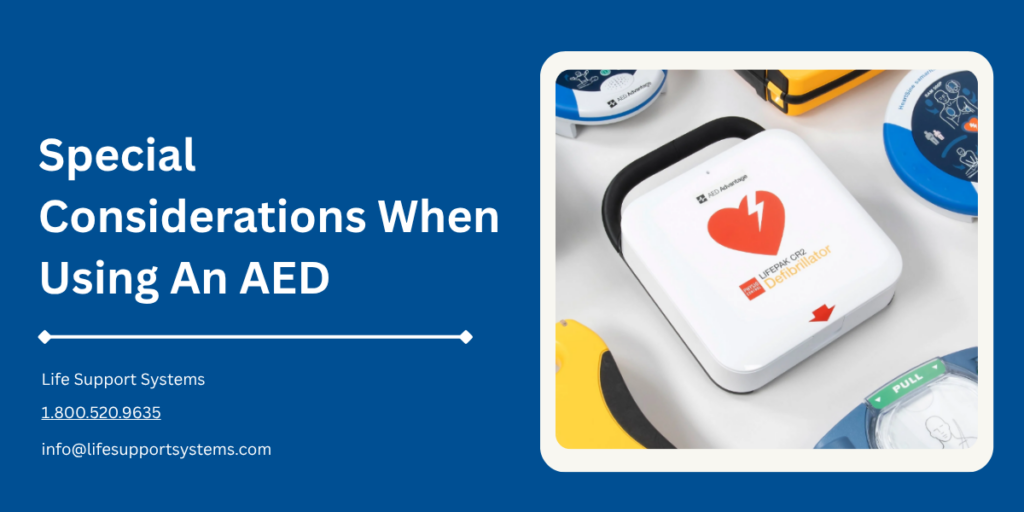
An AED is designed to make the right action possible in the most stressful moment. When someone collapses and is unresponsive, the priorities stay the same: call for help, start CPR, and use the AED as soon as it’s available. Special situations don’t change the urgency—they just change a few details that keep the response safe and effective.
This guide covers the most important “real-world” considerations people run into during AED use. Think of it as a quick-reference playbook for responders and safety teams who want fewer delays, cleaner pad placement, and a smoother path back to a verified ready status afterward.
What To Check In 10 Seconds
Most special considerations come down to two things: pad contact and scene safety. If pads can’t stick well, the AED can’t do its job. If the scene isn’t safe, responders get hurt or the response stalls.
Here’s the fast mental checklist: dry the chest, clear medication patches from the pad area, avoid placing pads directly over a pacemaker bump, use pediatric settings when available, and make sure no one touches the patient during analysis or shock.
If you keep those five points in mind, you’ll prevent the most common problems that slow down AED use in emergencies.
The Standard AED Sequence
Before we get into special situations, it helps to anchor the normal flow. When a responder knows the sequence, special circumstances become small adjustments instead of confusing detours.
The simplest way to think about it is: CPR starts first, AED arrives second, and the AED becomes part of the response without long pauses.
The 7 Steps For Using An AED
- Check responsiveness and breathing.
- Activate emergency response and call 911.
- Start CPR immediately.
- Turn on the AED as soon as it arrives.
- Expose the chest and place pads.
- Clear the patient for analysis and shock if advised.
- Resume CPR right away after a shock or “no shock advised.”
If you’re ever unsure, follow the AED’s voice prompts. The device is built to guide responders under pressure.
Should You Use The AED Before Or After CPR?
Start CPR immediately. The AED should be applied as soon as it becomes available, but CPR should not be delayed while someone goes searching for equipment or trying to make the scene “perfect.”
When the AED arrives, pause only as long as needed for pad placement and the device’s analysis. Then go right back to CPR unless the AED instructs otherwise.
Scene And Environment Considerations
Environmental issues can affect rescuer safety, pad adhesion, and the quality of rhythm analysis. The goal is not to overthink it—it’s to make quick adjustments that keep the response moving.
If the environment is dangerous or the patient is actively in water, address that immediately. If it’s simply damp or messy, fix what you can in seconds and continue.
Water, Rain, And Wet Surfaces
Do not apply an AED while the person is submerged in water. Move them to a dry surface as quickly as possible. Once the person is on a safe surface, quickly dry the chest where the pads will go.
Light rain, snow, or small puddles should not stop AED use, but excessive moisture can prevent pads from sticking well. Your priority is to get the chest as dry as you reasonably can, then apply the pads and follow prompts.
Metal Surfaces And Bleachers
If a person collapses on metal bleachers or a metal platform, the AED can still be used, but you should prevent pads from touching metal and follow the “clear the patient” rule carefully.
If it’s practical, move the person to a non-metal surface. If it’s not practical, focus on correct pad placement and making sure no one is touching the patient during analysis or shock.
Oxygen And Flammable Vapors
Avoid delivering a shock in an oxygen-rich or flammable environment. If oxygen is in use nearby, move the oxygen source away from the patient if it can be done quickly and safely.
The goal is not to create long delays. It’s to eliminate obvious ignition risks while keeping the response moving. If you’re in an area with flammable gases or vapors, prioritize moving the patient to a safer space if possible.
Moving Vehicles
If the patient is in a moving vehicle, stop the vehicle before AED analysis and shock delivery. Movement can interfere with rhythm analysis and creates additional safety risk for responders.
Once stopped, follow the normal sequence: CPR immediately, AED applied as soon as possible, and clear the patient during analysis and shock.
Chest Prep That Improves Pad Contact
Pad contact is one of the biggest “special considerations” because it directly affects whether the AED can read rhythm and deliver effective therapy. The best approach is quick, simple prep with minimal interruptions.
Expose the chest, dry the pad zones, and place pads firmly on bare skin.
Clothing, Bras, And Moisture
Pads must go on bare skin. Remove or cut clothing as needed so pads can adhere properly. If an underwire bra or metal component directly interferes with pad placement, remove it quickly.
Don’t get stuck trying to remove everything perfectly. The goal is pad contact in the correct zones, not a full wardrobe change.
Hairy Chest
Excessive chest hair can prevent pads from sticking. If your responder kit includes a razor, shave only the pad placement areas and move on.
If hair is preventing adhesion and you have no razor, apply pads firmly as directed and follow the AED’s prompts. Some teams keep a spare pad set available; in certain cases, a pad set can be used to pull hair off quickly, then a fresh set applied. If you don’t have spares, focus on firm contact and speed.
Medication Patches
If a medication patch is located where a pad needs to be placed, remove the patch and wipe the area clean before applying the pad. Patches can interfere with pad adhesion and may increase burn risk.
Don’t scan the whole body looking for patches. Check the pad zones and remove only what affects placement.
Jewelry And Piercings
In most cases, don’t waste time removing jewelry. If a piercing or metal object is directly under the pad placement zone, adjust pad position slightly to avoid placing the pad directly over it.
The key is to keep pads in the correct general placement pattern while avoiding direct contact with metal that could interfere with adhesion or increase burn risk.
Special Patient Considerations
Certain patient circumstances require small adjustments, not a slower response. The AED should still be applied quickly when the person is unresponsive and not breathing normally.
These situations are common in real rescues, and knowing them ahead of time helps responders act without hesitation.
Pacemakers And Implantable Defibrillators
A pacemaker or implanted cardioverter-defibrillator (ICD) may appear as a visible bump or lump under the skin, usually near the upper chest. Do not place AED pads directly over the device.
Instead, place the pad at least about an inch away from the implant area while keeping the pads in the recommended pattern. Don’t spend time “hunting” for the implant—if you notice it, adjust quickly and continue.
Pregnancy
Yes, an AED can be used on a pregnant person who is in cardiac arrest. The priority is restoring circulation and breathing, and that action supports the best possible outcome for both the pregnant person and the fetus.
Pad placement generally stays the same. Follow the AED prompts and continue high-quality CPR between analysis and shocks.
Children And Infants
Use pediatric pads or pediatric mode when available for younger children, commonly under 8 years old or under about 55 pounds (25 kg). If pediatric pads are not available, use adult pads.
When using adult pads on a smaller child, avoid pad overlap. If necessary, one pad may be placed on the front and one on the back (anterior-posterior) to prevent the pads from touching. Follow the AED device instructions when available.
Larger Bodies And Pad Spacing
For larger bodies, focus on firm adhesion, correct general placement, and making sure pads do not overlap. If you need to shift slightly for spacing, do so while maintaining the recommended placement pattern.
Again, speed matters. Pad contact and clear analysis windows are the goal.
Vomiting And Fluids: What Changes And What Doesn’t
Vomiting is a common concern because responders fear “doing the wrong thing” or worry about airway issues. The key is to manage it quickly without abandoning CPR and AED steps.
If vomiting occurs, clear the mouth quickly if needed, roll the person briefly to allow fluids to drain, then return to CPR and AED use. Don’t let vomiting turn into a long pause.
The AED should still be used if the person is unresponsive and not breathing normally. Just keep the chest area workable for pad placement and continue the standard sequence.
When An AED Should Not Be Used
This is simpler than many people think. Do not use an AED on someone who is awake, responsive, and breathing normally.
If the person is unresponsive and not breathing normally, begin CPR and use the AED as soon as it arrives. If you’re uncertain, follow dispatcher instructions and follow the AED’s prompts once it is turned on.
Troubleshooting During A Rescue
Sometimes the AED will prompt for adjustments. The goal is to fix what you can quickly without turning troubleshooting into the response.
If the device is telling you there’s a problem, it’s usually related to pads, contact, or movement.
“Check Pads” Or “Not Ready” Mid-Response
If you see “check pads,” recheck pad connection and adhesion. Confirm pads are on bare, reasonably dry skin and pressed firmly. Make sure pads are not expired or damaged if that information is available.
Continue CPR while another responder adjusts pads. If the AED still cannot analyze or function, continue CPR and have someone retrieve another AED if one is available.
Safety Reminder: Clear The Patient
No one should be touching the patient during analysis or shock delivery. Announce “Clear” loudly and confirm hands are off.
This is one of the most important safety steps in AED use, and it also improves the reliability of analysis.
After AED Use: Return The Unit To Ready Status
A rescue does not end when the AED stops prompting. Programs fail when the AED is used once, then quietly sits “out of service” for weeks because pads were never replaced or readiness was never verified.
After AED use, replace pads immediately, check battery status, confirm the device returns to a clear ready indicator, restock the responder kit, and document what happened. Returning the device to ready status is what keeps your program reliable for the next emergency.
How Life Support Systems Supports Confident AED Response
Life Support Systems helps organizations build AED programs that work in real conditions, not just on paper. We support everything from choosing the right AEDs for your environment to keeping every unit in verified ready status with structured AED maintenance and expiration tracking. When an AED is used—or when supplies are approaching their dates—our team helps you stay rescue-ready with timely AED pads replacement so your devices are always prepared for the next emergency.
FAQs
What are the safety considerations when using an AED?
Keep the scene safe, dry the chest for pad contact, avoid flammable environments, and ensure no one touches the patient during analysis or shock.
Which situations require special considerations with an AED?
Common situations include wet environments, pacemakers/ICDs, medication patches, excessive chest hair, pediatric patients, pregnancy, and oxygen-rich areas.
What are the 7 steps for using an AED?
Check responsiveness and breathing, call 911, start CPR, turn on the AED, place pads, clear for analysis/shock, and resume CPR immediately.
When can an AED not be used?
Do not use an AED on someone who is awake, responsive, and breathing normally.
Should an AED be used before or after CPR?
Start CPR immediately, then apply the AED as soon as it arrives with minimal pauses.
Is it safe to use an AED on a pregnant person?
Yes. Use the AED if the person is in cardiac arrest and follow the prompts. Restoring circulation is the priority.
What should you do if the patient has a pacemaker or ICD?
Do not place pads directly over the implant bump. Place pads about an inch away while keeping the recommended placement pattern.
Do you remove medication patches before using an AED?
If a patch is in the pad placement area, remove it and wipe the skin clean before applying the pad.
What if the chest is wet or sweaty?
Move out of water if needed and quickly dry the chest where pads go to improve adhesion and accuracy.
Is it safe to use an AED on metal bleachers?
It can be used, but avoid pads contacting metal and make sure no one touches the patient during analysis or shock.
What should you do about excessive chest hair?
If hair prevents adhesion, shave the pad zones quickly if possible. Otherwise, press pads firmly and follow the AED prompts.
What should you do if the person vomits?
Clear the airway quickly, roll briefly if needed, then resume CPR and AED use without long delays.
Last updated on 1 month ago
 Call Us
 Email Us