

Sudden cardiac arrest does not wait for adulthood. Between 7,000 and 10,000 children experience it every year in the United States, and for every minute without defibrillation, survival chances drop by as much as 10 percent.
Knowing how to use pediatric AED pads correctly is a responsibility that belongs to every parent, teacher, coach, and facility manager.
An AED is designed so anyone can use it regardless of medical training. The device analyzes the heart rhythm on its own and will never deliver a shock unless the heart truly needs one.
With pediatric pads and a few minutes of knowledge, you can be the person who saves a child’s life.
What Are Pediatric AED Pads?
Pediatric AED pads are smaller electrode pads built for children under 8 years old or weighing less than 55 pounds. They use the same conductive adhesive gel as adult pads but deliver a lower energy shock — typically around 50 joules compared to the 150 joules used for adults. This reduced energy is critical because a child’s heart and chest wall are smaller.
Not all AEDs handle pediatric capability the same way. Some require a completely separate set of pediatric pads that you swap in before use.
Others feature a pediatric key or child-mode switch that attenuates the energy without changing pads. Newer models use universal pads with a simple button toggle between adult and child mode.
For children under 8 or under 55 pounds, always use pediatric pads when available. For infants under 12 months, pediatric pads are strongly recommended. For children over 8, standard adult pads are appropriate.
And one rule overrides everything else: never delay treatment to figure out exact age or weight. If you are uncertain, use whatever pads you have and act immediately.
Step-By-Step: How To Use Pediatric AED Pads On A Child
Understanding the relationship between AED use and CPR is essential before walking through the steps. In pediatric emergencies, CPR often needs to begin before the AED arrives because children’s cardiac arrests are frequently caused by respiratory failure.
Assess, Call 911, And Start CPR
Check that the area is safe. Tap the child gently and shout to check for a response. If the child is unresponsive and not breathing normally, call 911 immediately or direct a bystander to call. Begin chest compressions right away — about 1.5 inches deep for infants, about 2 inches for children — at a rate of 100 to 120 per minute with 2 rescue breaths after every 30 compressions.
Prepare The Child’s Chest
Remove or cut away clothing to expose the bare chest. Wipe the skin dry if it is wet or sweaty, since moisture prevents the pads from adhering and can divert the electrical current. Check for and remove any medication patches, wiping away residue. Look for a pacemaker — a hard lump beneath the skin — and plan to place pads at least one inch away from it. Remove any metal jewelry from the neck area.
Apply The Pediatric AED Pads
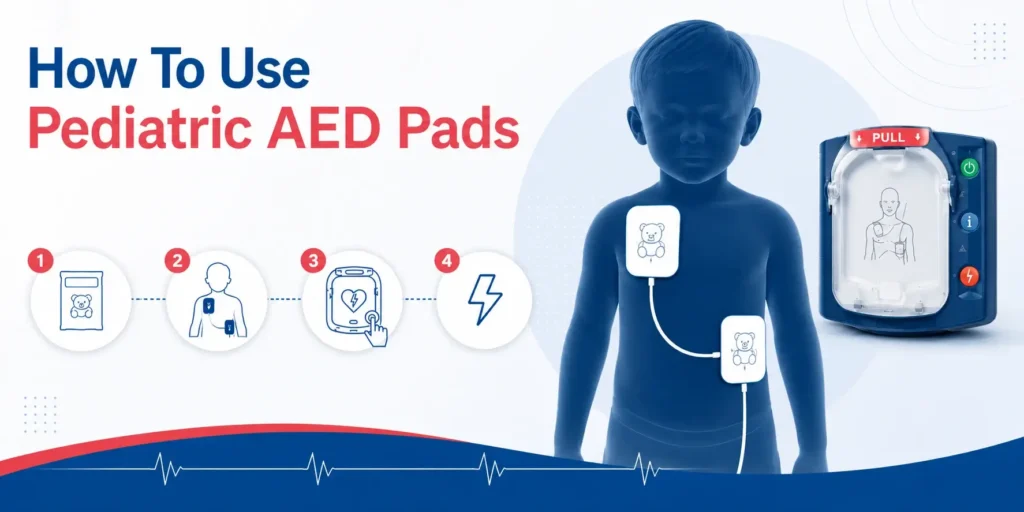
Turn on the AED and follow the voice prompts. Peel the backing off one pad at a time and place each pad firmly on bare skin according to the placement diagrams on the packaging. There are certain special considerations when using an AED on smaller patients — most importantly, the pads must never touch or overlap. If the child’s chest is too small, use anterior-posterior placement, which is covered in the next section.
Analyze, Shock, And Resume CPR
Plug the pad connector into the AED if it is not already connected. Make sure no one is touching the child while the device analyzes the heart rhythm.
If the AED detects a shockable rhythm, it will charge and instruct you to press the shock button. Shout “Clear!” and press the button. If no shock is advised, move immediately to CPR.
Begin compressions again within seconds. Do not remove the pads — the AED will continue monitoring and re-analyze the rhythm every two minutes. Keep performing CPR until EMS arrives, the child starts breathing, or another trained rescuer takes over.
Pad Placement: Infants Vs. Children Vs. Older Children
Correct placement is where most confusion happens, and the approach differs based on the child’s size and age.
Anterior-Posterior Placement For Children Under 8
For all children under 8, place one pad on the center of the bare chest over the sternum and the second pad on the back between the shoulder blades. This front-and-back positioning ensures the electrical current passes directly through the heart and eliminates the risk of pads overlapping on a small chest. This is the recommended method for infants as well.
Anterior-Lateral Placement For Children Over 8
Once a child is over 8 or weighs more than 55 pounds, use adult pads in the standard anterior-lateral position. Place the right pad below the collarbone to the right of the sternum, and the left pad on the left side of the chest a few inches below the armpit along the mid-axillary line.
If at any age the pads are too large to fit without touching, switch to anterior-posterior placement regardless of which pads you are using.
What If You Only Have Adult Pads?
If pediatric pads are not available, use adult pads. Both the American Heart Association and the American Red Cross confirm that adult pads on a child are vastly preferable to no defibrillation at all. Place them in the anterior-posterior position to prevent overlap, and check whether your AED has a child-mode switch that can reduce energy output. Never attempt to cut or trim pads to fit — altering them compromises conductivity and adhesion.
Common Mistakes That Cost Precious Time
Placing pads over clothing is the most frequent error — pads must contact bare skin. Applying pads to a wet chest breaks adhesion and can redirect current away from the heart.
Allowing pads to overlap shorts the circuit, which is why anterior-posterior placement exists for smaller chests. Forgetting to remove medication patches can cause burns at the pad site, and removing pads between shock cycles interrupts the AED’s continuous monitoring.
Perhaps the most costly mistake is hesitation. People freeze because they are afraid of hurting the child. But an AED will not shock a heart that does not need it. Acting is always the safer choice.
The 3-Minute Rule
The 3-minute rule is the principle that defibrillation is most effective when delivered within three minutes of cardiac arrest. Within that window, survival rates can reach 70 to 90 percent.
After three minutes, brain cells begin dying from oxygen deprivation, and the odds drop sharply with every passing minute.
The average EMS response time in the United States is 8 to 12 minutes. That gap is exactly why on-site AEDs — maintained and ready — are not a luxury. They are the difference between life and death.
Keeping Your Pediatric AED Pads Rescue-Ready
Having an AED on the wall only matters if it actually works when someone pulls it down. Pediatric pads typically expire every two to four years as the conductive gel dries out, and batteries lose charge over time.
Across a multi-site organization, it takes just one overlooked unit with expired pads to turn a rescue opportunity into a tragedy.
Routine inspections, proactive pad replacement, and battery monitoring are what separate a real AED program from a box on the wall. Understanding how long an AED lasts and planning for replacement before expiration is what keeps your program genuinely rescue-ready.
How Life Support Systems Keeps Your Program Ready
Since 1977, Life Support Systems has helped thousands of organizations build emergency readiness programs that work when it matters. We provide the equipment, on-site service, and certified training under one partner — delivered by our own full-time staff, never outsourced.
Our technicians conduct routine AED inspections at your location, replace pads and batteries before they expire, and track readiness across every device in your fleet.
Our instructors deliver AHA, and Red Cross-authorized CPR and AED training customized to your equipment and environment.
Whether you are equipping a single school or managing a nationwide program across gyms and fitness centers, we are the single partner that keeps your equipment, your pads, and your people ready.
Frequently Asked Questions
How Do You Use Pediatric AED Pads?
Turn on the AED, expose the child’s bare chest, and apply pediatric pads using anterior-posterior placement — one pad on the chest, one on the back between the shoulder blades. Follow the voice prompts, deliver a shock if advised, and resume CPR immediately.
What Is The 3-Minute Rule For AED?
Defibrillation is most effective within three minutes of cardiac arrest, with survival rates reaching 70 to 90 percent. After three minutes, brain damage begins and survival drops roughly 10 percent per minute.
Where Do AED Pads Go On Children Under 8?
One pad on the front of the chest over the sternum and one on the back between the shoulder blades. This anterior-posterior placement prevents overlap and ensures current passes through the heart.
Can You Use An AED On Children Under 8?
Yes. AEDs are safe for children of all ages, including infants. Use pediatric pads when available. If they are not available, adult pads placed in the anterior-posterior position are an acceptable alternative. Never delay treatment.
Can You Use Adult AED Pads On An Infant?
Yes, if pediatric pads are unavailable. Place the adult pads front-and-back to avoid overlap. The AHA and Red Cross both confirm that an adult-energy shock is far better than no defibrillation at all.
Last updated on 1 day ago
 Call Us
 Email Us