

A defibrillator can be the difference between life and death. But not all defibrillators are built for the same environment or user.
If you manage safety for a workplace, school, gym, venue, or multi-site organization, you’ve likely seen different terms online. Manual defibrillator. AED. Monitor-defibrillator. Paddles. Pads. It can feel like the same category of equipment with different labels.
In reality, a manual defibrillator is a very different tool from a public-access AED. It requires advanced training, clinical judgment, and active decision-making under pressure.
This guide breaks down what a manual defibrillator is, how it works at a high level, where it’s used, and why most non-clinical facilities are better served by an AED program designed for rapid public response.
What Is A Manual Defibrillator?
A manual defibrillator is a professional medical device used to deliver a controlled electrical shock to help restore a normal heart rhythm in certain life-threatening situations.
Unlike an AED, which guides the user through automated rhythm analysis, a manual defibrillator requires the operator to evaluate the rhythm and decide what to do.
These devices are most often used by paramedics, nurses, physicians, and other trained clinicians in emergency medical settings. They are designed for advanced care, where the provider is trained to interpret ECG rhythms and follow medical protocols.
In simple terms, the manual defibrillator gives the user more control. That control can be essential in clinical care. But it also comes with more responsibility and higher risk if used by someone without the proper training.
The Quick Answer
If you want the fastest, simplest definition, here it is.
A manual defibrillator is a defibrillator that requires a trained professional to interpret the heart rhythm on a monitor, choose the energy level, and decide when to deliver a shock. An AED is designed to analyze the rhythm automatically and guide a responder with prompts.
This difference matters because time is critical during sudden cardiac arrest. Most public locations need equipment that speeds up action, not equipment that requires advanced interpretation.
Manual Defibrillator Vs AED: The Core Differences
The difference between these devices is not just “manual” versus “automatic.” It’s about who the device is built for, how decisions are made, and what happens under stress.
A manual defibrillator is part of professional resuscitation care. An AED is part of public access readiness. Both can save lives. But they do it in different ways, in different places, with different users.
Who Can Use It
Manual defibrillators are intended for trained medical professionals. They are commonly used in EMS and hospitals where providers have rhythm interpretation skills and clinical oversight.
AEDs are built for use by lay responders. They are designed for workplaces, schools, and public spaces where the first person on scene may not have medical training.
Even in facilities with trained staff, an AED is often chosen because it supports fast action across an entire building. It helps the responder who arrives first, not only the responder with the highest certification.
How The Shock Decision Is Made
Manual defibrillation depends on the provider’s interpretation of the rhythm. The user analyzes what the heart is doing and decides whether a shock is appropriate.
With an AED, the device performs rhythm analysis and prompts the user. It will advise a shock only when the rhythm meets criteria for shockable rhythms.
This is one of the most important safety differences. AEDs are built to reduce the risk of inappropriate shocks and to simplify decision-making during a high-stress event.
Energy Selection And Control
Manual defibrillators allow the operator to select energy settings. The provider chooses the joules and controls the moment of delivery.
AEDs follow pre-set protocols and guide the user through a simplified process. The system is designed to remove guesswork and reduce the chance of user error.
For clinical care, manual control can be helpful. For public access readiness, simplicity is often the better design choice.
Safety Guardrails
Manual defibrillators assume a high level of training. They do not provide the same step-by-step coaching and guardrails that AEDs are designed to provide.
AEDs are built to help a responder act quickly, even if they are anxious, inexperienced, or unfamiliar with the device. Clear prompts, automated rhythm analysis, and structured steps make public response faster and safer.
Where Manual Defibrillators Are Typically Used
Manual defibrillators are most common in settings where advanced cardiac care is expected and trained professionals are present.
You’ll typically see them in emergency departments, intensive care units, ambulances, and other monitored clinical environments. These devices often serve as part of a broader monitoring setup, where clinicians are continuously assessing vital signs and cardiac rhythms.
It’s less common to see a manual defibrillator in a standard workplace, school, or public venue. Not because those environments don’t need defibrillation. They do. But because those environments usually need a device that supports rapid response without requiring rhythm interpretation.
What A Manual Defibrillator Can Do
Manual defibrillators are versatile, which is one reason they’re used in professional settings. They can provide multiple modes of therapy depending on the patient’s condition and the provider’s decision.
This section is educational and high-level. It is not a clinical guide. If you are a clinician, you should follow your training, protocols, and medical direction.
Defibrillation
Defibrillation is the delivery of an unsynchronized shock in certain cardiac arrest rhythms. The provider determines whether the rhythm is shockable and delivers the shock based on clinical assessment.
In a public access setting, an AED performs the analysis and advises shock when appropriate. That removes the need for rhythm interpretation by the first responder.
Synchronized Cardioversion
Manual defibrillators may also support synchronized cardioversion. This is a different type of therapy, timed with the heart’s rhythm, used in certain unstable arrhythmias under clinical supervision.
This feature is a key distinction between manual defibrillators and most public-access AEDs. It’s one reason manual units belong in professional care environments.
Transcutaneous Pacing
Many manual defibrillators also support transcutaneous pacing, which provides external pacing support when the heart rate is dangerously slow.
This is another capability commonly associated with advanced care and trained providers. It’s not typically part of a public access AED program.
Monitoring Capabilities
Manual defibrillators are often paired with advanced monitoring. These units may display ECG waveforms and capture events. They may also integrate with other vital sign monitoring, depending on the configuration.
This combination is part of why manual defibrillators are often referred to as monitor-defibrillators in professional settings.
Pads Vs Paddles: What People Mean
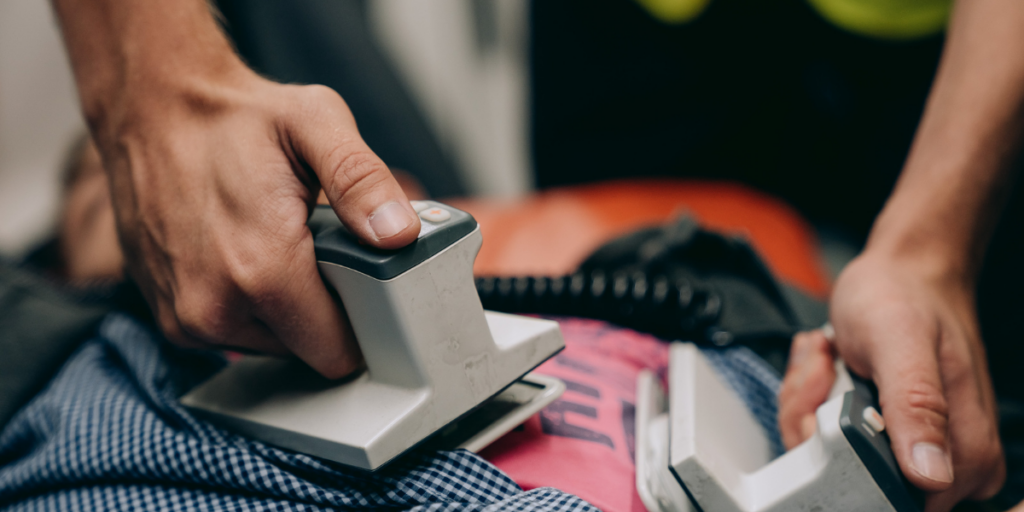
People often associate manual defibrillators with paddles, because that’s how defibrillation was commonly portrayed for years. Many manual units do support paddles, especially in certain clinical workflows.
But modern defibrillation frequently uses adhesive pads, even in professional care. Pads can support hands-free operation and reduce interruptions during resuscitation.
AEDs use adhesive pads. Manual defibrillators may use pads, paddles, or both depending on the unit and setting.
For most organizations, building a readiness program, the practical takeaway is simple. Your response plan should be built around what your responders can do confidently and consistently, not what looks familiar in the media.
What Training Is Required To Use A Manual Defibrillator?
Manual defibrillators require professional training because the device depends on the operator’s judgment.
The user must interpret the rhythm on the monitor, determine whether defibrillation is appropriate, select energy settings, and follow advanced resuscitation protocols. That decision-making is not realistic for most workplaces and public spaces.
Even well-intentioned responders can make mistakes under stress. That’s why public-access AEDs exist. They provide a faster, safer, and more standardized response pathway for non-clinical environments.
If your facility is not staffed with clinicians trained in rhythm interpretation and advanced resuscitation protocols, a manual defibrillator is generally not the right fit for your emergency readiness plan.
Why Most Organizations Should Not Choose Manual Defibrillators For Public Access
It may be tempting to assume “more advanced” equipment is always better. But in emergency readiness, the best device is the one that can be used correctly, immediately, by the person who arrives first.
Manual defibrillators increase complexity. They can slow down the action if the operator hesitates. They also increase the risk of misuse if the operator is not trained.
Public access AEDs are designed to remove barriers. They shorten the time to shock by guiding the responder through clear steps and reducing decision burden. For workplaces, schools, gyms, and public venues, that design is often the right approach.
The goal is not to own the most complex tool. The goal is to deliver the fastest effective care until EMS arrives.
Choosing The Right Defibrillator For Your Facility
Most facilities benefit from stepping back and asking one question. Who is most likely to respond first in the first two minutes?
That answer guides equipment selection. It also guides placement, signage, training, and maintenance expectations.
If You’re A Workplace, School, Gym, Or Venue
Public access AEDs are usually the right fit. They are built for fast use with simple prompts and structured decision support.
Selection should consider the environment. Noise levels matter. Building layout matters. Readiness indicators matter. Program ownership matters.
A strong AED program also plans for maintenance. Pads and batteries have expiration dates. Devices perform self-tests. The unit needs to stay accessible and in a verified, ready state.
If You’re EMS Or A Clinical Setting
Manual defibrillators may be appropriate because trained professionals can use the advanced capabilities. Procurement decisions should align with clinical workflows, training standards, and medical oversight.
In those settings, the manual defibrillator is one part of a broader care system. It is supported by protocols, ongoing training, and continuous clinical assessment.
Readiness Still Matters
No matter what defibrillator you have, readiness is the foundation. A defibrillator that is not ready is not a safety system. It is a liability.
For AED programs, readiness means the device shows a ready indicator, the pads and battery are within date, there are no warning alerts, and the unit is accessible. It also means the AED can be located quickly with signage and a clear response plan.
Readiness is not a one-time installation. It is an ongoing program. It needs ownership, inspections, tracking, and training alignment.
How Life Support Systems Supports Real-World Defibrillator Readiness
Life Support Systems exists to help organizations build emergency readiness that works under real conditions. That means helping you choose the right defibrillator approach for your environment, then supporting the system that keeps it rescue-ready over time.
We work with organizations nationwide to support AED selection, placement planning, signage guidance, replacement planning for pads and batteries, and on-site service and inspections delivered by full-time staff. We also provide training aligned to your equipment and facility, so responders are confident and prepared.
A defibrillator program is not just equipment. It’s a commitment to safety. Our role is to help you make that commitment clear, manageable, and consistently ready.
If you want help selecting the right defibrillator approach for your facility, or if you want to strengthen an existing AED program, request a readiness review. Share your facility type, number of locations, and current equipment, and our team can recommend a practical path to a stronger, more reliable emergency response program.
Frequently Asked Questions
What Is A Manual Defibrillator Used For?
A manual defibrillator is used by trained professionals to deliver shocks in certain emergency rhythms, with the provider interpreting the heart rhythm and controlling energy delivery.
Who Is Allowed To Use A Manual Defibrillator?
Manual defibrillators are designed for clinicians and EMS professionals with advanced training in rhythm interpretation and resuscitation protocols.
Is A Manual Defibrillator The Same As An AED?
No. An AED analyzes rhythm automatically and guides the user. A manual defibrillator requires the operator to interpret the rhythm and decide whether to shock.
Why Do Manual Defibrillators Require More Training?
Because the operator must interpret ECG rhythms, select energy settings, and make clinical decisions that AEDs handle automatically.
What Is The Difference Between Defibrillation And Cardioversion?
Defibrillation is an unsynchronized shock used in certain cardiac arrest rhythms. Cardioversion is synchronized to the heartbeat and is used for certain unstable arrhythmias under clinical supervision.
Can Manual Defibrillators Do Pacing?
Many manual defibrillators can provide transcutaneous pacing, which supports a dangerously slow heart rate under professional care.
Do Manual Defibrillators Use Pads Or Paddles?
They may use adhesive pads, paddles, or both depending on the device and the clinical setting.
Why Are AEDs Recommended For Schools And Workplaces?
AEDs are designed for fast public response with guided prompts and automated analysis, reducing hesitation and user error.
Can A Layperson Use A Manual Defibrillator In An Emergency?
Manual defibrillators are not intended for layperson use because they require rhythm interpretation and manual therapy decisions.
Which Defibrillator Is Best For A Business Or Public Building?
In most cases, a public access AED program is the best fit because it supports immediate response by non-clinical responders.
Do AEDs And Manual Defibrillators Require Maintenance?
Yes. All defibrillators require readiness checks, and AEDs require routine replacement of pads and batteries to stay in a verified ready state.
How Do I Build A Defibrillator Program That Stays Rescue-Ready?
Start with proper device selection, strategic placement, clear signage, regular inspections, tracked replacement schedules for consumables, and training aligned to your environment. A readiness partner can help maintain consistency across locations.
Last updated on 3 weeks ago
 Call Us
 Email Us