

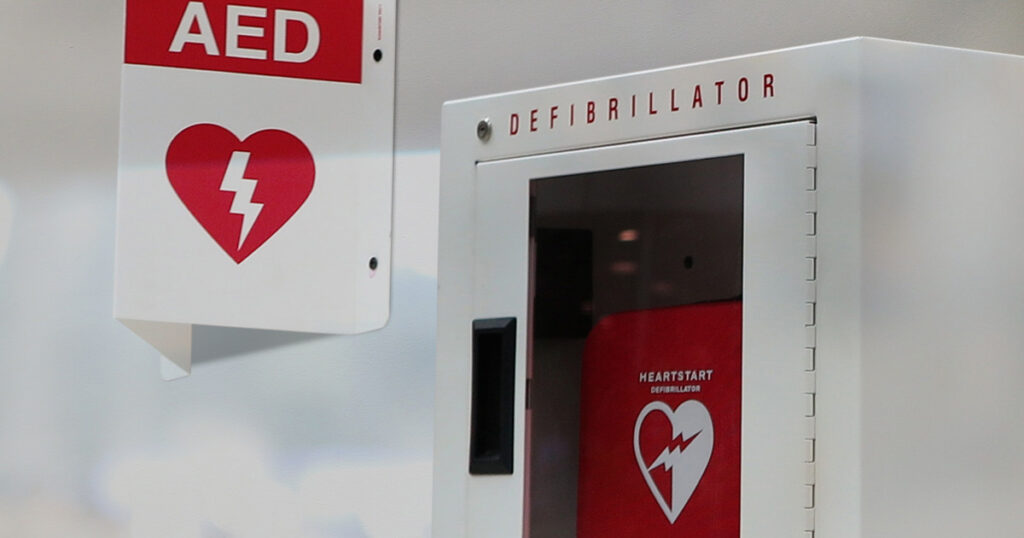
AED placement isn’t a “facilities decision.” It’s a readiness decision. In a cardiac emergency, the difference between a good outcome and a tragic one often comes down to how quickly someone can retrieve an AED, power it on, and apply pads.
Most organizations don’t struggle because they don’t care. They struggle because AED placement seems simple until you apply one real requirement: speed. The most useful placement strategy is the one that helps an ordinary bystander locate the AED fast and bring it back to the patient without hesitation.
This guide explains where AEDs should be placed in a building, how many you may need, what to avoid, and how to make placement work in real life with signage, accessibility, and routine readiness ownership.
Best AED Locations In Most Buildings
In most facilities, the best AED locations are central, highly visible, and easy to access without barriers. If someone had to guess where the AED is, they should be able to guess correctly.
Strong default placement zones include main lobbies, reception areas, security desks, elevator banks, and major corridors. These areas tend to be the simplest to find, the easiest to reach, and the most consistent across different building layouts.
AEDs should not be placed behind locked doors, inside private offices, or anywhere a responder might need permission to access the device. The AED must be available immediately, not “available once someone finds a key.”
High-Traffic And Central Areas To Prioritize
Central areas are valuable because emergencies can happen anywhere, and central placement reduces travel time from multiple directions.
Good starting points include reception desks, primary hallways, and shared spaces where people naturally pass throughout the day. If your building has a central spine corridor, that corridor is often the first place to evaluate for coverage.
High-Risk Zones To Prioritize
Some areas carry a higher likelihood or higher impact due to activity, occupancy, or physical exertion.
Gyms and fitness areas, cafeterias, auditoriums, and large meeting rooms are common examples. Industrial sites may also have remote work zones where distance and time become the main risk factors.
Start With The 3 Minutes Response Goal
The most practical way to plan AED placement is to plan around time, not floor plans. A device sitting on the “right wall” is meaningless if a responder can’t reach it and return in time.
Most placement guidance aims for AED retrieval and use within roughly 3 minutes of a collapse. That target includes much more than walking to a cabinet.
What “3 Minutes” Really Includes
It’s easy to underestimate what happens during a real response. Time isn’t only spent walking.
It includes recognizing an emergency, deciding to get the AED, locating it, opening the cabinet, returning to the patient, turning the unit on, and applying pads. If your placement plan only accounts for walking distance, you’ll likely miss the true response time.
A Simple Walk-Test Method To Decide How Many AEDs You Need
The walk-test is a straightforward way to turn placement into a measurable decision.
Choose a proposed AED location and walk briskly from your farthest or highest-risk areas to that AED and back. If the roundtrip already consumes most of your target window, you likely need another device for coverage.
Repeat the test for separate wings, floors, and areas that require transitions such as stairs, elevators, secured doors, or long corridors. This is where many buildings discover the “one AED for the whole building” assumption doesn’t hold up.
The Placement Rules That Prevent Real-World Failures
AED placement fails most often for predictable reasons: poor visibility, restricted access, or locations that don’t match how people move through the building.
A strong placement plan is built around behavior. In an emergency, a bystander goes toward what they can find quickly. Your AED needs to be in that path.
Make It Visible
If the AED is easy to miss, it is effectively not there.
Visibility is improved by using an obvious cabinet, placing the AED at a predictable spot, and keeping the area around it uncluttered. AED stations should not compete with a wall full of posters and announcements.
In larger buildings, consider projecting or 3D signage above the cabinet, so the AED can be seen from different directions and from farther away.
Make It Accessible
The AED must be reachable immediately. Locked doors and locked cabinets are common reasons AEDs fail in real emergencies.
If theft is a concern, use an alarmed cabinet rather than locking the AED away. The goal is deterrence without compromising access.
Also consider “functional access,” not just physical access. If the AED is accessible during business hours but the building is locked after hours while still occupied, your program has a readiness gap.
Place It Where People Actually Are
Empty hallways can look like perfect “clean walls” for equipment. But if people rarely pass that hallway, the placement won’t perform under pressure.
Follow real building traffic. Lobbies, main corridors, staff hubs, break rooms, and transition points between departments are often better placement zones than secluded walls.
ADA Mounting And Cabinet Basics
AEDs should be accessible to a wide range of users, including individuals with disabilities. Mounting decisions should support access and also keep corridors safe.
It’s helpful to think about two separate goals: the AED must be reachable, and the cabinet should not create hazards or obstructions.
Mounting Height For Access
A common best practice is to mount the AED cabinet so the operable parts can be reached comfortably without stretching or strain. This often aligns with ADA reach guidance, which varies depending on whether someone approaches from the front or the side.
Rather than focusing on one number, focus on the outcome: a broad range of users should be able to open the cabinet and remove the device quickly.
Don’t Forget The Path To The AED
Even a perfectly mounted AED can be functionally unreachable if the route to it is unreliable.
If the AED is placed behind doors that lock, inside areas that close after hours, or through corridors that are frequently blocked by deliveries or equipment, response time will suffer. Placement should account for how the building operates at different times of day and during special events.
High-Risk And High-Occupancy Zones To Prioritize
Once you’ve established a central AED location, the next step is extending coverage to where the risk or distance is highest.
High-occupancy areas are not just “busy.” They are places where a collapse is more likely to be witnessed, and where a fast response is most achievable if equipment is nearby.
Fitness Areas, Pools, And Athletic Spaces
Physical exertion is a common reason fitness areas are prioritized. Even when an AED exists elsewhere in the building, the response time can become too long if someone has to navigate hallways and stairwells to retrieve it.
For larger gyms or athletic complexes, consider whether one AED covers the whole space or whether a second unit is needed near a different entrance or activity zone.
Cafeterias, Break Rooms, And Large Meeting Spaces
These spaces combine occupancy density with predictable gathering. A single incident can involve many bystanders, and clarity matters.
AED placement near these zones can reduce travel time dramatically and makes it more likely that someone will locate the device without guidance.
Warehouses, Loading Docks, And Remote Work Areas
Industrial sites have a different challenge: distance. Long aisles, remote work zones, and transition points like loading docks can create response delays.
If your walk-test shows roundtrip retrieval is too long, consider adding AEDs at key transitions, such as the entrance to the warehouse floor, the loading dock area, or the midpoint of long wings.
Multi-Floor Buildings: One Per Floor And The “Wing Problem”
Multi-level buildings introduce two problems: vertical travel and navigational confusion.
Even if an AED is “close” in terms of straight-line distance, stairs and elevators add time, and responders may not know which floor the AED is on.
Elevator Banks And Stair Landings
Placing AEDs near elevator banks works well because elevator lobbies are predictable and easy to describe over the phone. They are also natural decision points where wayfinding signage can guide responders quickly.
Stair landings can also be useful in certain layouts, especially when stair access is faster than waiting for an elevator. The key is to place AEDs where the route is obvious and repeatable.
Long Wings, Connected Buildings, And Campuses
Many buildings don’t fail placement because of floors. They fail because of wings.
A long connected corridor, separate departments, or multiple building sections can create travel times that exceed the response goal even on the same floor. In these cases, consider AED placement at wing intersections, connector hallways, or department transition points.
If the building feels like multiple buildings inside one footprint, plan coverage that way.
Where Not To Place An AED
Poor placement creates delays, hesitation, and missed opportunities. The most common mistakes are easy to avoid once you name them.
Don’t place AEDs in locked offices, behind reception counters, inside closets, or anywhere that requires a staff member to “retrieve it for you.” Avoid spots where furniture, décor, or temporary signage can block access over time.
Also avoid environmental risk zones if the cabinet isn’t designed for them. Extreme heat, cold, humidity, and dust can reduce readiness and shorten battery and pad life.
Finally, avoid “out of sight, out of mind” locations. If your staff rarely sees the AED, they are less likely to remember where it is during a high-stress moment.
Signage That Makes Placement Work
Even the best AED placement can fail if nobody can find the device. Signage isn’t decoration; it’s wayfinding.
Good signage turns your AED into a visible station and creates a route a bystander can follow without instructions.
The Minimum Signage System
A basic signage system usually includes a sign at the cabinet and directional signs at decision points along the route.
In public-facing facilities, entrance decals can also increase awareness so visitors know an AED is available on-site. For larger buildings, projecting signage above the cabinet can improve long-distance visibility.
A Quick Test For Real-World Findability
Ask someone unfamiliar with your building to locate the AED using only signage and common sense. If they have to ask for help, your signage isn’t doing its job.
This test reveals blind spots quickly, especially in multi-wing buildings where people naturally take the wrong corridor or miss an alcove.
What To Keep With The AED Station
AED placement is stronger when the station is complete and consistent. People respond more confidently when the AED location looks like a purposeful rescue station, not a random wall cabinet.
Most AED stations include a basic responder kit and clear instructions that support action. If pediatric capability is needed, ensure pediatric pads or accessories are stored where they can be located instantly and are clearly labeled.
Keep the station tidy. A cluttered cabinet area slows response and creates uncertainty during an emergency.
Make It Operational: Maintenance, Ownership, And Drills
Placement is not the finish line. Readiness depends on what happens month after month.
The best AED placement plan can still fail if no one checks the status indicator, pads expire quietly, or the building layout changes without updating signage.
Monthly “Ready Status” Checks
A monthly readiness check is a simple habit with a major impact.
Confirm the AED shows a ready indicator, there are no warning beeps, pads and battery are within date, and the cabinet remains accessible. This prevents surprise failures and creates confidence in the program.
Post-Use Reset Matters
After an AED is used, it must be returned to ready status quickly.
Pads should be replaced immediately. The battery should be checked and replaced if needed. The unit should be inspected, cleaned as appropriate, and verified as ready. Documentation should be updated so your program remains consistent and auditable.
Assign A Program Owner
AED programs often fail due to unclear ownership.
Assign a responsible program owner and a backup. Define who checks readiness, who orders replacement components, and who verifies the AED returns to ready status after maintenance or use.
Ownership turns a device on a wall into a program you can trust.
Where Life Support Systems Fits In
AED placement is most effective when it is part of a complete emergency readiness strategy. The goal is not simply to place a device, but to build coverage you can rely on.
Life Support Systems supports organizations nationwide with consultative AED program design, including placement planning, signage guidance, on-site service and inspections, readiness tracking for pads and batteries, and training aligned to your building and environment. Whether you manage one facility or a multi-site footprint, the goal is the same: verified readiness and a response that works when seconds matter.
FAQs
Where Should An AED Be Placed In A Building?
Place AEDs in highly visible, central, and accessible locations such as lobbies, reception areas, security desks, and near elevator banks. Add additional AEDs for large wings, remote areas, or high-risk zones so response time stays within the target window.
What Is The 3 Minutes Rule For AED Placement?
It’s a practical planning guideline that aims to retrieve the AED, return to the patient, power it on, and apply pads within about 3 minutes. Buildings that can’t meet that goal with one device typically need more AEDs.
How Many AEDs Do I Need Per Floor?
Many multi-floor buildings place at least one AED per floor, then add additional units for long wings or remote zones where roundtrip retrieval time exceeds the response goal.
Should AEDs Be Near Elevators Or Stairwells?
Yes, elevator banks are often ideal because they are easy to locate and describe. Stairwells can be useful depending on the layout, but the route must be clear, accessible, and supported by signage.
Can An AED Be Kept In A Locked Cabinet Or Locked Room?
AEDs should not be locked away. If theft is a concern, use an alarmed cabinet rather than restricting access. The AED must be immediately available in an emergency.
What Is The ADA-Compliant Height For An AED Cabinet?
AED cabinets should be installed so the device can be reached and removed by a wide range of users, often aligning with common ADA reach guidance. The best approach is to ensure both accessibility and safe corridor clearance based on your facility.
Where Should AEDs Be Placed In Warehouses Or Industrial Buildings?
Place AEDs near high-traffic transitions such as entrances to the warehouse floor, loading docks, break areas, and at intervals that meet the response-time goal for remote work zones.
Where Should AEDs Be Placed In Schools And Campuses?
Common priority zones include main offices, gyms, cafeterias, auditoriums, and near stairwells or elevator lobbies. Large campuses often need multiple AEDs across buildings to meet response time goals.
Where Should AEDs Be Placed In Gyms And Fitness Centers?
Place AEDs where they are visible and quickly accessible from the workout floor, group class areas, and courts. If the facility is large, consider multiple units near different entrances or activity zones.
What Signage Should Be Installed To Direct People To An AED?
Use a clear cabinet identification sign plus directional arrow signs at decision points such as hallway intersections, elevators, and stairwells. Entrance decals are helpful in public-facing facilities.
What Should Be Kept With The AED?
Most AED stations include the device, current pads and battery, and a basic responder kit. If children are present, ensure pediatric capability is available and clearly labeled.
How Often Should AED Placement Be Reviewed?
Review placement whenever your building layout changes, after renovations, or when occupancy patterns shift. Routine program reviews help ensure the AED network still meets response-time goals.
Next Step
AED placement should not be guesswork. It should be a measurable plan based on response time, building layout, and real traffic patterns—supported by signage, training, and ongoing readiness checks.
If you want help confirming where your AEDs should be placed, how many you need, and how to keep every unit in verified “ready” status, request an AED placement and readiness review from Life Support Systems. Share your building type, approximate layout, and number of locations, and our team will help you build a practical placement plan that supports fast response and long-term program reliability.
Last updated on 1 month ago
 Call Us
 Email Us