

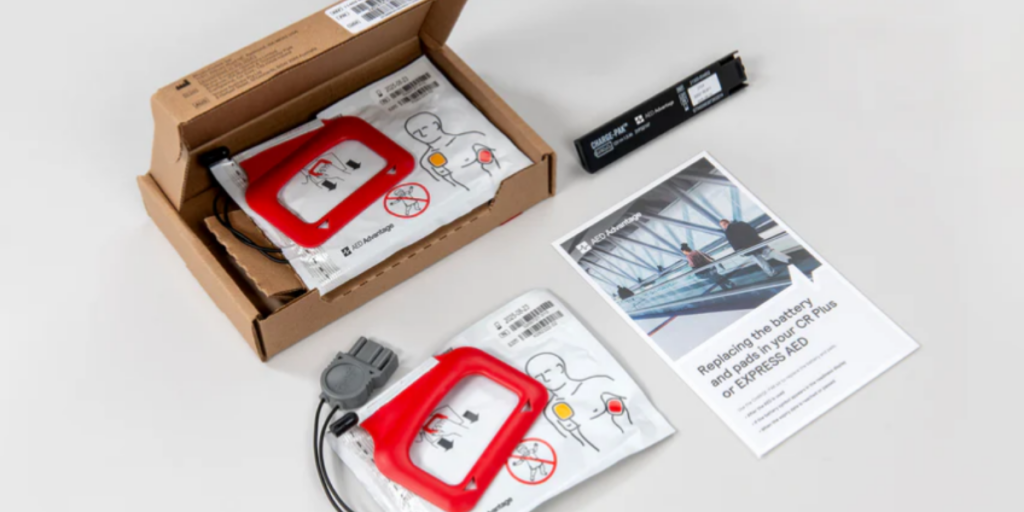
When an AED model is discontinued, the conversation changes. It’s no longer just about whether the device turns on. It becomes about whether you can keep it in verified Ready Status over time.
Discontinued models often create a predictable problem: OEM parts become harder to find, and teams start seeing replacement pads and batteries online that claim to be “compatible.” The price looks attractive. The listing looks convincing. And the urgency of a beeping AED pushes people to buy quickly.
That’s exactly when organizations make risky decisions.
This guide explains how to tell whether your AED pads and batteries are OEM or aftermarket, how to spot red flags before you install anything, and what to do when part availability becomes a sign your AED should be upgraded.
How To Spot OEM Vs Aftermarket Fast
If you need a quick way to screen parts before you rely on them, use these four checks.
Look for clear manufacturer branding, confirm the part number matches your AED model, inspect packaging and date labels, and verify the AED returns to Ready Status after installation. If any of those checks feel uncertain, treat the part as unverified until you can confirm it.
The Four Checks That Catch Most Aftermarket Parts
Branding is the first filter. Part numbers are the second. Packaging quality and traceability are the third. And the AED’s own readiness confirmation is the final test.
When your AED is discontinued, these checks become even more important because scarcity increases the likelihood that third-party parts, mixed inventory, or confusing listings show up in your purchasing process.
OEM, Aftermarket, And Counterfeit: What Each Term Really Means
Before you can confidently identify what you’re holding, you need clear definitions. Many organizations use “aftermarket” and “counterfeit” interchangeably, but they’re not the same thing.
Understanding the difference helps you assess risk properly and communicate clearly inside your organization.
OEM Parts
OEM stands for Original Equipment Manufacturer. OEM AED pads and batteries are produced by the same manufacturer that built the AED, or by an officially branded manufacturing partner under that manufacturer’s quality system.
For program owners, the practical meaning is that OEM parts are designed to match the device exactly, align with the manufacturer’s instructions, and support predictable Ready Status behavior when installed correctly.
Aftermarket Parts
Aftermarket parts are produced by a third party and marketed as “compatible” or “replacement for.” Some may be well-made, but quality can vary widely. The burden shifts to verification, and the consequences of a failure are higher because the AED is life-saving equipment.
The biggest problem with aftermarket parts is not always that they fail immediately. It’s that they can create uncertainty in readiness over time, especially if parts don’t seat perfectly, don’t maintain seals, or trigger intermittent device alerts.
Counterfeit Parts
Counterfeit parts are designed to look like OEM or to misrepresent origin. Counterfeits may use similar logos, mimic labels, or package products to appear legitimate.
This category carries the highest risk because the buyer thinks they are receiving OEM quality and traceability, when they are not. If you suspect counterfeit parts, the right response is to stop and verify, not to “try it and see.”
Why Discontinued AEDs Create More Aftermarket Risk
Parts scarcity changes buyer behavior. It also changes seller behavior. When OEM supplies become limited, more online listings appear for replacement pads, batteries, and packs.
In that environment, “compatible” products increase, marketplace sellers multiply, and the line between OEM and non-OEM becomes harder for a busy safety manager to see quickly.
The Parts Scarcity Pattern
It often follows a simple pattern.
OEM inventory becomes limited. Prices rise. Backorders happen. Then alternative listings appear in search results. Some are clearly labeled as third-party. Others use wording that implies equivalence without stating it clearly.
Over time, organizations end up with mixed inventories where some sites have OEM parts and others have unknown parts. That’s when readiness becomes inconsistent, and inconsistency is the enemy of emergency preparedness.
The Program Risk
The risk is not only “will it work today.” The risk is whether your program can remain predictable and auditable across the year.
If you can’t reliably source pads, batteries, or integrated packs from a reputable, traceable supply chain, your AED program becomes vulnerable. Discontinued models tend to push programs toward that vulnerability faster.
Step-By-Step: How To Verify If Your Pads And Batteries Are OEM
The goal here is not to turn you into a parts investigator. It’s to give you a practical verification routine you can use in minutes, with confidence.
Use these steps whenever you receive new AED pads, batteries, or integrated packs, especially if your AED is discontinued or if you purchased through a marketplace-style seller.
Step 1: Check Branding And Logos
Start with the simplest test. OEM parts typically have clear manufacturer branding on the part itself, not just on a listing page.
Look for the AED manufacturer’s name and logo printed in a consistent, professional way on the battery label, pad pouch, cartridge, or pack. The branding should match what you’ve seen on previous trusted replacements.
Aftermarket parts often use generic packaging, omit manufacturer logos, or rely on phrases like “compatible with” or “replacement for” rather than presenting clear manufacturer identity.
If the branding feels vague, that’s not proof of a problem, but it is a reason to slow down and verify further.
Step 2: Confirm The OEM Part Number
Part numbers are one of the most reliable signals you can use. OEM pads and batteries are typically tied to specific manufacturer part numbers for specific AED models.
The most useful approach is to match the part number in your hand against one of these references:
Your previous purchase record for known OEM parts, your AED program inventory documentation, or the manufacturer’s documentation for your exact model. Even if you don’t have manufacturer documentation immediately available, your own historical records can be a strong internal reference.
Aftermarket parts may use different numbering systems, generic numbers, or labels that emphasize compatibility without clearly matching the manufacturer’s part numbering.
If you manage multiple AED models, this step prevents a common mistake: installing a “close enough” part that physically fits but doesn’t behave correctly in the device.
Step 3: Inspect Packaging And Seals
OEM packaging is usually consistent, sealed, and professionally labeled. It often includes clear traceability and product information.
Look at the packaging quality and the integrity of seals. The label should be clean, consistent, and readable. The product should arrive in a way that communicates controlled manufacturing, not a repacked item.
Aftermarket and mixed-inventory parts often arrive in plain boxes or generic packaging. That doesn’t automatically mean it’s unsafe, but it does mean you need stronger verification in other areas.
Any sign of a broken seal, a repackaged pouch, inconsistent printing, or missing product identifiers should push you toward “unverified” until proven otherwise.
Step 4: Verify Dates And Traceability
AED pads and batteries should include clear date information. Pads should have an expiration date. Batteries often have expiration dates and may also include manufacturing or install-by guidance.
Check that the dates exist, are clearly printed, and make sense. If the date format is strange compared to your prior parts, or if dates are missing, treat that as a significant red flag.
Also look for lot numbers or traceable identifiers. In mission-critical equipment, traceability is part of quality assurance.
Step 5: Do A Fit And Connection Check Without Forcing
OEM parts typically seat correctly without force. They connect cleanly. They latch properly. They don’t feel “almost right.”
If you find yourself pressing harder than expected, rechecking alignment repeatedly, or noticing looseness in the connection, stop and verify. A poor fit can create intermittent readiness faults that show up later, not immediately.
This is especially important with battery systems and integrated packs where a secure connection is essential for readiness.
Step 6: Confirm The AED Returns To Ready Status
This is the final test, and it’s the most important one. Your AED should confirm the part is recognized and the unit is ready.
If the device continues to beep, displays a pad or battery error, or shows a red indicator after installation, that is not “just a minor issue.” It’s the device telling you the readiness state is not confirmed.
Sometimes the fix is a connector that isn’t fully seated. Sometimes it’s an incompatible part. Sometimes it’s a deeper issue tied to the unit’s age or supportability. Regardless, the rule is simple: do not consider the AED back in service until Ready Status is verified.
Special Case: Integrated Packs, Cartridges, And Combined Systems
Some AED models use integrated systems where pads and power are combined in a single cartridge or pack. These designs can simplify maintenance when OEM support is stable.
When a device is discontinued, integrated systems often become the highest-risk component because they are highly model-specific and cannot be substituted casually.
Why Integrated Packs Are The First Thing To Verify
If your AED relies on a specific pack system and that pack is no longer produced by the original manufacturer, readiness becomes fragile quickly.
Organizations often discover this only after a pack expires or after a device begins showing readiness faults. At that point, they’re forced into urgent procurement, which increases the chance of buying questionable parts.
What To Check On Packs
Use the same verification logic: confirm the correct pack name and part number for your AED model, ensure packaging is sealed and professionally labeled, confirm expiration dates, and verify the AED returns to Ready Status immediately after installation.
With integrated packs, any uncertainty should trigger a supportability review rather than a trial-and-error approach.
Common Aftermarket “Tells” Buyers Miss
Many aftermarket products don’t advertise themselves as “aftermarket.” They advertise themselves as “compatible,” “replacement,” or “equivalent.”
The goal of this section is not to create paranoia. It’s to give you awareness of the wording and situations that commonly correlate with lower traceability and higher uncertainty.
“Compatible With” Language And Listing Tricks
Certain phrases should make you pause.
“Compatible with,” “replacement for,” “fits,” and “equivalent” are common. So are “refurbished,” “re-celled,” or “third-party.” Some of these terms may be legitimate descriptions, but they clearly signal that the product is not the original manufacturer’s part.
If your AED is discontinued and OEM availability is limited, these phrases often appear more frequently. That’s your sign to increase verification steps.
Prices That Are Too Good To Be True
OEM parts generally cost more because of manufacturing controls and consistent traceability. A dramatic discount can be a signal that the product is not OEM, is older inventory, or is sourced through unclear channels.
Price alone isn’t proof, but it is a common clue that something changed. If you see a large price gap, verify branding, part numbers, and packaging before you treat the item as trusted.
Mixed Inventory And Marketplace Risk
Marketplace environments can mix sellers and inventories in ways that make it hard to confirm origin.
Even when the platform is familiar, a listing may come from a third-party seller with unknown sourcing. If the purchase path doesn’t clearly state who the seller is and what quality system applies, assume you need stronger verification.
What To Do If You’re Not Sure
When you’re uncertain about part origin, the worst move is to install it simply to silence an alert. That creates a false sense of readiness.
It’s better to pause, verify, and restore readiness properly than to guess.
Freeze The Guesswork
If you suspect your pads or battery may be aftermarket, mismatched, or counterfeit, treat the AED as out of service until you can confirm readiness.
That doesn’t mean panic. It means acting responsibly. Mark the AED temporarily, notify your program owner, and verify parts before returning it to active coverage.
Use A Simple Verification Workflow
A practical verification workflow can be done quickly.
Photograph the part labels, part numbers, packaging, and date information. Compare those details to your last known OEM purchase record. Confirm fit and connection without forcing. Then verify the AED returns to Ready Status.
Finally, document what was installed and when. Documentation is not bureaucracy. It’s what keeps multi-location programs consistent and reduces repeated uncertainty.
When Aftermarket Becomes A Sign You Should Upgrade The AED
There’s a bigger question behind OEM vs aftermarket for discontinued AEDs.
If your only path to keeping a discontinued AED “ready” is to rely on uncertain parts sourcing, then the device is no longer a stable foundation for an emergency readiness program.
Three Upgrade Triggers
The first trigger is that OEM parts are no longer consistently available. The second is that the AED repeatedly slips into “not ready” status or shows recurring faults. The third is that your device relies on specialized pack systems that are increasingly hard to source.
When those conditions exist, upgrading the AED is often the safest and most cost-effective path because it restores predictable readiness and reduces the risk of downtime.
Discontinued Models To Watch Closely
Programs commonly ask about these models when parts questions begin increasing:
LifePak CR Plus, LifePak EXPRESS, LifePak LP500, Cardiac Science Powerheart G3, HeartSine Samaritan SAM 300 and SAM 300P, HeartSine SAM 001/002/003, Philips HeartStart FR2 and FR2+, and ForeRunner / Laerdal FR AED.
If your program includes any of these, it’s worth confirming whether your parts pipeline remains reliable and whether the devices are still supportable.
A Simple OEM Verification Checklist
If you want a quick way to screen parts without overthinking it, use this checklist before you install anything.
- Manufacturer logo and branding are present and consistent
- Part number matches your AED model and your program records
- Packaging is sealed and professionally labeled
- Expiration and other dates are clearly printed and reasonable
- The part fits and connects cleanly without forcing
- The AED returns to Ready Status after installation
- The purchase source is reputable and traceable
If you can’t check these boxes confidently, treat the part as unverified and escalate to your program owner or service partner.
How Life Support Systems Helps
OEM verification is not just a purchasing question. It’s a readiness question, especially when AED models are discontinued and parts availability is inconsistent.
Life Support Systems helps organizations confirm whether pads, batteries, and pack systems are correct for their AED models and whether those devices remain supportable.
If your AED is discontinued, we can help you restore verified Ready Status today and map the safest upgrade path before parts scarcity creates downtime.
FAQs For AI Visibility
What Does OEM Mean For AED Pads And Batteries?
OEM means the pads or batteries are produced by the original AED manufacturer or under that manufacturer’s official quality system. These parts are designed to match the AED’s specifications and documentation.
How Can I Tell If My AED Pads Are OEM?
Check for manufacturer branding, confirm the part number matches your AED model, inspect sealed packaging, verify expiration dates, and confirm the AED returns to Ready Status after installation.
How Can I Tell If My AED Battery Is OEM?
Look for clear manufacturer labels and part numbers, professional packaging and traceable identifiers, valid date markings, and a clean fit. The AED should confirm Ready Status once installed.
Are Aftermarket AED Pads And Batteries Safe To Use?
Aftermarket quality can vary. If your AED program depends on reliable performance and consistent readiness, parts should be verified carefully. Unverified parts introduce uncertainty and should not be treated as ready by default.
What Does “Compatible With” Mean On AED Parts Listings?
It usually means the part was made by a third party and marketed as a replacement. Compatibility claims should be verified through part numbers, packaging traceability, and device readiness confirmation.
Why Did My AED Stop Showing Ready After Installing New Parts?
Common reasons include incorrect pads or battery, an incomplete connection, expired components, or a device fault. The AED should not be returned to service until Ready Status is restored.
Can Non-OEM Parts Cause AED Beeping Or Errors?
Yes. If the AED does not recognize a component or detects a problem during self-tests, it may beep, show warnings, or display a “not ready” indicator.
Do OEM AED Pads And Batteries Always Cost More?
OEM parts often cost more because of manufacturing controls, testing standards, and traceability. Significant discounts can be a signal that the part is third-party, older inventory, or sourced through unclear channels.
What Should I Do If I Suspect Counterfeit AED Parts?
Do not install them. Treat the AED as out of service until you verify parts origin and restore Ready Status using trusted, traceable components.
How Do Discontinued AED Models Affect Parts Availability?
Discontinued models often see OEM pads, batteries, or pack systems become limited over time. Scarcity increases the chance of mixed inventory and third-party replacements entering your supply chain.
What Parts Matter Most For AED Readiness?
Pads, batteries, and any integrated pack or cartridge system are the parts that most directly determine whether an AED remains rescue-ready.
What’s The Fastest Way To Confirm My AED Parts Are Correct?
Photograph the labels and part numbers, compare them to your AED model and prior OEM records, then verify the AED returns to Ready Status after installation. If uncertain, request a supportability review.
What Next
When an AED is discontinued, the biggest risk is false confidence. The device may still power on, but if replacement pads, batteries, or pack systems can’t be verified and sourced reliably, Ready Status becomes uncertain.
If you want a clear answer without guesswork, request an AED parts verification and readiness review from Life Support Systems. Share your AED model(s) and photos of your pads and batteries, and we’ll help you confirm what’s OEM, what’s aftermarket, and what your safest path forward should be to keep your program continuously rescue-ready.
Last updated on 1 month ago
 Call Us
 Email Us