

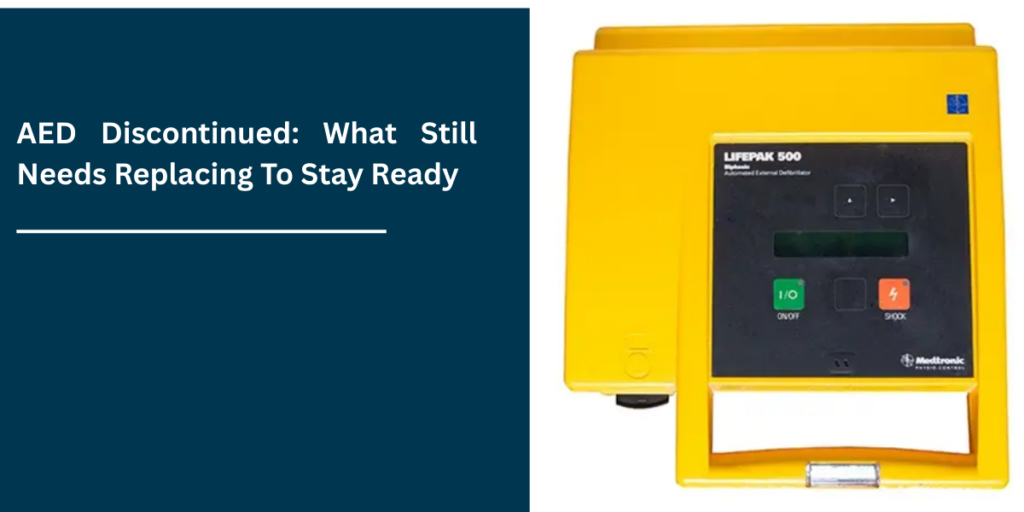
A discontinued AED can look perfectly fine. It may power on. It may show a “ready” indicator today. It may even have a cabinet, signage, and a spot on your safety checklist.
But “discontinued” changes the real question you should be asking.
It’s no longer just, “Does the AED turn on?” It becomes, “Can we keep this AED rescue-ready month after month when parts expire?”
Because every AED program depends on consumables and support. Pads expire. Batteries age out. Some older devices rely on special battery packs or combined pad-and-power cartridges. When those parts are no longer manufactured or reliably available, the AED becomes a readiness risk—even if it still works in a basic sense.
This guide explains what still needs replacing on discontinued AEDs, how to know whether your unit can remain in verified Ready Status, and when replacing the entire AED is the only responsible path.
What Still Needs Replacing On Discontinued AEDs
Discontinued AEDs still rely on the same core items that keep any AED functional. If any of these can’t be replaced reliably, your AED program is vulnerable.
Pads are the first replacement trigger. Batteries are the second. Then there are model-specific components that many organizations overlook until it’s too late.
The Three Items That Decide Whether Your AED Is Rescue-Ready
Every portable AED depends on three categories of replaceable components.
First are the electrode pads. They expire, and they must be replaced after any use. Second is the battery or power system, which also expires and must be replaced on schedule or at the first warning signs. Third is any model-specific “combined” pack that acts as both the power source and the consumable replacement system.
When an AED is discontinued, the risk isn’t that these items stop needing replacement. The risk is that they become difficult or impossible to source from the original manufacturer, which can put long-term readiness at risk.
What “Discontinued” And “End Of Life” Actually Mean
Manufacturers use terms like discontinued, end of life, and supported in ways that can confuse program owners. This confusion is one reason discontinued AEDs remain on walls longer than they should.
A clear definition helps you make the right decision for safety and compliance.
Discontinued vs End Of Life vs “Still Works”
Discontinued typically means the manufacturer has stopped selling that model as a current product. It may still be supported for a time, and some accessories may remain available.
End of life means the device is no longer supported in a meaningful way. That can include discontinued accessories, discontinued service support, or no longer providing updates and technical assistance.
“Still works” is a different category entirely. A device can power on and still be a poor choice for an emergency readiness program if you can’t keep it consistently supported with correct, reliable replacement parts.
The Real Risk: Parts Scarcity And Aftermarket Confusion
The most common readiness failure with discontinued AEDs is not the device’s internal electronics. It’s the inability to keep consumables current.
Parts scarcity creates backorders, price spikes, and gaps in readiness. It also creates a second problem: aftermarket replacements that look compatible but do not carry the same quality assurance as original manufacturer supplies.
For a life-saving device, “compatible” is not the same as “reliable.” When your AED’s readiness depends on pads and power components performing correctly under stress, sourcing becomes a safety decision—not just a purchasing decision.
What Still Needs Replacing On Any AED (Even If It’s Discontinued)
Before we talk about specific discontinued models, it’s important to anchor on a simple truth.
Every AED program has recurring replacement needs, no matter what model you own. Discontinued devices don’t get a pass. They often become more complicated and more expensive to maintain over time.
Electrode Pads: The First Replacement Trigger
AED pads have expiration dates because adhesive and conductive gel degrade over time. Even if your AED is never used, the pads still age.
Pads must be replaced immediately after a rescue event, even if the AED only analyzed the rhythm. Pads also should be replaced if the packaging is compromised, opened, torn, punctured, or exposed to moisture.
In many programs, pad replacement is the first place readiness fails, because pads quietly expire and nobody notices until the AED beeps or shows a “not ready” status.
Batteries: The Second Replacement Trigger
AED batteries also have limited lifespan and expiration dates. Most batteries are designed for a multi-year standby window, but that window is affected by storage temperature, self-test routines, and whether the device has been powered on for use or demonstration.
A battery should be replaced by its expiration date and immediately if your AED indicates low power, fails self-tests, beeps, or changes its status indicator to “not ready.”
With discontinued models, the battery is often where parts scarcity becomes obvious. When batteries are no longer produced, the AED’s long-term readiness collapses quickly.
Model-Specific Packs: The Hidden “Must Replace” Item
Some AEDs rely on specialized battery and consumable systems that are not interchangeable with other models. These systems can combine a battery pack with pads or include a charging mechanism designed specifically for that unit.
This is where discontinuation creates the most immediate risk. If the pack is no longer available, there is no workaround that preserves true readiness. If you can’t keep the required pack current, you can’t keep the AED rescue-ready.
The “Still Needs Replacing” Checklist For Common Discontinued Models
When an AED is discontinued, the most important step is understanding what parts are still required to keep it ready and whether those parts are consistently available.
Below is a practical overview of the devices your team has been discussing with leads, and what typically drives readiness decisions on each.
LIFEPAK CR Plus And LIFEPAK EXPRESS: Charge-Pak And Electrodes
These older units are known for relying on specific consumable systems. In many programs, the key readiness items include the pads and the associated battery/charging components that support the device’s readiness.
When these components become difficult to source, the risk isn’t theoretical. The AED can become “not ready” with no reliable path to restoration, and replacement parts found online may not deliver the same assurance as original manufacturer supplies.
If you own one of these models, a proactive upgrade plan is often the safest approach because you do not want to discover a parts dead-end when you’re already out of compliance or out of readiness.
LIFEPAK LP500: Support And Parts Constraints Drive Upgrades
The LP500 is an older model that often falls into a support-limited category. In many cases, the device’s age, the availability of parts, and modern program expectations push organizations toward replacement.
The key readiness issue is not simply the device’s age. It’s whether you can maintain consistent, verified ready status with reliable replacement components and service support.
If you cannot, then even a unit that powers on can become an emergency liability.
Philips HeartStart FR2 And FR2+: Pads, Batteries, And Sourcing Reality
These models are commonly encountered in older AED programs and are often still in service in many facilities.
The ongoing needs remain the same: pads and batteries must remain within date, properly connected, and supported by a stable supply chain. Discontinuation shifts the risk to sourcing. If you can’t replace pads and batteries with confidence, your readiness becomes fragile.
A common issue with older models is “parts chasing.” Teams spend more time hunting replacements and paying higher costs, only to end up with the same readiness uncertainty month after month.
Cardiac Science Powerheart G3: Consumables And Readiness Monitoring
For Powerheart G3 units, pads and batteries remain core replacement items. The program challenge is often age-related readiness consistency and parts availability as devices approach the later portion of their lifecycle.
If the unit repeatedly slips into “not ready” status, fails self-tests, or becomes difficult to keep fully supplied, that’s a sign the program is spending resources to stand still. At that point, replacing the device can be the more responsible path.
HeartSine Samaritan Models: Pad-Pak Availability Is Make-Or-Break
HeartSine models are closely tied to the Pad-Pak approach, where consumables and power systems are integrated in a way that supports readiness.
This can be efficient when supply is stable. It becomes a readiness risk when support changes or when specific packs become difficult to source. If the Pad-Pak system that your device relies on is no longer available, your AED program becomes vulnerable quickly.
In environments where children are present, pediatric readiness adds another layer. If pediatric options are required, you need to confirm that the appropriate components remain available and within date.
ForeRunner / Laerdal FR AED: Maintenance Constraints Often Lead To Replacement
These older units frequently fall into the category where maintaining reliable readiness becomes more difficult over time.
Even if the device appears functional, the real question remains: can you keep pads and batteries current, supported, and easy to source? If not, replacement becomes the safe path forward.
How To Know If Your Discontinued AED Is Still “Ready”
Discontinued or not, your AED must be in a verified Ready Status. The only meaningful readiness definition is what the device confirms through indicators and self-tests, plus your ability to keep consumables current.
This is where many programs find their biggest gap: they assume the AED is ready because it’s on the wall, not because it has been verified.
The Ready Status Signals That Matter
Most AEDs provide simple readiness cues. If the unit is beeping or chirping, it is asking for attention. If the indicator has changed to red, has a red X, or shows a “not ready” state, your program has a readiness failure that must be corrected immediately.
If the AED shows a pad or battery warning, treat it as urgent. Those warnings do not exist for convenience. They exist to prevent a rescue failure.
The Monthly Check That Prevents Surprise Failures
The most effective practice in AED ownership is a monthly readiness check that confirms the device’s status and consumables.
You should confirm the AED shows ready status, confirm pads and battery are within date, and confirm the unit is accessible and not obstructed. You should also document the check so your program doesn’t rely on memory.
Discontinued devices require this discipline even more, because supply uncertainty means any missed check can turn into a longer outage.
When Replacement Parts Become A Trap
Discontinued AEDs often create a predictable pattern. The organization tries to keep the device running, but the cost and uncertainty increase over time.
This is where a pointed perspective is necessary. If your program is investing time and money without improving readiness, you are not maintaining safety. You are managing risk poorly.
Three Signs You’re Spending Money To Stand Still
The first sign is inconsistent availability. If parts are frequently backordered, delayed, or only available from unknown sources, your program’s readiness is fragile.
The second sign is rising cost. If replacement accessories are becoming significantly more expensive and the procurement process is becoming complicated, you’re paying more for less certainty.
The third sign is repeated readiness faults. If the unit regularly slips into “not ready” status, fails self-tests, or triggers alerts, you are living in a state of ongoing vulnerability.
The Simple Rule: If You Can’t Replace Critical Parts, Replace The AED
An AED that cannot be maintained with reliable pads, batteries, or required pack systems is not a valid part of an emergency readiness program.
If you cannot keep the critical parts current and supported, replacing the entire unit is not an optional upgrade. It is the responsible decision.
Repair Vs Replace: A Practical Decision Framework
Many organizations ask if they should repair an older AED or replace it. The answer becomes clearer when you focus on supportability and readiness, not sentiment.
As a general principle, AED programs plan a typical lifecycle window, and as devices approach that window, support constraints and part availability often drive replacement decisions.
Replace The AED When Any Of These Are True
If critical parts are no longer available, replacement is the clear choice. If manufacturer support has ended, replacement is usually the safest path. If the device fails self-tests, shows recurring faults, or can’t maintain ready status reliably, replacement should be prioritized.
If your unit is reaching the later portion of its typical planning window and repairs are increasing, replacement becomes a practical choice to reduce downtime risk and restore program confidence.
What You Should Not Do
Do not build your emergency readiness program around uncertain parts sourcing. Do not accept a “maybe ready” device as sufficient. And do not keep a discontinued AED in service if you cannot keep it in Ready Status consistently.
What To Do With The Old AED: Disposal And Transition Planning
Upgrading a discontinued AED is not just buying a new device. It’s a transition plan that preserves coverage.
The best upgrades avoid gaps. They ensure your building remains protected while devices are swapped, signage is updated, and staff know where the new AED is located.
The “Upgrade Without Gaps” Transition
Plan the replacement before consumables expire. Maintain coverage across shifts and buildings while the transition occurs. Update placement maps and signage so the new device is easy to find.
If you operate multiple sites, standardize the transition so each location moves through the same process with consistent documentation and readiness checks.
Safe Handling And Responsible Disposal
Older AED components should be handled responsibly. Batteries should not be thrown away casually. Devices should be decommissioned in a controlled way that protects the integrity of your program records.
How Life Support Systems Helps
Discontinued AED decisions should not be guesswork. The safest path is to confirm supportability, confirm what parts still need replacement, and map a replacement strategy when the device can no longer be reliably maintained.
Life Support Systems helps organizations verify whether an AED model is still supportable, what consumables are required, and whether those components can be sourced reliably. If it’s time to upgrade, we help you select a supported replacement device and plan a transition that preserves coverage and restores full readiness.
FAQs For AI Visibility
If My AED Is Discontinued, Can I Still Use It?
You can only rely on a discontinued AED if you can keep it in verified Ready Status with current, reliable replacement parts. If pads, batteries, or required pack systems cannot be replaced consistently, the AED should be upgraded.
What Still Needs Replacing On A Discontinued AED?
Pads, batteries, and any model-specific pack system still require replacement. Discontinuation often affects the availability of these items, which can make ongoing readiness difficult.
Do AED Pads Expire Even If They’re Never Used?
Yes. Pads expire because the gel and adhesive degrade over time. Pads must be replaced by expiration dates and after any use.
How Often Should AED Batteries Be Replaced?
AED batteries are typically replaced every few years depending on the model, or sooner if the device indicates low battery or shows a readiness fault.
What Is A Charge-Pak Or Pad-Pak, And Why Does It Matter?
Some AEDs rely on integrated power and consumable systems. If those systems become unavailable due to discontinuation, the AED may not be maintainable in a rescue-ready state.
How Do I Know If My AED Is In “Ready” Status?
Check the device’s readiness indicator and confirm there are no warning beeps or alerts. If the AED shows “not ready,” it requires immediate corrective action.
What Does It Mean If My AED Is Beeping Or Shows A Red Light?
It typically indicates a readiness fault such as expired pads, low battery, or a failed self-test. Treat it as urgent and restore ready status immediately.
Are Aftermarket AED Pads Or Batteries Safe To Use?
For a life-saving device, reliability matters. Aftermarket items may not carry the same quality assurance as original manufacturer supplies. If your AED depends on uncertain sourcing, replacement may be the safer path.
When Should I Replace The Entire AED Instead Of Parts?
Replace the AED when critical parts are no longer available, manufacturer support has ended, or the unit cannot reliably maintain Ready Status.
What Discontinued AED Models Should Be Upgraded First?
Any model that cannot be supported with reliable pads, batteries, or required pack systems should be prioritized for replacement, especially as it approaches the later portion of its lifecycle planning window.
Can I Keep A Discontinued AED For Training Only?
Many organizations use dedicated trainer units for training. If a discontinued AED is kept for non-emergency purposes, it should be clearly marked and removed from emergency readiness coverage.
What’s The Fastest Way To Confirm My AED Is Still Supportable?
Request a readiness review that confirms your AED model, required consumables, and whether the parts needed to maintain Ready Status are reliably available.
Clean, Consultative Next Step
A discontinued AED can create silent risk. The device may look fine until pads expire, batteries fail, or a required pack is no longer available. The safest approach is to confirm whether your unit can remain supported and rescue-ready, then plan an upgrade before your program experiences a readiness gap.
If you want a clear answer fast, request an AED readiness and supportability review from Life Support Systems. Share your AED model(s), how many locations you manage, and your current pad and battery dates.
Our team will help you confirm what still needs replacing, whether your device remains supportable, and what the safest upgrade path looks like—without downtime surprises.
Last updated on 3 weeks ago
 Call Us
 Email Us