

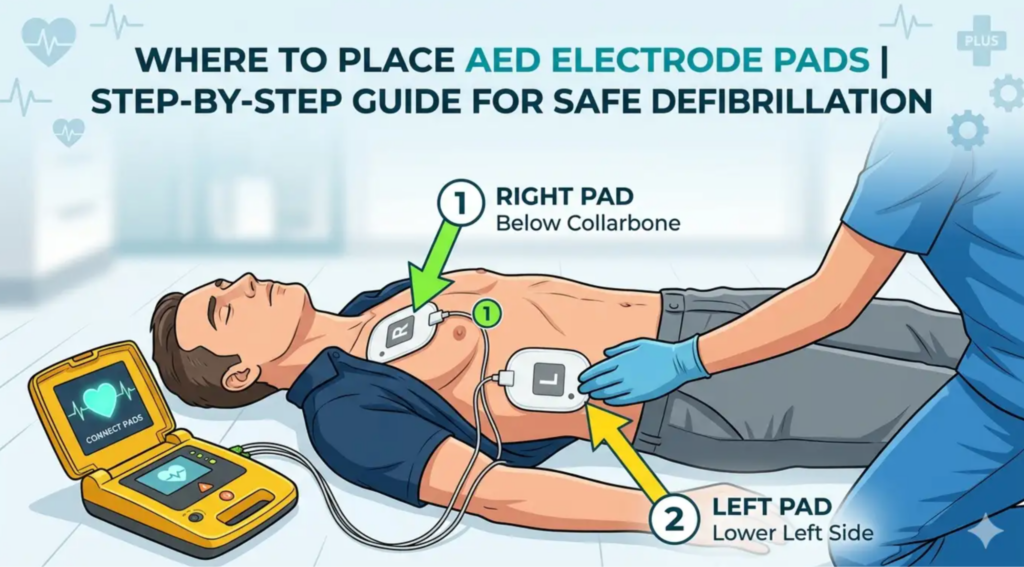
Correct placement of AED electrode pads is one of the most important factors in saving a life during sudden cardiac arrest. When the heart stops or enters a dangerous rhythm such as ventricular fibrillation, an Automated External Defibrillator (AED) delivers an electrical shock to restore a normal heartbeat. However, this only works effectively when the pads are placed in the correct positions on the chest.
In cardiac arrest emergencies, time is extremely critical. Brain damage can begin within minutes, and every second without effective defibrillation reduces the chance of survival. That is why proper AED pad placement must be done quickly, correctly, and without hesitation.
This guide is designed to be simple, clear, and focused on real emergency response situations. It removes unnecessary complexity and gives step-by-step clarity so that even a first-time responder can understand exactly what to do when using an AED device.
Correct pad placement directly improves the effectiveness of the shock by ensuring the electrical current travels through the heart muscle in the right direction. This significantly increases the chances of restoring a normal heart rhythm and improving overall survival rate in cardiac arrest cases.
All instructions in this guide follow widely accepted first aid protocols, CPR guidelines, and certified emergency medical standards used in professional healthcare and safety training environments.
What Are AED Electrode Pads and Why Placement Matters
AED electrode pads are adhesive, conductive pads used with an Automated External Defibrillator (AED) to deliver a controlled electrical shock to the heart during a cardiac emergency. These pads are placed directly on the bare chest and act as the connection point between the AED device and the patient’s body, allowing the machine to analyze cardiac rhythm and deliver defibrillation when needed.
When the AED detects a life-threatening rhythm such as ventricular fibrillation or pulseless ventricular tachycardia, it sends an electrical current through the pads to the heart. This process is called shock delivery, and its goal is to reset the heart’s electrical activity so a normal rhythm can return.
Correct AED pad placement is essential because it determines how effectively the electrical current travels through the heart. If pads are placed incorrectly, the shock may not pass through the heart properly, which can significantly reduce the effectiveness of defibrillation or delay life-saving treatment. In some cases, improper placement may also cause skin burns or ineffective shock delivery.
The key concept behind AED effectiveness is the electrical pathway through the heart. The pads must be positioned in a way that allows the electrical current to flow directly across the heart muscle, ensuring maximum impact on restoring a stable cardiac rhythm.
For beginners, understanding this basic principle is important: the AED does not “fix” the heart on its own—the correct pad placement ensures the shock reaches the heart in the most effective way possible during a critical emergency.
Standard AED Pad Placement for Adults (Anterior-Lateral Position)
The most commonly used method for AED electrode pad placement in adults worldwide is the anterior-lateral position. This is the standard placement recommended in most CPR and defibrillation guidelines, including widely accepted first aid protocols, because it provides the most direct electrical pathway through the heart for effective shock delivery.
Step-by-Step AED Pad Placement (Adults)
To ensure correct and safe defibrillation, follow this simple placement method:
- Place the first AED pad on the upper right side of the chest, just below the collarbone. This is known as the right external position.
- Place the second AED pad on the left side of the chest, slightly below the armpit on the side of the ribcage. This is known as the left lateral position.
This positioning ensures that the electrical current passes directly through the heart muscle rather than around it, which improves the effectiveness of restoring a normal cardiac rhythm during sudden cardiac arrest.
Why This Placement Works
The anterior-lateral position creates a strong electrical pathway across the heart, allowing the AED to deliver a more effective shock during ventricular fibrillation or other life-threatening rhythms. This increases the chances of successful defibrillation and improves overall survival outcomes in emergency situations.
Important Safety Notes
Before applying AED pads, always ensure:
- The chest is completely dry (remove sweat, water, or moisture)
- All clothing is removed from the chest area
- Any metal objects or accessories are cleared if possible
- The skin is clean so pads can properly stick and conduct electricity
Proper preparation ensures maximum pad adhesion and safe, effective shock delivery without interruption during the emergency response process.
AED Pad Placement for Children and Infants
Proper AED pad placement for children and infants requires special attention because their body size, chest structure, and heart positioning differ from adults. In pediatric defibrillation, the goal remains the same: deliver a safe and effective shock delivery to restore a normal cardiac rhythm, but pad positioning may be adjusted for safety and effectiveness according to rescue protocol and child CPR guidelines.
Child (Under 8 Years or Under 55 lbs)
For children, most AEDs follow the same general approach as adults, with adjustments depending on the availability of pediatric AED pads.
The preferred method is still the anterior-lateral placement:
- One pad placed on the upper right chest below the collarbone
- Second pad placed on the left side below the armpit
If the AED has a pediatric mode or pediatric pads, they should be used whenever available for safer energy levels
- If pediatric pads are not available, standard adult pads can still be used following emergency AED safety protocols
This placement ensures the electrical current passes through the heart in a controlled way, supporting effective defibrillation during child cardiac arrest situations.
Infants (Under 1 Year)
For infants, AED pad placement is modified due to the small chest size and delicate anatomy, following specialized pediatric CPR and rescue protocol guidelines.
The recommended method is anterior-posterior placement:
- One pad is placed on the center of the infant’s chest
- The second pad is placed on the back between the shoulder blades
This front-and-back positioning helps prevent pad overlap and ensures a safe and effective electrical pathway through the heart.
In infant cases, using an AED with pediatric settings is highly recommended, but in emergencies, a standard AED may still be used if it is the only available option.
Correct pediatric AED pad placement is critical because children and infants have higher sensitivity to electrical shocks. Following proper child CPR and defibrillation safety guidelines improves survival chances and reduces the risk of ineffective treatment during a life-threatening emergency.
Anterior-Posterior AED Placement (When and Why It Is Used)
The anterior-posterior AED pad placement is an alternative method used when the standard anterior-lateral position is not suitable or may reduce the effectiveness of defibrillation. In this technique, the AED electrode pads are placed on the front and back of the body to create a direct electrical pathway through the heart. This method is especially useful in specific emergency response situations where standard placement is not possible or not ideal.
This placement ensures proper shock delivery while avoiding obstacles on the chest and maintaining effective contact with the heart’s electrical system.
When to Use This Method
The anterior-posterior AED pad placement is typically used in the following situations:
- When the patient has a large chest size that makes standard placement less effective
- When there is a medical device or implant (such as a pacemaker or ICD) blocking the usual pad area
- In certain pediatric defibrillation cases, especially when chest space is too small for standard pad positioning
- When chest injuries, burns, or wounds prevent proper adhesion of pads in the front chest area
In these edge cases, adjusting placement ensures that cardiac rhythm analysis and shock delivery remain accurate and effective.
Correct Positioning Steps
To perform anterior-posterior AED pad placement correctly, follow these steps:
- Place one AED pad on the center of the chest, usually over the sternum area (front side)
- Place the second pad on the upper back, between the shoulder blades
This front-and-back positioning creates a straight electrical current pathway through the heart, improving the effectiveness of defibrillation when standard placement is not possible.
This method is widely recognized in advanced CPR protocols and specialized rescue protocols, especially in complex emergency cases where standard AED pad placement cannot be used safely or effectively.
Step-by-Step Guide to Using AED Pads Correctly in an Emergency
Using AED electrode pads correctly during a cardiac arrest emergency is a critical part of the chain of survival. Following the correct emergency response workflow ensures that defibrillation is delivered safely and effectively, improving the chances of restoring a normal cardiac rhythm.
Step 1 – Check Responsiveness and Call Emergency Services
- Check if the person is responsive by tapping and shouting
- Look for normal breathing or signs of life
- Immediately call emergency medical services (EMS) or ask someone else to call
- This activates the first step of the chain of survival, ensuring professional help is on the way
Step 2 – Expose and Dry the Chest
- Remove all clothing from the chest area to access the skin
- Ensure the chest is completely dry (wipe sweat, water, or moisture)
- Dry skin improves AED pad adhesion and ensures effective shock delivery
- Remove any obstacles such as jewelry or patches if possible
Step 3 – Attach AED Pads Correctly
- Place the AED electrode pads in the correct position based on age and body type
- Ensure pads are firmly attached with no air gaps
- Follow anterior-lateral placement for adults unless otherwise instructed
- Correct placement ensures proper electrical flow through the heart
Step 4 – Allow Device to Analyze Heart Rhythm
- Turn on the AED and follow voice prompts
- Do not touch the patient while the device is analyzing
- The AED checks for abnormal cardiac rhythm such as ventricular fibrillation
- This step determines whether a shock is needed
Step 5 – Deliver Shock if Advised
- Ensure everyone is clear from the patient (“Clear!”)
- Press the shock button if the AED instructs you to do so
- This delivers controlled defibrillation to reset the heart’s electrical activity
- Always follow AED voice instructions for safety
Step 6 – Resume CPR Immediately
- After the shock (or if no shock is advised), immediately start CPR (cardiopulmonary resuscitation)
- Continue chest compressions without delay
- This maintains blood flow until the heart stabilizes or emergency responders arrive
- CPR combined with AED use is a critical part of the emergency response workflow
Common Mistakes in AED Pad Placement (And How to Avoid Them)
Even though AEDs (Automated External Defibrillators) are designed to be simple and user-friendly, mistakes in AED electrode pad placement can reduce the effectiveness of defibrillation and delay life-saving shock delivery. Understanding these common errors helps improve confidence and ensures a correct emergency response workflow during cardiac arrest situations.
Placing Pads on a Wet or Sweaty Chest
- One of the most common mistakes is applying AED pads on a wet, sweaty, or damp chest
- Moisture can interfere with proper pad adhesion and electrical conduction
- This may reduce the effectiveness of the electrical current through the heart
- How to avoid it: Always dry the chest completely before placing pads to ensure safe and effective defibrillation
Incorrect Positioning Too Close Together
- Placing pads too close reduces the ability of the shock to pass through the heart muscle
- This can weaken or block proper cardiac rhythm correction
- How to avoid it: Follow correct anterior-lateral placement, ensuring pads are placed far enough apart to create a proper electrical pathway
Not Removing Clothing or Metal Objects
- Clothing, jewelry, or metal objects can interfere with AED pad contact
- This may cause poor adhesion or improper shock delivery
- How to avoid it: Fully expose the chest and remove any objects that could block pad placement before using the AED device
Interrupting CPR Unnecessarily
- Stopping CPR (cardiopulmonary resuscitation) for too long reduces blood flow to the brain and heart
- Long pauses can lower survival chances during sudden cardiac arrest
- How to avoid it: Only pause CPR when the AED is analyzing or delivering a shock, then resume immediately
AED Pad Placement Safety Checklist
A correct AED electrode pad placement process is essential for safe and effective defibrillation during a cardiac arrest emergency. This quick reference checklist helps ensure proper shock delivery, reduces errors, and supports a smooth emergency response workflow even under high-pressure situations.
AED Safety Checklist Table
| Step | Action | Why It Matters |
| 1 | Expose chest fully | Ensures proper AED pad adhesion and direct skin contact for effective shock delivery |
| 2 | Dry chest surface | Prevents moisture from interfering with electrical conduction and improves defibrillation success |
| 3 | Place pads correctly | Ensures correct electrical pathway through the heart, improving chance of restoring normal cardiac rhythm |
| 4 | Avoid touching victim during analysis | Prevents interference with heart rhythm analysis, ensuring accurate AED reading |
| 5 | Follow AED voice prompts | Reduces human error and guides proper CPR and AED usage in real-time emergency situations |
This checklist is designed for quick scanning during high-stress emergency response situations, helping users apply AED pads correctly and support effective life-saving action during sudden cardiac arrest.
AED Placement vs CPR: How They Work Together
Understanding the relationship between CPR (cardiopulmonary resuscitation) and AED use is essential for effective cardiac arrest response. Both work together as part of the chain of survival, but they serve two different purposes in saving a life.
CPR helps maintain blood flow to the brain and vital organs when the heart has stopped. By performing continuous chest compressions, CPR keeps oxygen circulating in the body, buying critical time until advanced help arrives. Without CPR, the chances of survival drop rapidly within minutes of sudden cardiac arrest.
On the other hand, an AED (Automated External Defibrillator) is used to restore a normal cardiac rhythm. It delivers a controlled electrical shock through properly placed AED electrode pads, targeting abnormal rhythms such as ventricular fibrillation. While CPR supports circulation, the AED directly addresses the electrical problem in the heart.
When used together, CPR and AED therapy create a powerful life-saving combination. CPR keeps the body alive temporarily, while the AED works to restart the heart’s normal rhythm through defibrillation. This coordinated approach significantly increases survival rates in emergency situations.
For beginners and responders, proper CPR training is highly recommended. Training improves confidence, reduces hesitation, and ensures correct technique when performing both CPR and AED pad placement under real-life emergency conditions.
DIY Understanding vs Professional Training (Why Certification Matters)
Understanding AED pad placement and CPR basics from online guides is helpful, especially for awareness during cardiac arrest emergencies, but there is a clear difference between basic knowledge and certified professional training. While guides can improve understanding, real-life emergencies require speed, confidence, and accurate execution under pressure.
What You Can Learn from Guides
- Basic knowledge of AED electrode pad placement and how defibrillation works
- Understanding of the chain of survival and emergency response steps
- Awareness of how CPR (cardiopulmonary resuscitation) and AED work together
- Ability to recognize emergency situations and respond without panic
- Introductory guidance on correct shock delivery procedures
Guides are useful for building awareness and improving general understanding of emergency medical response, especially for first-time learners.
Why Professional Training Is Better
- Faster response time during real cardiac arrest situations
- Reduced mistakes in AED pad placement under stress
- Hands-on practice improves confidence in CPR and defibrillation techniques
- Better ability to follow rescue protocols without hesitation
- Training helps users react correctly in high-pressure environments where every second matters
Professional certification ensures that individuals are not only informed but also prepared to act effectively when a life is at risk.
Maintenance and Readiness of AED Devices
Keeping an Automated External Defibrillator (AED) in proper working condition is just as important as knowing correct AED electrode pad placement. A well-maintained device ensures reliable defibrillation during a cardiac arrest emergency, where every second is critical for survival.
Battery Checks and Pad Expiration Monitoring
- Regularly check the AED battery status to ensure the device is always ready for use
- Replace batteries according to manufacturer guidelines or when low-power alerts appear
- Monitor AED pad expiration dates, as expired pads may lose adhesive strength and reduce shock delivery effectiveness
- Store spare pads in accessible emergency locations for quick replacement
Proper battery and pad management ensures uninterrupted performance during emergency response situations.
Regular Inspection Schedules
- Conduct routine AED inspections (weekly or monthly depending on workplace policy)
- Check device indicators, alarms, and readiness status lights
- Ensure pads, batteries, and accessories are properly stored and undamaged
- Maintain inspection logs for accountability and safety tracking
Consistent inspection reduces the risk of device failure during sudden cardiac arrest events.
Importance of Workplace Compliance
- Many workplaces are legally or ethically required to maintain functional AED devices
- Compliance ensures alignment with occupational safety standards and emergency preparedness regulations
- Proper training and device readiness improve overall workplace safety response systems
- Helps organizations reduce liability and improve emergency survival outcomes
Supporting Safety Systems and Digital Strategy
To improve AED readiness awareness and compliance:
- Email & Social Media Marketing can be used to send regular safety reminders, maintenance alerts, and training updates to staff and stakeholders
- Consulting & Retainers services help organizations build structured AED compliance programs, ensuring devices are inspected, maintained, and audit-ready at all times
Cost Factors for AED Training and Maintenance Services
Understanding the cost structure of AED training programs and AED maintenance services helps organizations and individuals plan for long-term emergency preparedness. These services are not just expenses—they are investments in safety, compliance, and effective response during cardiac arrest emergencies where proper AED electrode pad placement and device readiness can save lives.
Device Maintenance Costs
- Costs depend on the type and model of the Automated External Defibrillator (AED)
- Regular expenses include replacement of AED pads, batteries, and device accessories
- Some providers offer annual maintenance contracts covering inspection and servicing
- Additional costs may arise for software updates or compliance certifications
- Proper maintenance ensures reliable defibrillation performance during emergencies
Training Program Pricing Factors
- Pricing varies based on course depth (basic awareness vs certified CPR and AED training)
- Hands-on training sessions typically cost more due to equipment and instructor involvement
- Group training sessions are often more cost-effective than individual certification
- Location, certification body, and course duration also influence pricing
- Advanced training improves correct AED pad placement and reduces emergency response errors
Corporate vs Individual Pricing
- Corporate training packages are designed for workplaces and often include bulk pricing, on-site training, and compliance documentation
- Individual certification courses are typically shorter and focused on personal skill development
- Corporate plans may include ongoing AED compliance monitoring and refresher sessions
- Individual users usually pay per course or certification level
Strategic Marketing and Brand Value in Safety Services
To improve visibility and adoption of AED training and maintenance services, organizations can invest in:
- Paid Ads (Search, Social, Display) to target high-intent audiences searching for emergency safety solutions, CPR certification, and AED services
- Branding & Identity development to build trust for safety-focused organizations, ensuring they are recognized as reliable providers of life-saving training and equipment services
Benefits of Correct AED Pad Placement
Correct AED electrode pad placement plays a direct role in improving outcomes during sudden cardiac arrest. When pads are positioned accurately, the Automated External Defibrillator (AED) can deliver effective defibrillation, increasing the chances of restoring a normal cardiac rhythm and improving overall survival rates.
Higher Survival Rate in Cardiac Arrest
- Accurate AED pad placement ensures the electrical shock passes directly through the heart
- This improves the effectiveness of defibrillation in life-threatening rhythms like ventricular fibrillation
- Faster and correct application significantly increases survival chances during cardiac arrest
Faster Emergency Response Effectiveness
- Proper pad placement reduces delays during critical emergency response situations
- Helps responders act quickly without confusion or repositioning
- Supports the chain of survival by minimizing time to first shock
Reduced Operator Confusion
- Clear understanding of AED pad placement simplifies decision-making under stress
- Reduces hesitation during CPR and AED usage
- Improves confidence for both trained and untrained responders in emergencies
Compliance with Safety Standards
- Correct usage aligns with first aid protocols and recognized emergency medical guidelines
- Supports workplace safety requirements for AED readiness and defibrillation procedures
- Helps organizations maintain proper health and safety compliance
Trust-Building for Workplaces
- Demonstrates a strong commitment to employee and public safety
- Builds confidence among staff that emergency equipment is properly used and maintained
- Enhances organizational reputation as a safety-conscious environment prepared for cardiac emergencies
Conclusion
Correct AED electrode pad placement is critical in cardiac arrest emergencies where every second directly impacts survival. When AED pads are positioned correctly, the device can deliver effective defibrillation, helping restore a normal cardiac rhythm and significantly improving survival outcomes during life-threatening situations.
A clear understanding of AED usage, combined with awareness of proper CPR and emergency response steps, reduces errors, speeds up reaction time, and strengthens the overall chain of survival. This knowledge is essential for both trained responders and everyday individuals who may be the first to act in an emergency.
For professional AED support, training, and compliance services, lifesupportsystems provides trusted emergency safety solutions backed by industry expertise and certified standards. For immediate assistance or consultation, call 1.800.520.9635 to ensure your workplace is fully prepared, fully compliant, and ready to respond effectively to any sudden cardiac arrest situation.
Frequently Asked Questions
Where exactly do AED pads go on the chest?
AED pads are placed in the anterior-lateral position. One pad goes on the upper right chest below the collarbone, and the second pad goes on the left side below the armpit. This placement helps create a proper electrical pathway through the heart for effective defibrillation.
Can AED pads touch each other?
No, AED pads should not touch each other. If they are too close, the electrical shock may not travel correctly through the heart, which can reduce the effectiveness of shock delivery and cardiac rhythm correction.
What happens if AED pads are placed incorrectly?
Incorrect AED electrode pad placement can reduce the effectiveness of the shock. In some cases, the AED may not be able to properly reset the heart’s rhythm, which can delay life-saving defibrillation.
Can AED be used on a wet person?
Yes, an AED can be used on a wet person, but the chest must be dried first. Moisture can interfere with pad adhesion and reduce safe electrical conduction, so drying the chest is important before applying pads.
Do AED pads work through clothing?
No, AED pads must be placed directly on bare skin. Clothing prevents proper adhesion and can block effective shock delivery, so the chest must always be exposed first.
Are AED instructions the same for all devices?
Most AED devices follow similar voice-guided instructions, including pad placement, analysis, and shock delivery. However, slight differences may exist between models, but the core defibrillation process remains the same.
Can untrained people use an AED?
Yes, AEDs are designed for public use and are very simple to operate. Voice prompts guide the user step-by-step, making it possible for untrained people to assist during cardiac arrest emergencies, although CPR and AED training is always recommended for better response.
Last updated on 3 days ago
 Call Us
 Email Us