

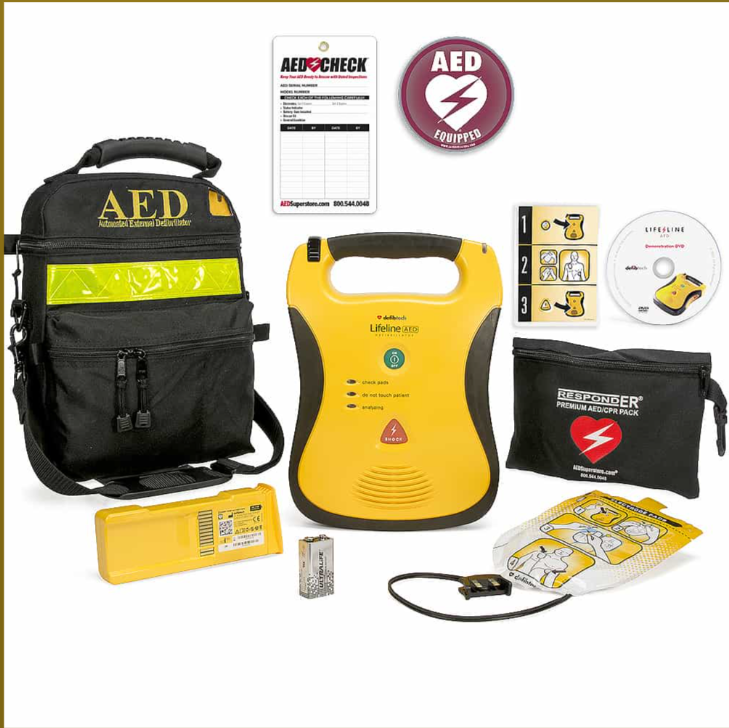
When someone collapses and isn’t breathing normally, the next few minutes matter more than anything else. In workplaces, gyms, schools, and public spaces, people often hesitate because they’re unsure what to do first: start CPR or use the AED.
The right answer is reassuringly simple. In most situations, CPR comes first while the AED is being brought to the person. Then, the AED is used as soon as it arrives, with CPR continuing in between the device’s prompts. This isn’t an “either-or” choice. CPR and AED use are a sequence that works together to support the best possible outcome.
This guide explains the correct rescue order in plain language, what changes if you’re alone, and exactly what to do when the AED arrives—so you can act fast without second-guessing.
AED Vs CPR: The Quick Answer
If you suspect cardiac arrest, start chest compressions immediately. At the same time, have someone call emergency services and bring the AED. Once the AED arrives, turn it on right away, apply the pads, and follow the prompts. Resume CPR immediately after a shock or if the AED says “no shock advised.”
Think of it like parallel action. CPR starts circulation support right away, while the AED is prepared to treat shockable rhythms if they are present. The best response is the one that reduces delay.
CPR And AED Are Not Either-Or
People often treat this question as a debate: “Should I do CPR first or use the AED first?” In real rescues, both are part of the same response.
CPR helps by moving oxygenated blood to the brain and vital organs while the AED is being retrieved and set up. The AED helps by analyzing the heart rhythm and delivering a shock if it detects a rhythm that can be treated with defibrillation. After the AED analyzes and shocks (if advised), CPR continues again. The process repeats until emergency responders take over.
So the goal is not choosing one. The goal is to keep the person supported while the AED is used as early as possible.
What CPR Does During Cardiac Arrest
In sudden cardiac arrest, the heart isn’t pumping blood effectively. Chest compressions act as a temporary pump. They are not a “nice extra.” They are the immediate action that keeps blood moving while the AED is being brought to the scene.
This is why high-quality CPR matters. Compressions should be steady and firm, with minimal stopping. Even short interruptions reduce the benefit of CPR. In a real environment, people tend to stop compressions too often to talk, move, or reassess. A strong response keeps compressions going whenever the AED is not actively analyzing or delivering a shock.
If you’re not trained in rescue breaths, Hands-Only CPR (continuous compressions) is still valuable. The most important thing is starting compressions quickly and staying consistent.
What The AED Does In Cardiac Arrest
The AED is designed to guide a rescuer through the steps without requiring medical judgment. Once it’s turned on, it will provide voice prompts that tell you exactly what to do, including when to stop compressions for rhythm analysis and when to deliver a shock.
One key point is that the AED does not replace CPR. It works with CPR. The AED may advise a shock, or it may advise no shock. Either way, the correct next step is almost always to resume CPR immediately after the device gives you direction.
The biggest mistake people make is waiting too long to use the AED. When the AED becomes available, it should be turned on and applied right away—without unnecessary delays.
The Correct Order Of Steps In Plain Language
In the moment, you don’t need complex terminology. You need a sequence you can remember and follow.
First, check responsiveness and breathing. If the person is unresponsive and not breathing normally, treat it as a cardiac arrest emergency. Call emergency services or direct someone else to call immediately.
Start CPR right away. If another person is present, send them to retrieve the AED while you keep compressions going. When the AED arrives, turn it on, expose the chest, attach the pads, and follow the prompts. Pause compressions only when the AED instructs you to pause for analysis or shock delivery.
After a shock, or if no shock is advised, resume CPR immediately and continue until the AED tells you to pause again or until emergency responders take over.
Team Scenario: Two Or More People
In a workplace or public setting, the best-case scenario is a team response. That doesn’t mean a large team. It just means more than one person can act at the same time.
With at least two people, the fastest response is parallel. One person begins CPR immediately. Another person calls emergency services and retrieves the AED. If a third person is available, they can help by guiding the AED carrier back quickly, clearing space around the patient, and meeting responders at the entrance.
When the AED arrives, CPR should continue while the AED is powered on and the pads are prepared whenever possible. The only time compressions should stop is when the AED tells you to stop for rhythm analysis or to deliver a shock. Minimizing interruptions is one of the easiest ways to improve the effectiveness of the response.
Solo Scenario: You’re Alone
If you are alone, you need a decision rule that keeps the person supported without creating long delays.
If the AED is truly within immediate reach—meaning you can grab it in seconds without leaving the person unattended for long—activate emergency services and get the AED quickly. Then return and start compressions if you haven’t already, or resume compressions immediately once the AED is in place.
If the AED is not immediately reachable, do not leave the person to search for one. Start CPR and continue. If you have a phone, put it on speaker and call emergency services so you can receive dispatcher guidance while you provide compressions.
The main point is not to trade minutes of CPR for minutes of searching. If the AED is not right there, CPR becomes the priority until help arrives.
The “3-Minute Rule” For AEDs
You may hear people talk about the “3-minute rule” for AEDs. This is usually a planning concept, not a rigid promise. It refers to the idea that an AED should be reachable quickly from key areas in a facility so that defibrillation can happen early.
In practical terms, this is a facility planning question. Can someone retrieve the AED and return to the person within a few minutes without confusion or delays? If not, the facility may need better placement, better signage, more than one AED, or a more defined response plan.
Workplaces can use a simple walk test to evaluate this. Start from high-traffic and higher-risk areas, retrieve the AED, and time the round trip. If the path includes turns, locked doors, long elevators, or uncertainty, the solution is not “hope people run faster.” The solution is better readiness design.
When The AED Becomes Available, What Should You Do First?
This is one of the most important questions because it affects real-world delays.
When the AED arrives, the first step is to turn it on. Turning it on starts the guided workflow. Then you expose the chest, apply the pads, and follow the device prompts. If the AED tells you to stand clear, you stand clear. If it advises a shock, you deliver it as instructed. If it advises no shock, you resume CPR immediately.
After any shock or “no shock advised” message, the correct move is to return to compressions right away unless the device tells you otherwise. The AED is designed to guide you through these transitions.
Common Myths That Slow Response
A lot of hesitation comes from myths people pick up online or from outdated assumptions. The biggest danger is delay.
One common myth is that you should stop CPR while someone sets up the AED. You should not. Compressions should continue while the AED is being prepared whenever possible, with pauses only when the device instructs a pause.
Another myth is that you can’t use an AED in challenging environments, like outdoors in cold weather. In real situations, you focus on making the chest area workable for pads and following prompts. If the person is on snow, the priority is still to begin compressions, attach pads to the chest, and follow the AED’s direction.
People also worry they won’t know how to use the AED. The device is built to guide you. If you can turn it on and follow prompts, you can begin the process. Training makes you faster and more confident, but the AED is designed to support responders under stress.
CPR Vs AED Survival Rates: What People Are Really Asking
When people search “CPR vs AED survival rates,” they’re usually trying to understand whether CPR alone is enough.
The truth is that survival depends on many factors, including how quickly the person is found, whether the rhythm is shockable, and how quickly CPR and AED use begin. CPR helps keep blood moving. The AED treats certain rhythms that CPR alone cannot correct. That’s why early CPR and early AED use are often described as a combination that improves outcomes.
For workplaces, the key takeaway is not a specific percentage. It’s what you can control. You can control response time, location visibility, staff readiness, and whether the AED is actually ready to perform when needed.
What Workplaces Should Do Differently
Workplaces have a unique advantage: they can plan. They can place AEDs deliberately, create clear roles, train teams, and maintain readiness over time.
A rescue-ready workplace AED program includes visible placement, accessible mounting, clear signage, and a routine that ensures the device is always in ready status. That means pads and batteries are in date, the AED shows it is ready, and the cabinet isn’t blocked or locked in a way that delays access.
The strongest programs also define response roles. People should know who calls emergency services, who retrieves the AED, who performs CPR, and who meets responders. That clarity reduces panic and improves speed.
Life Support Systems Support For AED Readiness
Life Support Systems helps organizations build and maintain AED programs that work in real conditions. If your team is focused on staying rescue-ready, it helps to have a clear plan for inspection, replacement cycles, and fast response.
For ongoing support, many organizations rely on services like AED maintenance to keep equipment inspected, documented, and ready to perform. When it’s time to replace expired components, AED pads replacement and AED battery replacement help keep units in service without last-minute surprises.
If you want to tighten your workplace response plan, improve AED access, or ensure your devices are consistently in ready status, a structured readiness program makes the difference between having an AED and being truly prepared.
FAQs
Should CPR be done before or after AED?
CPR should start first, while another person retrieves the AED. Use the AED as soon as it arrives, then resume CPR immediately after a shock or if no shock is advised.
Do you start CPR or defibrillator first?
Start CPR immediately. The AED should be turned on and applied as soon as it is available, with minimal interruptions to compressions.
When an AED becomes available, what should you do first?
Turn the AED on first. Then expose the chest, apply pads, and follow voice prompts for analysis and shock delivery.
What is the correct order of the steps for resuscitation?
Check responsiveness and breathing, call emergency services, start CPR, use the AED as soon as it arrives, and continue CPR as directed.
What is the 3-minute rule for AED?
It’s a planning idea that an AED should be reachable quickly from key areas of a facility. Workplaces use walk tests to evaluate if placement and response are fast enough.
When should you use AED vs CPR?
You use CPR immediately when cardiac arrest is suspected, and you use the AED as soon as it becomes available. They work together, not separately.
Can you use an AED while someone is lying on snow?
Yes. Begin CPR and apply pads to the chest as directed. Focus on getting pads to adhere and follow AED prompts.
How do you know how to use the AED?
Turn it on and follow the voice prompts. The device guides you step-by-step through pad placement, analysis, and shock delivery if needed.
What should you do after the AED says “no shock advised”?
Resume CPR immediately and continue until the AED prompts you to pause again or until emergency responders take over.
Can 911 tell you where an AED is located?
In some areas, dispatchers may have access to AED location information or can guide you based on what’s known in the area. In a workplace, the best approach is making AED locations clearly marked and known internally.
Last updated on 2 days ago
 Call Us
 Email Us