

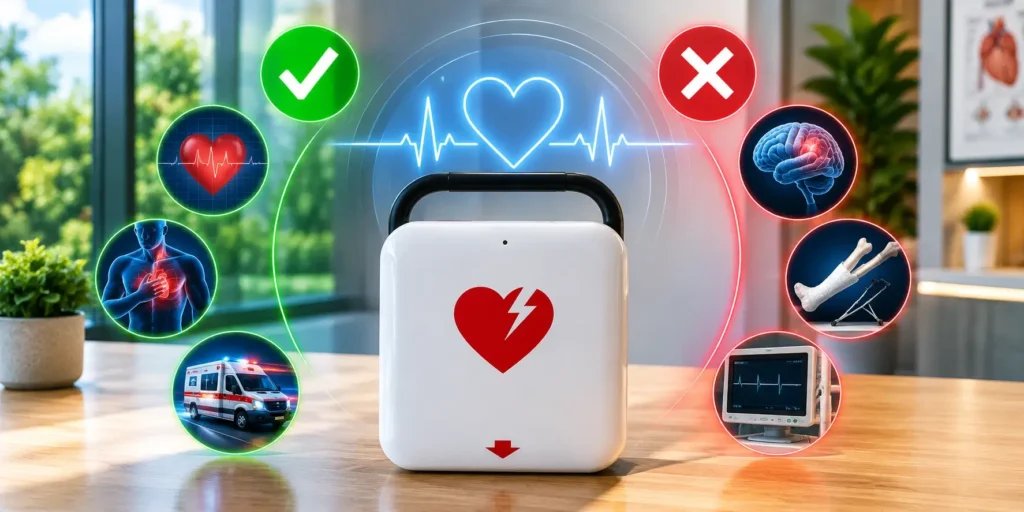
An AED is designed to guide ordinary people through one of the most serious emergencies they may ever face: sudden cardiac arrest. When someone collapses, is unresponsive, and is not breathing normally, every second matters.
Still, many people hesitate because they are afraid of making the wrong decision. They wonder whether the person truly needs an AED, whether they could cause harm, or whether they should wait for emergency responders.
The most important thing to understand is this: an AED is built to analyze the heart rhythm and only deliver a shock if one is needed. Your role is not to diagnose the person. Your role is to recognize the emergency, call for help, start CPR, apply the AED, and follow the voice prompts.
When You Should Use an AED
Use an AED when someone appears to be in sudden cardiac arrest. This usually means the person has collapsed, is unresponsive, and is not breathing normally.
Sudden cardiac arrest is different from a heart attack. A heart attack is usually a circulation problem caused by blocked blood flow to the heart. Sudden cardiac arrest is an electrical problem where the heart suddenly stops pumping effectively.
AEDs are made for sudden cardiac arrest. They help identify certain dangerous heart rhythms and deliver a shock when the device determines a shock may help restore a more effective rhythm.
The Main Signs To Look For
A person may need an AED if they are unresponsive, not breathing normally, and showing no normal signs of life. These signs should be checked quickly so care is not delayed.
Tap the person’s shoulders and shout to see if they respond. If there is no response, look for breathing. If the person is not breathing, or is only making irregular gasping sounds, treat it as a life-threatening emergency.
Sudden cardiac arrest can include agonal breathing, which may look like occasional gasps but does not provide normal oxygen flow. Recognizing this difference helps responders avoid dangerous delays.
What To Do Before Using an AED
The first steps should happen quickly and clearly. Check responsiveness, call 911, start CPR, and send someone to get the AED.
Avoid vague instructions like “somebody call 911.” In an emergency, direct assignments work better. Say, “You, call 911,” and “You, get the AED.”
In most emergencies, AED and CPR work together, with CPR starting immediately and the AED applied as soon as it arrives. CPR helps move oxygenated blood through the body while the AED is being prepared.
Once the AED arrives, turn it on and follow the prompts. Apply the pads to the bare chest as shown in the diagrams. The AED will analyze the heart rhythm and guide the next step.
When Not To Use an AED
AEDs are safe and highly guided, but there are situations where you should not apply or activate one.
Do not use an AED on a person who is awake, responsive, talking, moving normally, or breathing normally. These are not signs of sudden cardiac arrest. The person may still need medical help, but they do not need defibrillation if they are conscious and breathing normally.
Do not use an AED on someone with a known, valid Do Not Resuscitate order. A DNR is a medical and legal directive, and responders should follow applicable policies, training, and local procedures.
Do not use an AED while the person is in a moving vehicle. Movement can interfere with the device’s ability to accurately analyze the heart rhythm. Bring the vehicle to a stop and move the person to a safe, stable location if possible.
Do not deliver a shock while the person is lying in standing water or when the chest is submerged. Move the person away from pooled water when safe to do so, dry the chest, and then apply the pads.
These “when not to” rules are not meant to create fear. They are meant to help responders make safer, faster decisions.
Common AED Mistakes That Delay Care
The biggest mistake is waiting too long. People often pause because they want to be absolutely certain the person needs an AED. In sudden cardiac arrest, waiting for perfect certainty can cost precious time.
The AED is designed to make the shock decision. If no shock is advised, it will tell you. If a shock is needed, it will instruct you. That is why applying the AED when cardiac arrest is suspected is safer than waiting because of uncertainty.
Another common mistake is confusing gasping with breathing. A person in cardiac arrest may make strange, irregular gasping sounds. These breaths may appear dramatic, but they are not effective normal breathing.
A third mistake is failing to continue CPR. AED use and CPR work together. If the AED tells you to resume CPR, begin compressions immediately and continue until emergency responders take over or the person shows signs of life.
Safety Rules During AED Use
AEDs are designed for public use, but responders should still follow basic safety rules.
Make sure no one is touching the person during rhythm analysis and shock delivery. Loudly say “Clear” and visually confirm that everyone has moved away.
Dry the chest if it is wet from sweat, rain, or water. Pads need good contact with the skin to work properly.
Remove medication patches from the pad placement area if they are in the way. Use gloves if available, remove the patch, wipe the skin, and place the AED pad on clean, dry skin.
Correct AED pad placement helps the device analyze the rhythm and deliver a shock effectively when one is advised. If the person has an implanted device, such as a pacemaker bump under the skin, place the pad slightly away from it while still following the AED diagram.
Can an AED Shock Someone Who Does Not Need It?
This is one of the most common fears, and it is also one of the biggest reasons people hesitate.
AEDs are built to analyze the heart rhythm before delivering a shock. They do not shock simply because pads are attached. If the device does not detect a shockable rhythm, it will not advise a shock.
That means the responder should not try to decide whether the rhythm is shockable. The AED makes that determination. The responder should focus on calling emergency services, starting CPR, applying the AED pads, and following prompts.
This built-in rhythm analysis is one reason AEDs are appropriate for trained lay responders and public-access settings. The device supports the responder with clear instructions while helping reduce the risk of an unnecessary shock.
Real-World Scenarios Where AED Decisions Matter
In an office, a person may collapse during a meeting or in a hallway. If they are unresponsive and not breathing normally, the team should call 911, begin CPR, and use the AED immediately.
In a gym or athletic facility, sudden collapse during exercise should always be treated seriously. Do not assume the person is only tired or dehydrated if they are unresponsive and gasping. Begin emergency response and apply the AED.
In a school, church, hotel, warehouse, or public venue, the same rule applies. The setting changes, but the decision does not: unresponsive plus not breathing normally means sudden cardiac arrest should be suspected.
A strong AED program helps organizations plan for these moments before they happen, including device placement, responder training, signage, maintenance, and internal response roles.
When You Should Not Panic
AEDs are intentionally designed to be simple. They speak to the responder, show pad placement, analyze the rhythm, and give clear instructions. Even if the responder is nervous, the device guides the process.
A person using an AED does not need to be a doctor, nurse, or paramedic. Training is strongly recommended because it builds confidence and reduces hesitation, but AEDs are built for use by non-medical responders.
Confidence matters because hesitation is one of the most common barriers in emergencies. People often know an AED is nearby but are unsure whether they should act. The safest mindset is to follow the emergency signs, start CPR, and let the AED guide the shock decision.
Why Training Still Matters
Although AEDs are designed to be used by the public, training makes a major difference in how quickly and confidently people respond.
Training teaches responders how to recognize cardiac arrest, understand gasping, assign tasks, perform CPR, apply pads, and stay clear during shock delivery. It also helps people practice under realistic pressure, which reduces panic during a real event.
Quality AED training turns emergency instructions into practiced action. When teams know what to do before an emergency happens, they are more likely to respond quickly when every second matters.
AED Readiness Is More Than Knowing When To Use It
Knowing when to use an AED is essential, but the device also has to be ready. A missing battery, expired pads, blocked cabinet, or unclear signage can slow response even when people are trained.
A maintained AED should be visible, accessible, powered, stocked, and within its inspection schedule. The status indicator should show that the device is ready. Pads and batteries should be current. Staff should know where the AED is located.
Consistent AED maintenance helps ensure the device is not only present in the building, but ready to perform during a rescue.
Quick AED Decision Checklist
Use an AED if the person is unresponsive and not breathing normally.
Do not use an AED if the person is conscious, responsive, and breathing normally.
Call 911 immediately, start CPR, and send someone to get the AED.
Follow the AED prompts and make sure no one is touching the person during analysis or shock.
If the AED says “no shock advised,” resume CPR and continue following instructions until emergency responders arrive.
Life Support Systems Emergency Readiness Support
Life Support Systems helps organizations build complete emergency readiness programs that support real-world response, not just equipment ownership. That includes AED equipment, placement planning, on-site inspections, maintenance, replacement parts, and training for the people most likely to respond.
The right AED equipment is only one part of a dependable program. Teams also need clear roles, accessible devices, current accessories, and the confidence to act.
If your organization wants to improve AED readiness, request a consultation with Life Support Systems. Our specialists can help evaluate your current program, identify readiness gaps, and support a safer response plan for your facility or multi-location organization.
FAQs About When To and When Not To Use an AED
Can an AED hurt someone who does not need it?
An AED is designed to analyze the heart rhythm before delivering a shock. If the device does not detect a shockable rhythm, it will not advise a shock.
What happens if you use an AED on someone with a pulse?
If the person is responsive and breathing normally, do not use an AED. If the person is unresponsive and not breathing normally, apply the AED and follow the prompts. The AED will analyze the rhythm and determine whether a shock is advised.
Do you use an AED if someone is breathing but unconscious?
If the person is breathing normally, do not use an AED. Call emergency services and monitor them closely. If breathing becomes abnormal, gasping, or stops, begin CPR and use the AED.
How do you know if someone is in cardiac arrest?
A person in cardiac arrest is usually unresponsive and not breathing normally. They may also be gasping, which is not normal breathing.
Can an AED be used if the person is wet?
Yes, but the chest should be dried before applying pads. Do not deliver a shock if the person is lying in standing water or their chest is submerged.
Should CPR or AED come first?
Start CPR immediately and use the AED as soon as it arrives. If there are multiple responders, one person should begin CPR while another gets the AED.
Will an AED shock someone unnecessarily?
AEDs are designed to shock only when they detect a shockable rhythm. The device analyzes the heart rhythm before advising a shock.
What is agonal breathing?
Agonal breathing is abnormal gasping that can happen during cardiac arrest. It is not normal breathing and should not delay CPR or AED use.
Can an untrained person use an AED safely?
Yes. AEDs are designed with voice prompts and visual instructions. Training is still strongly recommended because it helps people respond faster and with more confidence.
What is the most important rule when using an AED?
If someone is unresponsive and not breathing normally, call 911, start CPR, apply the AED, and follow the prompts.
Last updated on 4 months ago
 Call Us
 Email Us