

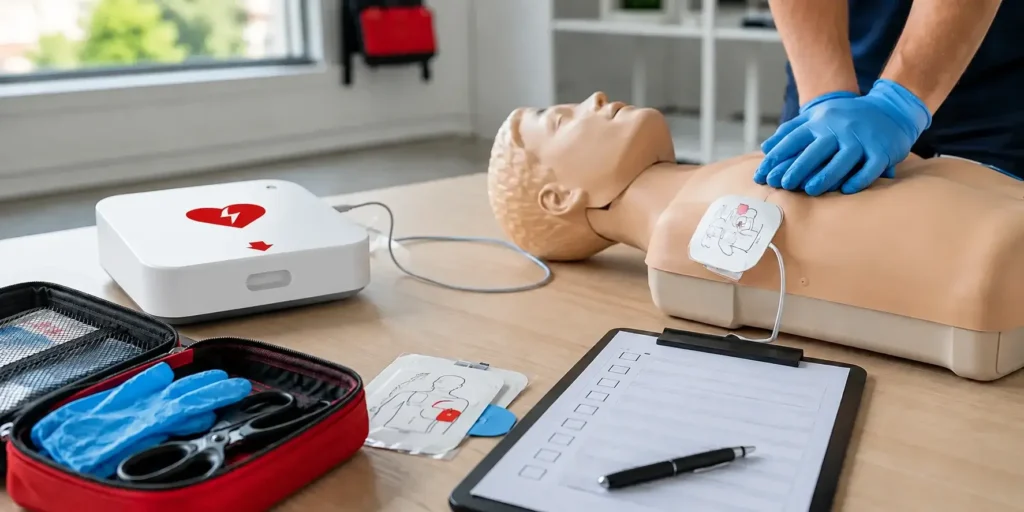
CPR certification is typically renewed every two years, but the real goal is not just keeping a card current. The goal is making sure people can respond quickly, correctly, and confidently when someone collapses and every second matters.
Many people complete CPR training, receive their certification, and assume they are ready until the expiration date arrives. In reality, lifesaving skills can fade long before the card expires. Chest compression depth, rhythm, AED confidence, and decision-making under stress all depend on practice.
For workplaces, schools, healthcare settings, gyms, public venues, and organizations with AEDs on-site, CPR renewal should be treated as part of a larger emergency readiness program. A valid certification matters, but a confident response matters even more.
The Standard Renewal Timeline: Most CPR Certifications Last Two Years
Most CPR certifications are valid for two years. This is the common standard used by major certifying organizations, including the American Heart Association and the American Red Cross.
For many employees, teachers, coaches, office responders, fitness professionals, and community volunteers, renewing every two years keeps credentials active and helps maintain compliance with workplace or licensing requirements.
However, the two-year timeline should be understood as the maximum credential period, not the perfect practice schedule for every environment. Some organizations choose annual refreshers or shorter practice sessions because they want their teams to stay sharp between full certification courses.
If your CPR card is close to expiring, start renewal planning 30 to 60 days before the expiration date. Waiting until the final week can create problems with class availability, employer compliance, and scheduling for larger teams.
Why CPR Certification Expires
CPR certification expires because emergency response skills need to be refreshed, tested, and updated. Even people who completed a strong course can lose confidence if they do not use or practice the skills regularly.
CPR is physical. It requires proper hand placement, compression depth, compression rate, full chest recoil, and the ability to switch between CPR and AED use without freezing. These actions are easier to perform when they have been practiced recently.
Certification renewal also helps responders stay aligned with current best practices. CPR guidelines can change over time as research improves how communities respond to sudden cardiac arrest and other emergencies.
For employers, certification expiration creates an additional concern. If a role requires CPR credentials, expired cards can affect staffing, job compliance, facility policy, licensing expectations, and internal safety plans.
Who Should Renew CPR Certification Every Two Years?
Most trained responders should renew CPR certification every two years unless their employer or industry requires a shorter interval. This includes general workplace responders, teachers, childcare providers, coaches, athletic staff, security teams, hospitality employees, lifeguards, fitness professionals, and community volunteers.
Any organization with AEDs on-site should also make CPR renewal a priority. AEDs are designed to guide users with voice and visual prompts, but CPR training helps responders recognize cardiac arrest, start compressions, retrieve the AED, apply pads correctly, and follow prompts without delay.
For organizations building broader emergency preparedness, CPR renewal often works best when paired with CPR, AED, First Aid, and OSHA training that fits the actual equipment, layout, and response needs of the facility.
Who May Need CPR Refreshers More Often?
Some people and workplaces should consider refreshers more often than every two years, even when the formal certification remains valid.
Healthcare professionals and BLS providers often operate under employer, licensing, or clinical requirements. Their certification may still run on a two-year cycle, but many healthcare environments expect a higher level of ongoing readiness.
High-risk workplaces may also benefit from annual or semiannual practice. Industrial sites, warehouses, manufacturing facilities, schools, gyms, senior living communities, and large public venues often have more people on-site, more physical activity, or a higher chance of a medical emergency occurring.
AED response teams should practice regularly because their role involves more than knowing CPR. They must know where AEDs are located, how to access them, who calls emergency services, who starts compressions, and how the team communicates during a real event.
Should You Renew CPR Certification Before It Expires?
Yes. Renewing before expiration is the safest approach, especially for workplaces and organizations with multiple employees who need active credentials.
If your certification expires, you may not qualify for a shorter renewal course, depending on the training provider and how long it has been expired. You may need to take the full course again, which can take more time and create avoidable delays.
For individual responders, early renewal prevents a gap in confidence. For employers, it prevents compliance gaps. A good rule is to schedule renewal 30 to 60 days before the certification expiration date.
Organizations with many employees should keep a central training record instead of relying on each person to remember their own renewal date. This helps prevent last-minute scheduling issues and keeps teams ready year-round.
What Happens If Your CPR Certification Expires?
An expired CPR certification does not mean you should avoid helping in a true emergency. If someone is unresponsive and not breathing normally, starting CPR and calling emergency services can still be critical. AEDs are also designed so bystanders can follow prompts during an emergency.
However, expired certification can create problems for employment, licensing, workplace compliance, or internal safety requirements. If your job requires current CPR credentials, an expired card may need to be corrected before you can meet that role requirement.
If your certification has already expired, check with the organization providing your training. Some providers may allow renewal within a limited window, while others may require you to complete the full course again.
The best option is to avoid the lapse entirely.
Online, Blended, Or In-Person Renewal: Which Is Best?
CPR renewal is available in several formats, but not every format is accepted for every role.
Online CPR renewal can be convenient for knowledge review. It may help refresh steps, emergency concepts, and basic decision-making. However, online-only courses may not satisfy employers, healthcare settings, licensing boards, or roles that require hands-on skills evaluation.
Blended CPR renewal combines online coursework with an in-person skills check. This is often a strong option for busy teams because it reduces classroom time while still verifying physical skills.
In-person CPR renewal gives responders hands-on practice, instructor correction, AED practice, and confidence with real equipment. For workplaces, schools, gyms, healthcare teams, and public-facing facilities, in-person or blended training is usually the stronger choice because CPR is a hands-on skill.
CPR Renewal For Organizations And Multi-Site Teams
For organizations, CPR renewal should not depend on scattered reminders or individual memory. A reliable safety program needs a system.
That system should track expiration dates, identify who needs renewal, schedule courses before credentials lapse, document completed training, and connect CPR certification with AED readiness, First Aid training, and internal emergency procedures.
Multi-site organizations need even stronger tracking. Different locations may have different AED models, different staffing patterns, and different response risks. Without central oversight, one site may stay current while another slowly falls behind.
CPR renewal also becomes more effective when it reflects the real environment. A team in a warehouse may need different scenario practice than a school office, gym, hotel, or corporate campus. Training should not feel generic when the emergency response will happen in a real building with real people and real equipment.
CPR Renewal And AED Readiness Go Together
A common question is whether someone needs certification to use an AED. In most public emergencies, AEDs are designed so untrained bystanders can follow voice prompts. A person should not refuse to act simply because they do not have a current CPR card.
Still, training matters.
Certification helps responders recognize cardiac arrest, call for help, begin compressions, apply AED pads, clear the patient during analysis and shock, and continue care until emergency medical services arrive. It reduces hesitation in the moment when hesitation costs time.
Organizations with AEDs should connect CPR renewal to AED maintenance and readiness checks so equipment and training support each other. A trained team needs a working AED. A working AED needs people who know how to respond.
This is also why AED signage, placement, batteries, pads, and training should be reviewed together. Emergency readiness is strongest when every part of the program works as one system.
Common CPR Renewal Mistakes To Avoid
Most renewal problems are preventable. The most common mistake is waiting until the certification expires before trying to schedule a class. This creates unnecessary urgency and can leave employees without valid credentials.
Another mistake is choosing a course that the employer, licensing board, or organization does not accept. Before registering, confirm whether online-only training is allowed or whether hands-on skills testing is required.
Some teams renew CPR but skip AED practice. That creates a gap because CPR and AED use are connected during sudden cardiac arrest response.
Organizations also run into problems when no one owns the training record. If every employee is expected to track their own renewal without oversight, lapses are much more likely.
How Life Support Systems Helps Teams Stay Certified And Ready
Life Support Systems helps organizations prepare people, equipment, and response systems for real emergencies. Training is not treated as a one-time class. It is part of a larger emergency readiness program that can include AED equipment, on-site service, inspections, replacement supplies, and ongoing program support.
Life Support Systems provides CPR, AED, First Aid, oxygen, OSHA, and emergency response training tailored to the organization’s equipment and environment. Courses can be delivered on-site or online with flexible scheduling, making it easier for teams to stay certified without disrupting operations.
Organizations that also need AEDs, first aid kits, oxygen systems, or related supplies can connect training with emergency equipment solutions and nationwide on-site service for a more complete readiness plan.
FAQs About CPR Certification Renewal
How Long Is CPR Certification Valid?
Most CPR certifications are valid for two years. Some employers or industries may require more frequent refreshers, even if the certification card itself is valid for two years.
Does CPR Certification Need To Be Renewed Every Year?
Usually, CPR certification does not need to be renewed every year. However, annual refreshers may be required or recommended for healthcare workers, lifeguards, safety teams, and high-risk workplaces.
How Long Do You Have To Renew CPR After It Expires?
This depends on the certifying organization and employer requirements. Some providers may allow renewal shortly after expiration, while others may require a full course.
How Do I Know If My CPR Certification Is Still Valid?
Check the expiration date on your certification card or eCard. Employers may also keep training records or verify credentials through the certifying organization.
Can You Use An AED Without Certification?
Yes. AEDs are designed to guide users with voice and visual prompts. Certification is strongly recommended because it improves confidence, speed, and coordination during a real emergency.
Do You Have To Be Qualified To Use An AED?
In many emergency situations, formal certification is not required to attempt AED use in good faith. Workplaces may still train designated responders as part of their safety program.
Can An Untrained Person Use An AED?
Yes. AEDs are built for public use and provide step-by-step prompts. Training helps people act faster and reduces hesitation.
Do You Remove A Woman’s Bra For CPR Or AED Use?
For AED use, pads must be placed directly on bare skin. Clothing, including a bra if it interferes with pad placement, may need to be removed or adjusted quickly and respectfully.
How Long Does CPR Renewal Take?
Many CPR renewal courses take a few hours, depending on the course level, provider, format, and whether hands-on skills testing is required.
Is Online CPR Renewal Accepted?
Sometimes, but not always. Employers, licensing boards, and healthcare settings may require in-person or blended training with hands-on skills verification.
When Should A Workplace Schedule CPR Renewal?
A workplace should begin renewal planning 30 to 60 days before certifications expire, especially when multiple employees or locations need training.
Should CPR Training Include AED Practice?
Yes. CPR and AED response work together. Responders should feel comfortable retrieving the AED, turning it on, applying pads, and following prompts while CPR continues.
Keep Your Team Certified, Confident, And Ready
Renewing CPR certification every two years keeps credentials current, but true readiness requires more than a date on a card. It requires practice, equipment awareness, AED confidence, and a system that keeps training from lapsing.
If your organization needs help managing CPR renewal, AED training, or team-wide emergency readiness, request support from Life Support Systems. A specialist can help you plan training, align certification schedules, and build a program that keeps your people prepared to respond when it matters most.
Last updated on 4 months ago
 Call Us
 Email Us