

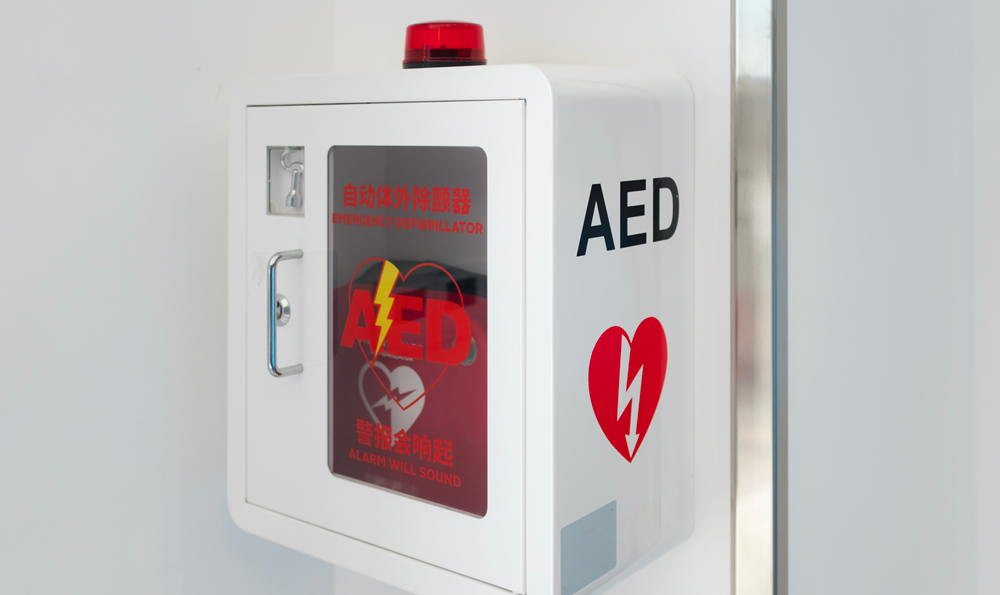
An AED can save a life in the first critical minutes of sudden cardiac arrest—but only if someone can find it immediately. In real emergencies, people don’t calmly “look around.” They move fast, under stress, and they follow what they can see. That’s why AED signage isn’t a finishing touch. It’s a core part of emergency readiness.
The right signage does three things:
- It tells people an AED is available.
- It guides them to the AED without hesitation.
- It supports a confident response once they arrive.
This guide walks through the signage most organizations should have, where to place it, what commonly goes wrong, and how to think about requirements (including state-specific considerations) without turning your AED program into a complicated project.
What Most Facilities Need
If you want a practical baseline that works in most workplaces, schools, gyms, and public spaces, build your AED signage around four elements:
- An AED identification sign at the cabinet (so it’s unmistakable when you’re nearby).
- Directional “AED →” signs at decision points (so people can follow a path without asking for help).
- Entrance notice signage or decals (so staff and visitors know an AED exists in the building).
- A simple instruction placard near the AED (so the first actions are reinforced under stress).
Use Recognizable Symbols and Keep It Consistent
When seconds matter, clarity beats creativity. AED signage should be instantly recognizable to anyone—employees, visitors, vendors, and even someone who has never used an AED before.
Use the standard AED symbol (heart with a lightning bolt) and keep the same look throughout your building. If your signs vary by hallway or department—different colors, icons, or wording—people pause to confirm they’re following the right thing. Consistency reduces hesitation.
Aim for high contrast, bold lettering, and simple text such as “AED” or “Automated External Defibrillator.” Your signage should be readable at a glance, from multiple angles, in normal building lighting.
The Essential AED Sign Types (and When to Use Each)
1) The Sign at the AED Cabinet (Identification)
This is the “You’re here” sign. Place it directly above the cabinet or immediately adjacent to it. The purpose is to remove any doubt—when someone reaches the AED station, they should instantly know they’ve found the right equipment.
There are two common formats:
Flat wall signs sit flush against the wall. They work well in small offices and tight spaces where people are already close when they see the AED station.
Projecting or V-shaped signs extend outward and are easier to spot from farther down a hallway or from multiple directions. These are especially helpful in larger buildings, schools, airports, department stores, churches, and multi-tenant properties.
If your AED is around a corner, set back in an alcove, or near visual clutter (posters, doors, displays), projecting signage is often the difference between immediate recognition and a missed cabinet.
2) Directional Signs (Wayfinding)
Directional “AED →” signs are what make your program usable under pressure. These signs belong where people have to decide: turn left or right, take stairs or elevator, continue forward or enter a corridor.
Good directional signage is repetitive and reassuring. If the path includes multiple turns, a single arrow sign at the start is not enough. In an emergency, people move quickly and will abandon a route if they feel uncertain.
In multi-floor buildings, directional signage is especially important near elevators and stairwells. If your AED is on one specific floor, your signage should clearly guide a responder toward that floor and then toward the exact corridor and AED station.
3) Entrance Notice Signs / Window & Door Decals
Entrance signage tells people “An AED is available here” before an emergency happens. This matters more than many organizations realize—especially in public-facing facilities where the first person to respond may be a visitor rather than staff.
Entrance decals are particularly helpful for gyms, restaurants, retail locations, venues, schools, places of worship, and community centers. They also help emergency responders and security teams who arrive onsite and need immediate awareness of available equipment.
The goal is not to replace hallway wayfinding. It’s to increase awareness so people know an AED exists and are more likely to move decisively to find it.
4) Instruction Placards Near the AED
AEDs provide voice prompts, but a simple instruction placard near the cabinet can reduce hesitation and reinforce the first critical steps. Under stress, people benefit from short, clear confirmation of what comes first:
Call emergency services. Start CPR. Use the AED. Follow prompts.
Keep the placard brief and readable. Avoid dense paragraphs. The instruction sign should support action, not demand reading time.
Where to Place AED Signs So They Actually Work
The best signage plan is built around how people move through your facility—not how you hope they move.
Think “Response Time,” Not “Wall Space”
Many organizations use a practical planning concept often referred to as the “3-minute rule,” meaning the AED should be reachable and applied quickly (within minutes) from key areas. Whether your internal target is 3 minutes or another standard, the idea is the same: signage should support fast retrieval and fast return to the patient.
If your AED is technically “in the building” but signage doesn’t create a clear route to it, your response time stretches—and that’s exactly what signage is supposed to prevent.
Do a Walk Test
A simple walk test is one of the most effective ways to validate signage:
Start from your lobby, gym floor, meeting rooms, classrooms, production area, or any high-traffic space. Then walk to the AED as if you’ve never been in the building before.
If you hesitate at any point—at a turn, a hallway split, an elevator lobby—you likely need directional signage at that decision point.
Avoid Obstructions and “Sign Clutter”
AED signage should never be blocked by banners, seasonal décor, posters, propped-open doors, or furniture. This is one of the most common failures, especially in schools and offices where hallways change visually over time.
Also avoid placing AED signage among a wall of unrelated safety posters. When everything is important, nothing is. Make AED signage stand out with clear spacing and consistent design.
Accessibility and Visibility Are Two Different Goals
It’s important to separate these:
- The AED cabinet must be accessible—easy to open, easy to reach, and not restricted.
- The AED signage must be visible—easy to spot from a distance and above normal visual clutter.
Some competitor content mentions a “7-foot” placement for wall signs as an ADA-related point. In practice, accessibility requirements can depend on local codes and facility context, so treat height guidance as a planning consideration, not a one-size-fits-all rule. The most reliable approach is to ensure the AED is reachable for a broad range of users and the sign is visible from common approach paths.
A major practical reminder: signage can’t solve access problems. If an AED is locked, hidden in an office, or inaccessible after hours, that’s a readiness issue that needs to be addressed directly.
Requirements and State-by-State Considerations (What to Know)
There isn’t one universal, nationwide AED signage rule that applies to every facility in the same way. Requirements can vary by state, by facility type (school vs workplace vs healthcare), and sometimes by local jurisdiction or industry program rules.
That said, certain state-level requirements are often discussed and commonly referenced. Here are examples you’ll hear frequently—always verify what applies to your facility and location:
California
Some guidance commonly references that facilities may need to post AED instructions near the device in a minimum font size (often described as “14-point”). The intent is simple: ensure the instructions are readable and present where the AED is located.
New York
New York is often referenced in discussions about entrance notice requirements, where a sign at the main entrance indicates that an AED is available and where it is located.
Pennsylvania
Pennsylvania is often referenced for requiring signage that is visible near the AED—supporting the idea that an AED should not be “in the building” but effectively marked.
New Jersey schools
New Jersey is frequently mentioned in school-related AED discussions, including expectations around clearly identifying AED locations.
These examples reflect why the “best practice” signage system—cabinet identification + directional signs + entrance notice + clear instructions—tends to be a safe baseline. Even where laws differ, the purpose is consistent: make AEDs easy to locate and use.
Don’t Let Signage Hide Bigger Readiness Problems
When people talk about AED signage, the strongest frustrations are rarely about the design of the sign. They’re about real-world breakdowns:
- The AED is locked or access is unclear.
- The AED is placed where no one naturally goes.
- The building changed layouts and signage wasn’t updated.
- People assume “someone else knows,” and no one does.
A strong AED program setup treats signage as part of a living system: placement, visibility, accessibility, inspections, replacement tracking, and training.
Facility-Specific Signage Tips
Offices and multi-tenant buildings: Put directional signs near elevators and main corridors. Don’t assume visitors know where “Suite 210 hallway” is—make the path obvious.
Warehouses and manufacturing: Noise, distance, and large floor plans increase the need for repeated directionals. Use signage at aisle breaks and entrances to the production floor.
Gyms and athletic facilities: Place entrance decals and directionals near check-in, courts, and training areas. AEDs should be easy to locate even during events when crowds are present.
Schools and campuses: Multiple buildings and long hallways require wayfinding. Consider signage at main entry points, office areas, gyms, cafeterias, and near stairwells for multi-story buildings.
Hotels, venues, and houses of worship: Visitors may be first responders. Entrance notice signage and clear wayfinding matter as much as cabinet signage.
A Simple AED Signage Audit Checklist (Minimal, Practical)
You don’t need a complicated system to validate your signage. Ask:
- Could a visitor find the AED quickly without asking staff?
- Are there directional signs at every major decision point?
- Is the AED accessible right now (not locked, not blocked)?
- Is the cabinet clearly labeled and visible from approach paths?
- Are instruction placards present, readable, and current?
- Do you re-check signage after remodels, events, or layout changes?
If you can confidently say “yes” to these, your signage is supporting readiness—not just compliance.
A Clean Next Step: Make Your AED Station Rescue-Ready
Signage works best when it’s built into a complete emergency readiness program —one that considers AED placement, accessibility, ongoing inspections, replacement pads and batteries, and training.
Life Support Systems helps organizations design and maintain AED programs that work in real conditions, not just on paper. We support AED selection, placement planning, signage recommendations, on-site service and inspections, readiness tracking, and training—so your AED stations are visible, accessible, and ready to perform when it matters most.
If you’d like, our team can help you review your facility layout and confirm the right AED signage approach for your location(s)—including practical wayfinding placement and program support—so your AED program is not only installed, but truly rescue-ready.
FAQs
Do I legally need AED signage?
In many places, AED signage is considered a best practice, and some states or facility types do require specific signs (such as entrance notices or posted instructions). Even when it’s not legally required, clear signage is essential because it helps responders find the AED quickly during an emergency.
What is the minimum signage I should have for an AED?
At minimum, most facilities should have:
- a sign at the AED cabinet, and
- directional “AED →” signs at key decision points like hallways, elevators, or stairwells.
Many facilities also add an entrance decal and a simple instruction placard near the device.
Where should AED signs be placed in a building?
Place an AED sign directly at the cabinet, then add directional signs at locations where someone could hesitate—hallway intersections, elevator lobbies, stairwell exits, and major corridor turns. In public-facing buildings, add an entrance notice or window decal.
How high should an AED sign be mounted?
AED signs should be mounted high enough to be easily seen from a distance and not blocked by people or furniture. The AED cabinet itself should be installed at a height that keeps the unit accessible for a wide range of users. When in doubt, follow your local code/ADA guidance and aim for maximum visibility plus easy access.
What should an AED sign say?
Keep the wording simple: “AED” or “Automated External Defibrillator.” Signs should also include the AED symbol (heart with a lightning bolt) and use high-contrast colors to improve visibility.
Should I use a flat sign or a V-shaped (projecting) sign?
Flat signs work well in small offices or tight spaces where the AED is easy to see up close. V-shaped or projecting signs are better for larger facilities because they’re visible from multiple directions and longer distances.
Do I need directional arrow signs for AEDs?
Yes, if a person cannot see the AED cabinet from the area where an emergency might happen. Directional arrow signs are especially important in large buildings, multi-floor facilities, schools, warehouses, and multi-tenant office properties.
Do I need an AED sign at the building entrance?
It’s strongly recommended, especially for public-facing locations like gyms, venues, restaurants, churches, schools, and community centers. An entrance notice improves awareness and helps people know an AED is available before they need it.
What is the “3-minute rule” for AEDs?
The “3-minute rule” is a practical planning guideline that aims to help responders retrieve and apply an AED within about three minutes from key areas of a facility. Signage supports this by reducing confusion and guiding people quickly to the AED location.
What should be kept with the AED (besides signage)?
Most AED stations include a small responder kit with basic items such as gloves, scissors, a razor, and a CPR barrier mask. Facilities should also plan for replacement pads and batteries and track expiration dates so the AED stays rescue-ready.
Should AED signage include “No Training Required”?
It can be helpful in public-facing facilities because it reduces hesitation and encourages action. However, signage should remain simple, and training is still strongly recommended so staff respond confidently and effectively.
Do state laws require different AED signs in different states?
Sometimes, yes. Some states are commonly cited for requirements such as posting instructions near the AED or posting an entrance notice that identifies AED availability and location. Requirements can vary by state and facility type, so it’s best to verify local rules while still following best-practice signage.
How many AED signs should I install?
Enough so a person can follow a clear route without guessing. A good rule is: one sign at the cabinet, and directional signs at every key decision point along the route from high-traffic areas.
How often should AED signage be checked or updated?
AED signage should be checked during routine inspections and reviewed after remodels, layout changes, tenant changes, or major events. If the AED location changes, signage should be updated immediately.
What’s the biggest mistake facilities make with AED signage?
The most common mistakes are: placing an AED where it’s hard to access, using too few directional signs, allowing signs to become blocked by posters or décor, and failing to update signage after building changes.
Last updated on 4 weeks ago
 Call Us
 Email Us