

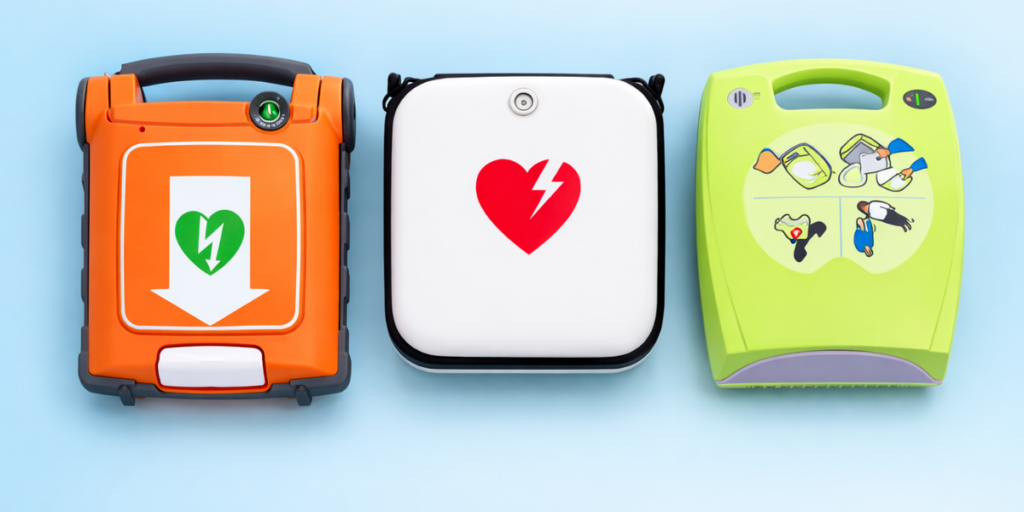
A discontinued AED doesn’t always need to come off the wall today. In many buildings, the unit still powers on, shows a “ready” indicator, and looks like it’s doing its job.
The problem is that “discontinued” marks the beginning of a new risk cycle. Over time, pads, batteries, and specialized pack systems become harder to source, more expensive, and less predictable. That’s how organizations fall into what we call the parts trap.
If you’re responsible for safety, facilities, HR, operations, or compliance, you need a simple way to answer one question: When should we upgrade, and when can we safely keep this AED in service?
This article gives you a straightforward decision tree you can run on every AED in your organization. It’s designed to help you avoid readiness failures, reduce uncertainty, and plan upgrades without creating coverage gaps.
When To Upgrade A Discontinued AED: The Quick Answer
If your AED fails self-tests, shows a red indicator, beeps or chirps, or displays “not ready,” you should treat that as an immediate upgrade trigger. Reliability is not negotiable when the equipment is meant to save a life.
If OEM pads, batteries, or required pack systems are no longer reliably available for your exact model, upgrade is also immediate. A device you can’t maintain with confidence is not a dependable emergency resource.
If the unit is nearing the later portion of a typical program lifecycle window—often around 8 to 10 years—and you’re seeing rising costs, backorders, or repeated readiness friction, plan a replacement within 6 to 12 months. That gives you time to budget, standardize, and transition without disruption.
The Simple Decision Tree You Can Use Today
This decision tree is intentionally simple. You can run it in minutes per device, and it works whether you have one AED or hundreds.
Use it per unit, per location, and document the outcome. That documentation is what keeps programs consistent across departments and shifts.
Q1: Does The AED Pass Self-Tests And Show Ready Status?
Start with what the device is telling you right now. If the AED shows a red light, a red X, a “not ready” message, or it’s beeping or chirping, it is not in a verified ready state.
If the answer is “no,” upgrade the unit immediately or remove it from coverage until it can be restored to ready status with certainty. Do not assume the device will “probably work” in an emergency.
If the answer is “yes,” move to the next question. Passing self-tests and showing ready status is the baseline requirement, not the finish line.
Q2: Are OEM Pads And Batteries Still Available For Your Exact Model?
Ready status today means little if you can’t keep the unit ready tomorrow. Pads and batteries expire whether the AED is used or not, and they must be replaced on schedule.
If OEM consumables are no longer available for your exact model, your upgrade decision becomes immediate. When only “compatible” or unknown parts remain, you lose control over readiness reliability.
If OEM consumables are still available, proceed. Availability is not just “I found one listing online.” It’s whether you can source parts consistently, with traceability, on a predictable timeline.
Q3: Are You “Parts Chasing” To Keep The AED Ready?
Parts chasing happens when the program spends time and effort just to keep the AED in the same place it was last year. It looks like repeated backorders, rising costs, switching sellers, and uncertainty about whether the part you’re buying is truly OEM.
If parts chasing is already happening, plan to replace soon. You may still be in ready status today, but you’re living too close to a future readiness gap.
If parts chasing is not happening, move to the final question. A stable supply chain is a sign the unit may still be supportable for now.
Q4: Is The Device 8–10+ Years Old Or Near End Of Support?
Age matters, but not because older devices are automatically “bad.” Age matters because support and parts availability tend to narrow as models mature, and maintenance friction increases.
If your device is approaching the later portion of a typical lifecycle planning window, plan replacement within 6 to 12 months. This timeline allows budgeting, training refreshers, placement review, and a clean transition.
If your device is younger and stable—ready status is consistent and parts are reliably available—you can keep it in service while maintaining strict monthly checks and clear replacement schedules.
What “Discontinued” And “End Of Life” Really Mean
Discontinued does not mean your AED must be thrown away immediately. It means the model is no longer the manufacturer’s current offering, and your program is entering a higher-risk phase for parts and support.
End of life is more serious. It’s the point where support, service, or critical accessories are no longer produced or reliably available. That’s when long-term readiness becomes difficult or impossible.
The mistake many organizations make is treating “still works” as the same thing as “still supportable.” Those are not the same. Supportability is what keeps your AED ready across years, not days.
The Parts Trap: Why Most Programs Upgrade Too Late
The parts trap doesn’t happen overnight. It happens gradually, and that gradual change is why it’s so dangerous.
First, parts take longer to arrive. Then a vendor says “out of stock” more often. Then prices climb. Then someone buys “compatible” parts to get the device back to green. Then the AED beeps again, or readiness becomes inconsistent.
By the time most organizations decide to upgrade, they’re already reacting to a readiness failure instead of preventing one.
A strong AED program upgrades before it’s forced to. That’s not overreaction. That’s operational maturity.
Immediate Upgrade Triggers You Should Treat As Non-Negotiable
Some signals are clear enough that the decision should not require debate. These triggers put your program at too much risk.
Ready status failures are at the top of the list. If the AED won’t pass self-tests, continues beeping, or repeatedly falls into “not ready” status, reliability is compromised.
Parts unavailability is another non-negotiable. If OEM pads, batteries, or required pack systems cannot be sourced with confidence, your program can’t maintain readiness.
Physical damage also matters. Cracked cases, water exposure, missing components, broken buttons, or corrosion should move a unit out of coverage immediately. Even if the AED powers on, damage increases the chance of failure at the worst moment.
“Replace Soon” Signals That Should Trigger Upgrade Planning
Not every situation is urgent, but many are time-sensitive. These signals suggest you should begin an upgrade plan before you lose control of readiness.
Rising total cost of ownership is one major signal. If you’re spending increasing time sourcing parts, paying more for consumables, or absorbing more downtime risk, you’re paying more for less certainty.
Operational friction is another. Multi-site teams often struggle to keep different models aligned, especially when each model has different pad and battery cycles. If your tracking system is strained and expirations are getting missed, the program is already drifting.
Finally, device age and support windows matter. Warranty is likely long expired. Supportability may be narrowing. Even if the device is functioning, your ability to keep it functioning with confidence may be declining.
Discontinued Models That Deserve Priority Review
The same decision tree applies to every AED, but certain discontinued models tend to show up in parts-related conversations more often.
If your organization has any of the following, prioritize them in your audit so you’re not surprised by parts gaps:
LifePak CR Plus, LifePak EXPRESS, LifePak LP500, Cardiac Science Powerheart G3, HeartSine Samaritan SAM 300 and SAM 300P, HeartSine SAM 001/002/003, Philips HeartStart FR2 and FR2+, and ForeRunner or Laerdal FR AED.
Even if your unit isn’t on this list, the decision tree still applies. The key is readiness and supportability, not a brand label.
How To Run A Fast AED Audit Across Your Organization
A decision tree is only useful if you can apply it consistently. The fastest way to do that is a short, structured audit.
Start by inventorying every AED. Capture location, model, serial, approximate install year, and who “owns” the device internally. If ownership isn’t clear, that’s an immediate program risk.
Next, verify ready status. Confirm what the device shows today, and note any repeated beeps, warnings, or service issues. These patterns often reveal aging units before they fail completely.
Then validate consumables supportability. Can you source OEM pads and batteries consistently for that exact model? Are required pack systems available with traceability? If the answer is uncertain, the unit should move toward replacement.
Finally, categorize each AED into one of three buckets: keep in service, replace soon, or replace now. Once you have those categories, budget and timelines become straightforward.
Upgrade Without Gaps: How To Transition Cleanly
Upgrading shouldn’t create confusion or coverage holes. The goal is to improve readiness while maintaining protection across the building.
If you manage one facility, keep coverage by swapping devices in a planned order and updating signage and staff communication as you go. Make sure everyone knows where the AED is today, not where it used to be.
If you manage multiple locations, standardize the transition. Replace by site, floor, or zone with consistent steps, and document the change. This prevents a mix of old and new systems that becomes hard to track.
After upgrades, reset your readiness system. New pads and batteries should be logged with expiration dates and scheduled checks. Ownership should be confirmed. Monthly readiness checks should become routine.
Why Upgrading Often Improves Readiness And Lowers Risk
Upgrading is not just replacing old technology. It’s reducing operational uncertainty.
Newer devices tend to improve readiness indicators and fault detection. That means fewer surprises and faster correction when something is wrong.
Upgrading also reduces administrative burden. Supported devices have predictable sourcing and replacement cycles. Teams spend less time chasing parts and more time maintaining readiness.
Modern features can also help in certain environments. CPR feedback, clearer prompts, pediatric modes, and readiness monitoring can reduce hesitation and support a stronger response culture. The biggest benefit is still the simplest one: confidence that the device will work when it’s needed.
How Life Support Systems Helps Organizations Upgrade With Confidence
Discontinued AED decisions can feel unclear because they sit at the intersection of safety, operations, and budget. The most effective approach is to remove guesswork with a structured review.
Life Support Systems helps organizations confirm whether an AED is still supportable, whether OEM consumables can be sourced reliably, and whether the unit can be kept in verified ready status. If it’s time to upgrade, we help you select supported replacement devices and plan a transition that maintains coverage.
For multi-site programs, we also help standardize placement, signage, service schedules, and training so every location follows the same readiness system.
FAQs
Does A Discontinued AED Need To Be Replaced Immediately?
Not always. If the device is in ready status and OEM pads and batteries are reliably available, it may remain in service. If parts are unavailable or readiness is unstable, the upgrade is immediate.
What Is The “Parts Trap” For Discontinued AEDs?
It’s when pads, batteries, or pack systems become hard to source or expensive, forcing you to chase parts to maintain readiness. This often leads to readiness gaps and rushed decisions.
How Do I Know If My AED Is Still Supportable?
Confirm the AED passes self-tests and stays in ready status, then confirm OEM pads and batteries are available consistently for your exact model. Supportability requires both reliability and sourcing stability.
What If My AED Still Shows Ready Status—Should I Keep It?
Ready status today is a good sign, but you should also verify future readiness. If OEM consumables are hard to source or the device is near end-of-support, plan replacement before a gap occurs.
When Do I Have To Upgrade If OEM Pads Or Batteries Aren’t Available?
If OEM consumables or required pack systems cannot be sourced reliably, upgrading should be treated as an immediate need. You cannot maintain readiness without dependable replacement parts.
What Does It Mean If My AED Is Beeping Or Shows A Red X?
It generally indicates the AED is not ready. Treat it as urgent, correct the issue, and if readiness can’t be restored reliably, replace the unit.
Is It Safe To Use “Compatible” Aftermarket Pads Or Batteries?
For life-saving equipment, reliability and traceability matter. If your program is forced into uncertain sourcing, upgrading to a supported device is often the safer path.
How Long Do AEDs Typically Last In A Workplace Program?
Many programs plan for replacement as devices approach the later portion of their lifecycle, often around 8 to 10 years, especially when support and parts availability begin to narrow.
What’s The Best Timeline To Budget For Replacements Across Multiple Sites?
If devices are aging or parts chasing is occurring, plan a phased replacement over 6 to 12 months so you can maintain coverage, standardize systems, and avoid readiness gaps.
Which Discontinued AED Models Should Be Reviewed First?
Any discontinued model with limited parts availability or specialized pack systems should be prioritized, along with units showing repeated alerts or readiness instability.
Can I Keep A Discontinued AED For Training Only?
Many organizations use dedicated trainer units. If an older AED is kept for non-emergency purposes, it should be clearly labeled and removed from emergency readiness coverage.
What’s The Fastest Way To Get An AED Upgrade Plan For My Locations?
Run the decision tree on each unit, then request a supportability review to confirm parts availability and readiness status. A structured review makes budgeting and timelines clear.
Last updated on 3 weeks ago
 Call Us
 Email Us