

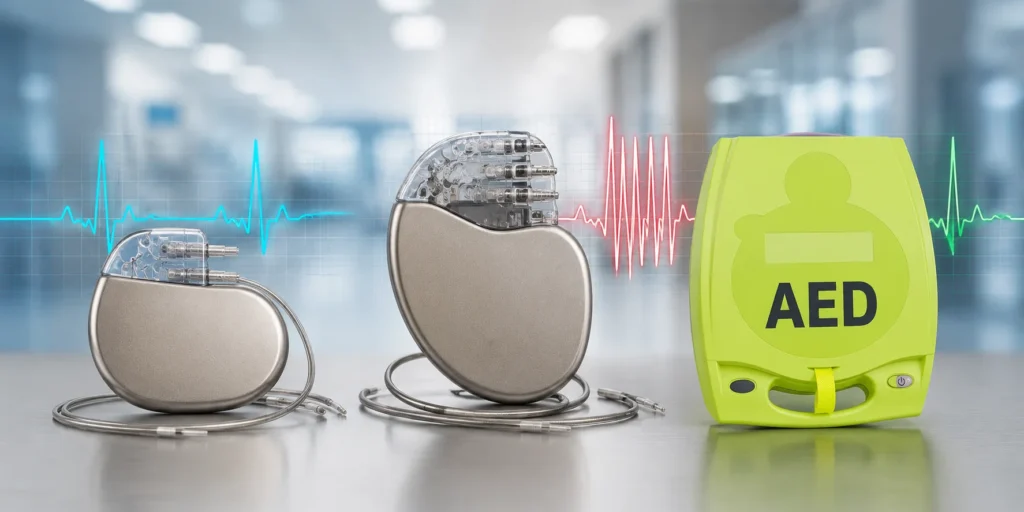
ICDs, pacemakers, and AEDs are often discussed together because they all relate to heart rhythm and electrical therapy. But they are not the same device, they are not used in the same way, and they do not serve the same purpose.
A pacemaker is implanted to help the heart maintain a proper rhythm, usually when the heartbeat is too slow. An ICD is also implanted, but it is designed to detect and treat dangerous rhythms that may lead to sudden cardiac arrest. An AED is different because it is external, portable, and used by responders during a cardiac emergency.
Understanding the difference matters for patients, families, safety teams, schools, workplaces, gyms, and public facilities. It also helps reduce hesitation when someone collapses and needs immediate help.
The Quick Comparison
A pacemaker, ICD, and AED all support heart-related care, but each one has a different role.
A pacemaker helps regulate the heartbeat through low-energy electrical pulses. It is prescribed and implanted by a medical team for people whose heart may beat too slowly or irregularly.
An ICD, or implantable cardioverter-defibrillator, monitors the heart and can deliver a shock if it detects a life-threatening rhythm. Many ICDs can also provide pacing support, but their main purpose is protection from dangerous rhythms.
An AED, or automated external defibrillator, is used outside the body during sudden cardiac arrest. It analyzes the heart rhythm and delivers a shock only if the device determines a shock is needed.
In simple terms:
- Pacemaker: Helps a slow heart keep pace
- ICD: Monitors and shocks dangerous rhythms when needed
- AED: External emergency device for sudden cardiac arrest
Each device can be lifesaving, but each belongs in a different setting.
What Is A Pacemaker?
A pacemaker is a small medical device implanted under the skin, usually near the collarbone. It uses thin wires called leads to send low-energy electrical signals to the heart.
The main job of a pacemaker is to help the heart beat at a steady and appropriate rate. It is often used for conditions such as bradycardia, heart block, or certain rhythm problems where the heart does not beat reliably on its own.
A pacemaker does not function like an AED. It does not deliver a high-energy shock to treat sudden cardiac arrest. It is a long-term rhythm support device managed by a physician.
What A Pacemaker Does Not Do
A pacemaker does not replace CPR, AED use, or emergency medical care. If a person with a pacemaker collapses, becomes unresponsive, and is not breathing normally, responders should treat the situation as a possible cardiac arrest.
The presence of a pacemaker should not stop someone from calling 911, starting CPR, or using an AED when the signs of cardiac arrest are present.
What Is An ICD?
An ICD is also implanted under the skin and connected to the heart with leads. The difference is that an ICD is designed to monitor for dangerous heart rhythms that may become fatal without rapid treatment.
ICDs are commonly used for people at risk of ventricular tachycardia or ventricular fibrillation. These are serious rhythms that can prevent the heart from pumping blood effectively.
When an ICD detects a dangerous rhythm, it may deliver pacing therapy or a higher-energy shock to restore a safer rhythm. Many modern ICDs can also provide pacemaker-like support if the heart beats too slowly.
Can An ICD Work Like A Pacemaker?
Many ICDs can provide pacing therapy, but that does not make every ICD the same as a pacemaker. An ICD is generally larger and more complex because it can treat life-threatening rhythms with shock therapy.
A pacemaker can pace the heart, but it cannot deliver the same emergency shock function as an ICD. This is one of the clearest differences between the two devices.
What Is An AED?
An AED is an external device used during sudden cardiac arrest. It is not implanted and does not work continuously inside the body. Instead, it is placed in workplaces, schools, gyms, airports, hotels, houses of worship, government buildings, and other public or private facilities.
AEDs are designed to guide responders through a cardiac emergency. Once the pads are applied to the person’s bare chest, the AED analyzes the heart rhythm and determines whether a shock is advised.
The right AED equipment helps organizations prepare for emergencies by making defibrillation accessible before EMS arrives.
AEDs Are Built For Public Response
AEDs are made for trained lay responders and public-access use. They use voice prompts, visual instructions, and automatic rhythm analysis to support fast action.
A responder does not have to diagnose the rhythm. The AED does that. If no shock is advised, the device will say so. If a shock is advised, the device will guide the responder through the next step.
This is why AEDs are essential for emergency readiness programs. They are not patient-prescribed implanted devices. They are community and workplace safety tools.
ICD Vs. Pacemaker: The Main Difference
The main difference between an ICD and a pacemaker is what each device is designed to treat.
A pacemaker helps prevent the heart from beating too slowly. It supports rhythm through low-energy electrical pulses.
An ICD protects against dangerous fast rhythms that may cause sudden cardiac arrest. It monitors the heart continuously and can deliver a shock when needed.
A useful way to think about it is this: a pacemaker helps the heart stay on pace, while an ICD watches for life-threatening rhythm problems and intervenes when necessary.
AED Vs. ICD: The Main Difference
An AED and an ICD can both be associated with defibrillation, but they work in very different ways.
An ICD is implanted inside a person who has a known medical need. It monitors the heart continuously and can deliver therapy automatically.
An AED is external and is used by a responder when someone collapses and appears to be in sudden cardiac arrest. It requires someone nearby to retrieve the device, apply the pads, and follow the prompts.
This difference is important for workplaces and public spaces. Not everyone at risk has an ICD. Sudden cardiac arrest can happen to people with no known heart condition, which is why public-access AEDs remain critical.
AED Vs. Pacemaker: The Main Difference
A pacemaker supports a person’s ongoing heart rhythm. An AED is used during an emergency when the person is unresponsive and not breathing normally.
A pacemaker does not remove the need for AEDs in schools, offices, gyms, or public buildings. People with pacemakers can still experience emergencies, and many cardiac arrests happen in people without implanted devices.
When sudden cardiac arrest is suspected, AED and CPR should work together. CPR helps move blood through the body while the AED is retrieved, applied, and prepared to analyze the rhythm.
Can You Use An AED On Someone With A Pacemaker Or ICD?
Yes. If the person is unresponsive and not breathing normally, use the AED and follow the prompts.
The main adjustment is pad placement. Do not place an AED pad directly over a visible implanted device bump, such as a pacemaker or ICD under the skin. Place the pad slightly away from the implanted device while still following the AED’s pad placement diagram.
Correct AED pad placement helps the device analyze the rhythm and deliver therapy effectively if a shock is advised.
Do not delay care because someone has an implanted device. Call 911, start CPR, apply the AED, and follow the instructions.
Which Device Treats Which Heart Problem?
Pacemakers, ICDs, and AEDs are tied to different heart rhythm problems.
A slow heartbeat, heart block, or certain rhythm pauses may require a pacemaker. That decision belongs to a cardiology team.
A dangerous fast rhythm risk may require an ICD. This is often considered for people at higher risk of ventricular tachycardia or ventricular fibrillation.
A sudden collapse in a workplace, school, gym, or public setting calls for emergency response. If the person is unresponsive and not breathing normally, CPR and AED use should begin immediately.
Understanding shockable rhythms can help safety teams understand why an AED may advise a shock in some cases and not in others.
Why AEDs Still Matter Even When ICDs Exist
ICDs save lives for people who have been identified as high risk, but they do not replace public AED programs. Many people who suffer sudden cardiac arrest have no implanted device and no warning signs.
AEDs protect broader communities. They are available for employees, students, athletes, visitors, customers, patients, guests, and anyone else who may collapse unexpectedly.
That is why an on-site AED program is a practical safety investment for organizations that want to be prepared before an emergency happens.
AED Readiness Goes Beyond The Device
Owning an AED is only the first step. The device must be visible, accessible, maintained, and supported by trained responders.
A reliable AED program includes proper placement, clear signage, current pads, working batteries, documented inspections, and training that helps people act under pressure.
Regular AED maintenance helps prevent the most common readiness problems, including expired accessories, depleted batteries, blocked cabinets, and devices that are present but not rescue-ready.
Battery and pad tracking is especially important. AEDs may sit unused for years, but the components still expire. A device can only be trusted when every part of the system is ready.
Current AED batteries and properly dated AED pads are essential for emergency readiness because both must perform immediately during a rescue.
Why This Difference Matters For Organizations
Organizations do not control whether a visitor, employee, student, or guest has a pacemaker or ICD. They do control whether an AED is available and whether people know how to respond.
That is the practical difference for safety planning. Medical teams manage implanted devices. Facilities manage AED readiness.
A workplace, school, hotel, gym, church, or public venue should not assume that existing medical devices will solve every emergency. The facility still needs an AED program that supports rapid response.
Effective AED training helps staff recognize sudden cardiac arrest, begin CPR, apply AED pads, and stay calm while following the device prompts.
Common Misunderstandings About ICDs, Pacemakers, And AEDs
Many people use the terms pacemaker and defibrillator interchangeably, but they are not the same. A pacemaker supports slow rhythms. A defibrillator delivers a shock to treat certain dangerous rhythms.
Another misunderstanding is that an ICD means an AED is not needed. An ICD protects the person who has it implanted. An AED protects the broader environment.
Some people also worry that an AED can shock anyone by mistake. AEDs are designed to analyze the rhythm before recommending a shock. They do not shock simply because pads are attached.
There is also a belief that only medical professionals can use AEDs. AEDs are built for trained lay responders and public-access use, with voice and visual prompts that guide the rescue.
Quick Decision Summary
A pacemaker is an implanted device that helps manage slow or irregular rhythms.
An ICD is an implanted device that monitors for dangerous rhythms and can deliver a shock when needed.
An AED is an external emergency device used when someone is unresponsive and not breathing normally.
CPR should begin immediately during suspected sudden cardiac arrest, and the AED should be applied as soon as it arrives.
Life Support Systems Emergency Readiness Support
Life Support Systems helps organizations prepare for cardiac emergencies with equipment, service, and training designed around real-world response.
That includes AED selection, placement planning, inspections, battery and pad replacement tracking, CPR/AED training, and support for facilities with one location or many.
If your organization wants to strengthen emergency readiness, request an AED readiness review. Our team can help evaluate current equipment, identify gaps, and build a program that keeps your AEDs visible, accessible, maintained, and ready when they are needed most.
FAQs About ICDs, Pacemakers, And AEDs
What Is The Difference Between An ICD And A Pacemaker?
A pacemaker helps a slow heart maintain rhythm through low-energy electrical pulses. An ICD monitors for dangerous rhythms and can deliver a shock when needed.
Is An ICD The Same As An AED?
No. An ICD is implanted inside the body and works automatically for a specific patient. An AED is external and used by a responder during sudden cardiac arrest.
Is A Pacemaker The Same As A Defibrillator?
No. A pacemaker supports rhythm but does not deliver a high-energy defibrillation shock. A defibrillator is designed to treat certain dangerous rhythms with a shock.
Can An ICD Also Work As A Pacemaker?
Many modern ICDs can provide pacing support for slow rhythms, but the device’s programming depends on the patient’s condition and medical plan.
Can A Pacemaker Shock The Heart?
A standard pacemaker does not deliver a high-energy shock. It sends low-energy pulses to help control the heartbeat.
Can You Use An AED On Someone With A Pacemaker?
Yes. If the person is unresponsive and not breathing normally, use the AED. Avoid placing the AED pad directly over the implanted device.
Can You Use An AED On Someone With An ICD?
Yes. If the person appears to be in cardiac arrest, apply the AED and follow the prompts. Place pads slightly away from the implanted ICD if it is visible under the skin.
Does An AED Replace CPR?
No. CPR and AED use work together. CPR supports blood flow while the AED is retrieved, prepared, and applied.
Which Device Is Used For Ventricular Fibrillation?
An ICD can treat ventricular fibrillation in a patient with an implanted device. An AED can treat ventricular fibrillation during a public emergency response if a shock is advised.
Why Do Workplaces Still Need AEDs?
Workplaces need AEDs because sudden cardiac arrest can happen to anyone, including people with no known heart condition or implanted device.
Last updated on 4 months ago
 Call Us
 Email Us