

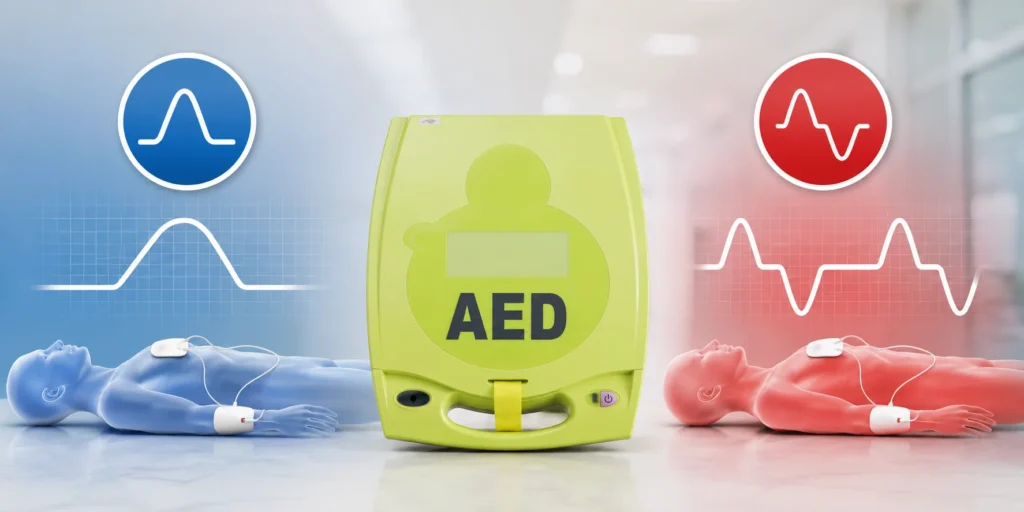
When comparing AEDs, you may see the terms monophasic and biphasic used to describe how a defibrillator delivers an electrical shock. These words sound technical, but the basic difference is simple: they describe the direction and pattern of the electrical current during defibrillation.
Both types of shocks were designed to help treat life-threatening heart rhythms during sudden cardiac arrest. The difference is how the energy travels through the heart and how much energy the device typically needs to deliver.
For facility managers, safety leaders, schools, gyms, healthcare offices, and multi-site organizations, this topic matters most when evaluating older AEDs, comparing new equipment, or deciding whether an AED program is still rescue-ready.
What A Defibrillator Waveform Means
A defibrillator waveform is the path or pattern of the electrical current delivered during a shock. The waveform affects how energy moves from one electrode pad to the other and through the heart.
AED users do not need to understand waveform science during an emergency. The device analyzes the heart rhythm, determines whether a shock is advised, and gives voice prompts that guide the responder.
Because AEDs are designed to identify shockable rhythms, the responder’s role is to call emergency services, start CPR, apply pads correctly, and follow the AED prompts.
What Is A Monophasic AED Shock?
A monophasic shock sends electrical current in one direction. The current travels from one electrode pad to the other in a single phase.
This technology was common in older defibrillators. Monophasic devices typically required higher energy levels, often ranging from 200 to 360 joules, depending on the device and shock sequence.
Higher energy needs also meant larger internal components, heavier batteries, and bulkier device designs. Many older monophasic units were effective in their time, but they do not reflect the design standard used in most modern public-access AEDs.
What Is A Biphasic AED Shock?
A biphasic shock sends electrical current in two phases. The current travels in one direction, then reverses direction during the same shock.
This two-way current flow allows the AED to deliver effective defibrillation at lower energy levels, commonly around 120 to 200 joules depending on the manufacturer and device settings.
Lower joules do not mean the shock is weaker. Biphasic waveform technology is designed to use energy more efficiently, often adjusting to patient resistance, also called impedance, so the shock can be delivered effectively across different body types.
Most modern AED options use biphasic technology because it supports smaller, lighter, more efficient devices for public-access and workplace settings.
Monophasic Vs. Biphasic AED Shocks: Main Differences
The biggest difference is current direction. Monophasic shocks move in one direction. Biphasic shocks move in two directions.
The second major difference is energy level. Monophasic defibrillators often use higher energy, while biphasic AEDs usually deliver lower-energy shocks with efficient waveform design.
The third difference is device design. Because biphasic AEDs usually require less stored energy, they can be built with smaller batteries and capacitors. This supports lighter, more portable devices that are easier to place in offices, schools, gyms, churches, public venues, and emergency vehicles.
The fourth difference is lifecycle relevance. If your organization still has an older monophasic AED, the issue may not only be waveform. The bigger concern may be whether the device is still supported, inspected, stocked with current accessories, and able to pass readiness checks.
Are Biphasic AEDs Better Than Monophasic AEDs?
For modern AED programs, biphasic AEDs are generally preferred. They are more energy-efficient, more common in current AED models, and better suited to compact public-access designs.
That does not mean every monophasic defibrillator was ineffective. Older monophasic units helped save lives and played an important role in the history of defibrillation. But modern AED programs usually focus on equipment that is current, supported, easy to maintain, and simple for responders to use.
In an emergency, the best AED is the nearest working AED. If a monophasic AED is the only available device and it is functioning properly, it should be used immediately during suspected sudden cardiac arrest.
Are Monophasic AEDs Still Used?
Some older monophasic defibrillators may still exist in clinics, industrial sites, emergency vehicles, older workplace programs, storage cabinets, or legacy safety programs. They may not always be obvious until someone performs a full AED inventory.
The real question is not only whether the device is monophasic. A practical AED review should ask:
- Are batteries and pads still available?
- Is the manufacturer still supporting the model?
- Does the AED pass inspection and self-tests?
- Are staff familiar with the device?
- Does the unit fit current facility needs?
If the answer to any of these questions is uncertain, your program may need replacement planning. Strong AED lifespan planning helps organizations avoid discovering equipment gaps during a real emergency.
Should Your Facility Replace A Monophasic AED?
Replacement is often a readiness decision rather than a purely technical one. A device can only support emergency response if it is accessible, working, supported, and stocked with current parts.
A monophasic AED may need to be replaced if it is no longer supported by the manufacturer, difficult to inspect, incompatible with available replacement parts, or inconsistent with the rest of your AED program.
Organizations with older AEDs should also check whether the device model has been discontinued. A discontinued AED upgrade may be the safest path when pads, batteries, service support, or warranty options are limited.
For multi-location organizations, consistency matters. Using many different older AED models can make inspections, staff training, replacement tracking, and emergency response more complicated.
What This Means For AED Buyers
Most organizations buying new AEDs today should expect biphasic waveform technology. But waveform should not be the only buying factor.
The best AED for your facility depends on placement, user confidence, battery life, pad availability, pediatric needs, maintenance requirements, training plans, and long-term support.
For example, a gym may need durable AED placement near high-activity areas. A school may need pediatric capability and clear responder training. A manufacturing site may need rugged storage, signage, and multi-shift readiness. A healthcare office may need dependable equipment that staff can locate and use quickly.
Reliable AED equipment should fit the environment, the people using it, and the long-term readiness plan behind it.
Why Joules Alone Do Not Tell The Whole Story
It is easy to assume that a higher joule number means a stronger or better AED. That is not the best way to compare devices.
Monophasic devices often used higher joules because their one-way waveform required more energy to achieve effective defibrillation. Biphasic devices use a different waveform, so they can often deliver effective therapy with lower energy.
Pad placement, CPR quality, device readiness, battery condition, and response speed all matter. In a real emergency, a well-maintained biphasic AED that is easy to find and use is more valuable than an older device with higher joule numbers but uncertain readiness.
Correct AED pad placement helps the device analyze the rhythm properly and deliver the shock path as designed.
What This Means During An Emergency
Responders do not need to ask whether an AED is monophasic or biphasic during a rescue. They should use the nearest working AED immediately.
The device will analyze the heart rhythm and determine whether a shock is advised. If a shock is not advised, the AED will tell the responder to continue CPR. If a shock is advised, the device will guide the responder through the safety steps before delivery.
A clear response plan should always include CPR. Effective AED and CPR work together because CPR helps circulate oxygenated blood while the AED is being retrieved, prepared, and used.
AED Readiness Is More Important Than Waveform Alone
Waveform matters, especially when comparing old and new devices. But readiness matters more.
An AED program should include current batteries, unexpired pads, clear signage, accessible placement, regular inspections, and trained responders. A modern biphasic AED with expired pads or a dead battery is not rescue-ready.
Routine AED maintenance helps confirm that devices are visible, accessible, powered, stocked, and able to perform when needed.
Replacement parts also need active tracking. Reliable pad replacement and battery replacement planning prevent small overlooked components from becoming major readiness failures.
How Life Support Systems Supports AED Selection And Readiness
Life Support Systems helps organizations evaluate AED equipment, select appropriate devices, and maintain AED programs built for real-world response.
That support includes AED selection, placement planning, on-site inspections, accessory tracking, maintenance, staff training, and replacement planning for older or discontinued devices.
Nationwide on-site service helps organizations keep AED programs consistent across offices, campuses, facilities, and multi-state operations. Practical AED training also helps responders understand what to do before, during, and after a rescue.
If your organization is unsure whether your AEDs are current, supported, and rescue-ready, request a readiness consultation. A specialist can help review your equipment, replacement parts, service status, and training needs so your AED program stays prepared when every second matters.
FAQs About Monophasic Vs. Biphasic AED Shocks
What Is The Difference Between Monophasic And Biphasic AED Shocks?
Monophasic shocks send electrical current in one direction. Biphasic shocks send current in two directions during the same shock, allowing the AED to use energy more efficiently.
How Many Joules Is A Monophasic Shock?
Monophasic defibrillators commonly use higher energy levels, often ranging from 200 to 360 joules depending on the device and shock sequence.
How Many Joules Is A Biphasic AED Shock?
Biphasic AED shocks commonly fall around 120 to 200 joules, depending on the manufacturer, model, and programmed settings.
Are Biphasic AEDs Better Than Monophasic AEDs?
For modern AED programs, biphasic AEDs are generally preferred because they use lower energy efficiently, support compact device design, and are common in current AED models.
Can A Monophasic AED Still Save A Life?
Yes. If a monophasic AED is working, accessible, and the nearest available device during sudden cardiac arrest, it should be used immediately.
Should My Facility Replace An Old Monophasic AED?
Replacement should be considered if the AED is unsupported, difficult to service, hard to find parts for, or no longer fits your emergency readiness program.
Does A Responder Need To Know The AED Waveform?
No. A responder should turn on the AED, apply the pads, and follow the prompts. The AED controls rhythm analysis and shock delivery.
Last updated on 4 months ago
 Call Us
 Email Us