

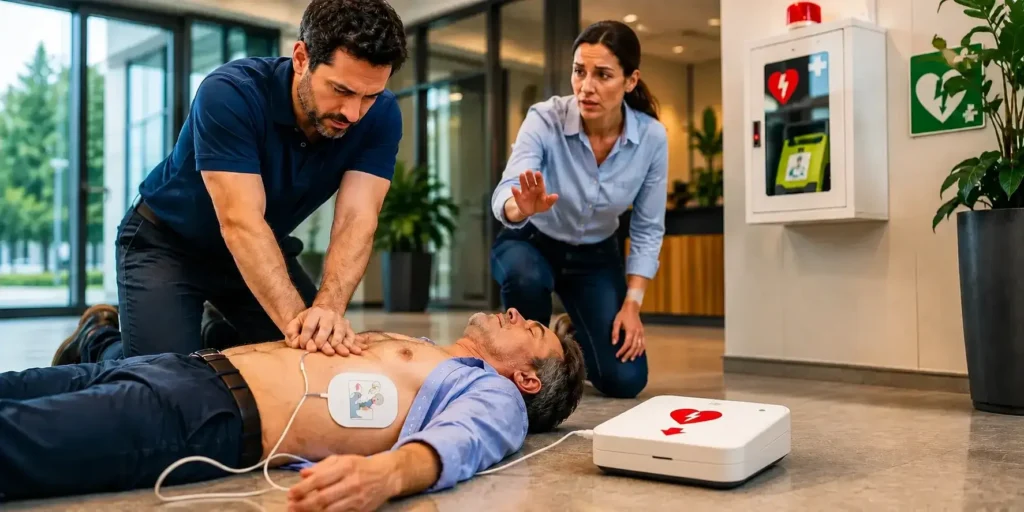
Sudden cardiac arrest can happen without warning. A person may collapse, become unresponsive, and stop breathing normally within seconds. In that moment, the response must be fast, organized, and focused on restoring circulation as quickly as possible.
Rapid defibrillation is one of the most important actions in a cardiac arrest emergency because certain life-threatening heart rhythms require an electrical shock. CPR helps move blood to the brain and vital organs, but defibrillation can help reset the heart’s electrical activity when a shockable rhythm is present.
For workplaces, schools, gyms, public buildings, and multi-location organizations, rapid defibrillation is not only a medical concept. It is a readiness issue. AED placement, signage, training, inspections, and replacement tracking all affect how quickly someone can respond.
What Rapid Defibrillation Means
Rapid defibrillation means using a defibrillator as soon as possible after sudden cardiac arrest is recognized. In most public settings, this usually means retrieving an Automated External Defibrillator, turning it on, applying the pads, and following the voice prompts.
The AED Analyzes The Rhythm
An AED is designed to analyze the heart rhythm and determine whether a shock is advised. The device does not shock every person who collapses. It only advises a shock when it detects a rhythm that may respond to defibrillation.
This design helps trained and untrained responders act with more confidence. The AED guides the response step by step, tells users when to stand clear, and supports action while emergency medical services are on the way.
Rapid Does Not Mean Rushed Or Unsafe
Rapid defibrillation does not mean skipping key steps. It means recognizing the emergency, calling emergency services, starting CPR, bringing the AED quickly, and following the AED prompts without delay.
The goal is to reduce hesitation. A well-placed AED and a trained response team can save critical minutes during the period when survival depends on immediate action.
What Happens During Sudden Cardiac Arrest
Sudden cardiac arrest is different from a heart attack. During cardiac arrest, the heart stops pumping blood effectively. The person becomes unresponsive and may not breathe normally.
Ventricular Fibrillation
One common rhythm in sudden cardiac arrest is ventricular fibrillation. In this rhythm, the heart’s electrical system becomes chaotic. Instead of pumping blood, the heart quivers.
When blood is not moving, the brain and organs lose oxygen quickly. Defibrillation can help stop the chaotic electrical activity and give the heart a chance to resume a more organized rhythm.
Pulseless Ventricular Tachycardia
Another shockable rhythm is pulseless ventricular tachycardia. The heart may be moving too fast and ineffectively to produce a pulse.
These rhythms are time-sensitive. The longer defibrillation is delayed, the harder it becomes to restore effective circulation.
Why CPR And Defibrillation Work Together
CPR and defibrillation are both essential, but they do different jobs. CPR supports circulation. Defibrillation treats certain abnormal rhythms.
CPR Buys Time
High-quality CPR helps move oxygen-rich blood to the brain and vital organs. This can slow damage while the AED is being brought to the patient.
CPR is especially important during the minutes before the AED arrives and during pauses between AED prompts. It keeps the rescue effort active when the heart is not pumping on its own.
Defibrillation Can Treat The Rhythm
CPR alone usually does not correct ventricular fibrillation or pulseless ventricular tachycardia. A shock may be needed to interrupt the chaotic rhythm.
That is why AED access matters. A facility may have trained people ready to perform CPR, but without an AED close by, the response may still lose precious time.
Why Every Minute Matters
Time is one of the biggest factors in cardiac arrest survival. The longer the delay before defibrillation, the lower the chance of a successful outcome.
Survival Drops Quickly Without A Shock
During sudden cardiac arrest, the brain begins losing oxygen almost immediately. CPR helps, but the heart still needs the right treatment if a shockable rhythm is present.
This is why rapid defibrillation is often discussed as a matter of minutes, not convenience. An AED on-site can shorten the time between collapse and shock, especially when EMS response time is affected by distance, building access, traffic, or facility layout.
The First Few Minutes Are Critical
When CPR and AED use happen in the first few minutes after collapse, survival chances can improve significantly. The strongest AED programs are built around this window.
A device that is hidden, locked away, expired, or unknown to staff does not support rapid defibrillation. A device that is visible, ready, and matched with trained responders does.
Rapid Defibrillation And The Chain Of Survival
Rapid defibrillation is a key part of the Chain of Survival, the sequence of actions that improves cardiac arrest response.
Recognition And Emergency Activation
The first step is recognizing that someone may be in cardiac arrest. If the person is unresponsive and not breathing normally, emergency services should be called immediately.
Clear internal emergency procedures help people know who calls, who starts CPR, who retrieves the AED, and who directs EMS to the location.
CPR And AED Use
The next steps are CPR and AED use. CPR keeps blood moving. The AED analyzes the rhythm and advises a shock if needed.
These actions work best when they are practiced before an emergency happens. Training reduces hesitation and helps teams respond in a coordinated way.
Continued Care
After the AED is used, responders continue following prompts until EMS arrives or the person begins showing signs of life. The device may continue to analyze and guide the response.
An effective AED program does not stop when the AED is installed. It includes training, maintenance, replacement planning, documentation, and post-event restocking.
Can An Untrained Person Use An AED?
AEDs are designed for public use. They provide voice prompts, visual instructions, and automated rhythm analysis to help guide responders.
Certification Is Not Usually Required In An Emergency
In many emergency situations, a person should not avoid using an AED simply because they are not certified. The AED is built to support action and will only advise a shock when the device detects a shockable rhythm.
That said, training is strongly recommended. People who have practiced CPR and AED use are more likely to act quickly, apply pads correctly, and continue compressions with less hesitation.
Training Improves Response Speed
A person may understand that an AED is easy to use, but stress can still slow action. Training gives people the confidence to respond under pressure.
Organizations that want a faster response should invest in AED and CPR training tailored to their equipment and environment. Training helps employees understand the device, recognize cardiac arrest, and move through the response steps with less uncertainty.
Do You Remove Clothing Or A Bra For AED Use?
AED pads must be placed directly on bare skin. Clothing covering the chest should be removed or cut away so pads can be applied properly.
Pad Contact Matters
If a bra prevents correct pad placement, or if underwire interferes with where the pads need to go, it may need to be removed or cut away. The priority is fast, correct pad placement with direct contact to the skin.
Responders should act respectfully while keeping the emergency goal clear. The AED cannot analyze and deliver therapy properly if the pads are not placed correctly.
Follow The AED Prompts
AEDs guide users through the process. Once the device is turned on, responders should listen carefully, apply pads as shown, and stand clear when the AED analyzes or advises a shock.
For more detailed safety and use considerations, LSS has guidance on AED pad placement and safe AED use during emergencies.
What Is The AED 3-Minute Rule?
The “3-minute rule” is a practical planning concept. It means an AED should be close enough that a responder can retrieve it, return, and apply it within minutes.
Placement Should Be Based On Walking Time
AED placement should not be based only on where there is open wall space. It should be based on how people move through the building and how long it takes to reach the device.
A large warehouse may need more than one AED. A school may need devices near offices, gyms, and athletic spaces. A multi-floor building may need AED access on multiple floors or strong directional signage from elevators and stairs.
Signage Reduces Search Time
A good AED location can still fail if nobody can find it. Clear wall signs, directional arrows, and entrance awareness signs all support faster defibrillation.
The goal is simple: no one should waste time asking where the AED is.
Rapid Defibrillation Is A Facility Planning Issue
Rapid defibrillation depends on everything that happens before the emergency. The right device must be available, visible, maintained, and supported by trained people.
AEDs Must Be Accessible
An AED should not be hidden in a locked office or stored where only one person has access. If the device cannot be reached immediately, it cannot support rapid defibrillation.
Facilities should review placement from the viewpoint of a visitor or new employee. If that person could not find the AED quickly, the program needs improvement.
AEDs Must Be Rescue-Ready
A device is only useful if it is ready. Pads expire. Batteries expire. Cabinets get blocked. Staff changes happen. Locations move.
This is why organizations benefit from a documented AED program. A strong program includes inspections, service, expiration tracking, and a named person responsible for ongoing readiness.
LSS supports this kind of structure through AED maintenance and readiness programs that track pads, batteries, inspections, and service needs.
Common Delays That Prevent Fast AED Use
Many delays are preventable. They often happen because the AED program was installed once and then forgotten.
Staff Do Not Know Where The AED Is
If only a few people know where the AED is located, the response becomes fragile. New employees, visitors, and shift workers may not know where to go.
Regular awareness reminders and visible signage can make the AED part of the facility’s safety culture.
The AED Is Not Maintained
A beeping AED, expired pads, or a low battery can take a device out of service. If no one checks the status indicator, the problem may go unnoticed.
Routine inspections help ensure the AED is ready before an emergency happens, not discovered afterward.
The Facility Has Outgrown The Original Plan
Buildings change. Teams move. New floors open. More visitors arrive. A program that worked five years ago may no longer support fast access.
A periodic review can show whether AED placement still matches the facility’s current layout and risk areas.
How Organizations Can Reduce Time To Defibrillation
Fast response is not accidental. It comes from planning.
Place AEDs Where People Can Reach Them Quickly
AEDs should be installed in visible, accessible, high-traffic areas. Placement should account for walking routes, stairs, elevators, locked doors, and after-hours access.
Organizations planning a new program can benefit from a structured approach to building an on-site AED program based on response time, training, and readiness.
Train People Before The Emergency
Training helps responders know what to do and reduces fear. Even though AEDs are designed for public use, trained staff can move faster and communicate better during a real event.
Training should fit the environment. A school, gym, office, and manufacturing site may all need different response planning.
Track Maintenance And Replacement Dates
AED readiness depends on current pads, working batteries, clear signage, and accessible placement. A monthly check can identify problems early.
For multi-site organizations, tracking should be centralized. Missed expiration dates are one of the easiest readiness failures to prevent.
How Life Support Systems Helps Organizations Be Ready
Life Support Systems helps organizations (LSS) build AED programs that support rapid response in real conditions. That includes device selection, AED placement guidance, nationwide on-site service, inspections, replacement tracking, and AED and CPR training.
One Program Instead Of Disconnected Tasks
An AED program should not be a collection of separate tasks managed by different people with no shared system. Equipment, training, service, signage, and replacement planning all affect response time.
LSS provides nationwide on-site AED service designed to keep equipment rescue-ready for organizations with one location or many.
Equipment And Training Work Together
Choosing the right AED matters, but the device is only one part of readiness. Organizations also need people who know where it is, how to use it, and how to keep it available.
LSS supports AED equipment selection and emergency readiness equipment planning so organizations can match devices, service, and training to the way their facilities actually operate.
FAQs About Rapid Defibrillation
Why Is Rapid Defibrillation So Important?
Rapid defibrillation is important because certain cardiac arrest rhythms require an electrical shock. The sooner the AED is applied and a shock is delivered when advised, the better the chance of restoring effective heart activity.
What Is Defibrillation?
Defibrillation is the delivery of an electrical shock to the heart. The shock can stop chaotic electrical activity and give the heart a chance to restart in a more organized rhythm.
What Is Rapid Defibrillation?
Rapid defibrillation means using an AED or defibrillator as quickly as possible after sudden cardiac arrest is recognized. It is a key part of a strong emergency response.
What Is The AED 3-Minute Rule?
The AED 3-minute rule is a planning concept that helps facilities place AEDs close enough for fast retrieval and use. It encourages organizations to think about walking time, signage, and accessibility.
Can You Use An AED Without Certification?
Yes, AEDs are designed for public use and guide responders with prompts. Certification is still strongly recommended because training builds confidence and reduces hesitation.
Can An Untrained Person Use An AED?
Yes, an untrained person can use an AED in an emergency. The device analyzes the rhythm and gives step-by-step instructions.
Does CPR Restart The Heart?
CPR usually does not restart the heart on its own. CPR keeps blood moving, while defibrillation may be needed to treat a shockable rhythm.
Do You Remove A Woman’s Bra For AED Use?
AED pads need direct contact with bare skin. If a bra interferes with pad placement, it may need to be removed or cut away so the pads can be placed correctly.
Where Should AEDs Be Placed For Faster Defibrillation?
AEDs should be placed in visible, accessible areas where responders can reach them quickly. High-traffic areas, gyms, lobbies, schools, warehouses, and multi-floor facilities often need careful placement planning.
How Can A Workplace Improve Rapid Defibrillation Readiness?
A workplace can improve readiness by placing AEDs strategically, adding clear signage, training staff, checking device status regularly, and tracking pad and battery replacement dates.
Build A Faster AED Response Plan
Rapid defibrillation depends on preparation before the emergency happens. The AED must be easy to find, easy to access, properly maintained, and supported by people who are ready to act.
Life Support Systems helps organizations create complete AED readiness programs that support faster response across one facility or many. If you want to reduce uncertainty around placement, training, inspections, and maintenance, request an AED readiness review.
Our specialists can help you evaluate your current AED program, identify gaps, and build a plan that keeps your equipment visible, accessible, and rescue-ready.
Last updated on 4 months ago
 Call Us
 Email Us