

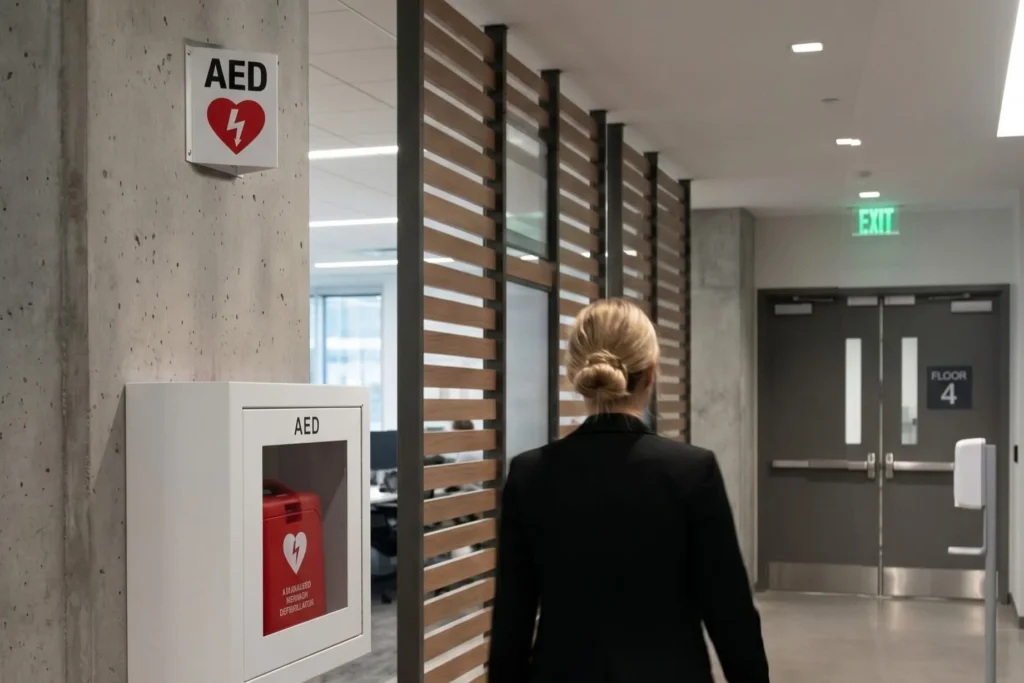
Ask almost anyone responsible for an AED how it is maintained and you will hear the same answer: “We check it every month.” Someone walks over, looks at the cabinet, sees the green light, and moves on. It feels responsible. It is certainly better than nothing. But it is worth being honest about what that monthly walk actually tells you and what it cannot.
What the Glance Confirms
A glance confirms three things. The device is still there. The cabinet is closed. The status indicator is showing whatever it showed last month. On many models that indicator is a small green symbol or a blinking light, and it means the device passed its own most recent self-test.
Those are real facts, and they are worth knowing. A device that has gone missing, or a cabinet that has been propped open and emptied, is a problem you want to catch quickly. If the monthly glance is all you can do this month, do it.
The trouble starts when the glance becomes the whole program, because the things most likely to fail on the day you need the device are exactly the things a glance was never designed to see.
What the Glance Cannot Tell You
Whether the pads are still good. Electrode pads have an expiration date, and the gel on them dries out over time, sometimes early if the cabinet sits in heat or sun. Expired or dried pads may not deliver a shock properly. The date is printed on a package inside the case. A closed cabinet does not show it.
Whether the battery will hold up. A green indicator means the device woke up, ran a quick check, and went back to sleep. It does not mean the battery has the reserve to charge for a shock, deliver it, and charge again, and a battery that is nearing the end of its life can pass a self-test and still come up short under real load. Batteries and pads are the two most common reasons a device fails when it is needed.
Whether the last self-test actually passed. Many devices keep an internal log of every self-test and every error. A glance reads the light. It does not read the log, and it does not catch a device that has been quietly flagging a fault behind a cabinet door.
Whether the device is on a recall or needs a software update. Manufacturers issue field notices and firmware updates. Nothing about the device on the wall changes when one goes out.
Whether the rescue kit is complete. Scissors, a razor, gloves, a barrier mask, and spare pads. Small items walk away. A responder who has to hunt for them loses minutes.
Whether anyone on shift could use it. The device can be perfect and still be useless if the people on the floor do not know where it is, are not sure they are allowed to touch it, or let their training lapse. Certifications expire on their own quiet schedule too.
Whether you could prove any of this. If an auditor, an insurer, or an attorney asked what was checked on a given date, by whom, and what they found, “someone looked at it” is not an answer that holds up.
The Portal Version of the Same Problem
Some AED providers now offer a software portal that emails your staff a reminder each month, asks them to look at the device, and records a checkmark when they say it looked fine. That is a useful tool, and a good portal is a real asset. It keeps every device, expiration date, and responder certification in one place, and it produces the records you will want later.
But be clear about what the record says. If the entry behind the checkmark was a glance, the portal has documented a glance. It has not tested a battery or checked pad expiration dates. The software is doing its job. The question is whether anyone with hands and training is standing behind it.
What a Real Inspection Covers
You do not need to know the technical details to hold a provider to a standard. Any real inspection of an AED, done by anyone, should be able to answer these questions:
- Was the device physically opened and examined, not just observed through a door?
- Were the pads checked for expiration, and replaced if needed?
- Was the battery tested for actual capacity, not just presence?
- Was the device’s internal self-test history reviewed?
- Were recalls and software updates checked against this specific unit?
- Was the rescue kit restocked?
- Was the placement still right for the building as it is used today?
- And was all of it written down, with a date and a name, in a place you can find later?
If your current answer to most of these is “I am not sure,” that is not a criticism—but it IS a red flag and a natural result of a monthly glance doing a job it was never built for.
The Question to Ask
The goal is not to stop checking the device every month. Keep doing it. The goal is to make sure the monthly glance sits on top of something more thorough: a scheduled, hands-on inspection by someone accountable for the result, recorded in a system you can pull up on the day someone asks.
Sudden cardiac arrest is a clock problem. Survival falls roughly 10 percent for every minute without defibrillation, and a device that is “probably fine” is not part of the plan. The way to know a device works is for someone to have actually tested it.
If you are responsible for AEDs across more than one location, see how oversight works when one partner is accountable for every device. And if you would like a plain assessment of where your own program stands, we are always happy to take a look.
Life Support Systems has helped organizations stay ready for nearly 50 years, servicing devices in all 50 states. Our technicians put hands on every device we manage, and the AEDTrack portal keeps the record because the software and the person belong together.
Last updated on 4 weeks ago
 Call Us
 Email Us